“…in a world that is truly open there are no objects as such. For the object, having closed in on itself, has turned its back on the world, cutting itself off from the paths along which it came into being and presenting only its congealed, outer surfaces for inspection. That is to say, the ‘objectness’ of things – or what Heidegger called their ‘over-againstness’ – is the result of an inversion that turns the lines of their generation into boundaries of exclusion. The open world, however, has no such boundaries, only comings and goings. Such productive movements may generate formations…but not objects.”
– Tim Ingold: ‘Bindings against Boundaries – entanglements of life in an open world’ in ‘Environment & Planning’ vol. 40, pp. 1796-1810, 2008
Footnote 05.07.2025
[finitude, openness, the limit, appresentation, formation over objecthood, and place over site / resist closure, activate presence, and make visible the limits of visibility itself]
This can all be understood through the lens of periechontologie, a philosophizing that orients itself not toward fixed truths or objective knowledge, but toward the encompassing (das Umgreifende). It is a mode of thought that remains with the limit, not to overcome it, but to dwell with the incompleteness that makes all appearance meaningful. It is this structure—the tension between presence and absence, appearance and implication, form and excess—that grounds both human finitude and aesthetic fullness.
Some important texts…

PDF: Walter Darby Bannard | Touch & Scale 1971
PDF: Tim Hilton | John Walker 1972
“What is obtained from architecture, at all levels, is graduated experience. I would regard this as a fundamental problem. …the attempt to fuse all forms of visual imagery with architecture and architectural concepts. It also poses the question – an immensely important one – of whether the essential act of contemplation of a work is at all possible outside that graduated experience…”
– Peter de Francia: ‘Mandarins and Luddites’, Royal College of Art Inaugral Lectures, 1973
PDF: Raymond Hains (1975)
‘John Panting: Sculpture 1940-1974’, Serpentine Gallery, 2–28 September 1975
“…to attend to the nature of spatial relationships, their manipulation and the nature of their construction and perception – movement analysed in terms of sequence – qualities of weight, substance, an occasion to examine sequences of construction / manipulation – problem to divest material of associative meaning – avoiding begging questions of meaning in material terms – illustration – presentation of perceptual configurations that function in terms of their relationships – eschewing alternative literary, structural or mathematical interpretation.”

Untitld XI 1973-74, wood, resin & steel, 167 x 152 x 122cm
Unfinished sculpture 1974, 180 x 200 x 240cm
PDF: Leger | Functions of Painting
“In the middle of the nineteenth century both bourgeois and popular culture were in dissolution: the one shaken and fearful, trying to grapple with the fact of revolution; the other swollen with new themes and threatened by mass production. What might have happened—what Courbet for a while tried to make happen—was a fusion of the two.”
– T. J. Clark: ‘Image of the People: Gustave Courbet and the 1848 Revolution’, Thames and Hudson Ltd, 1982
PDF: ‘Modern art and modernism: Manet to Pollock’ (A315) / ‘Modern Art and Modernism: A Critical Anthology’, The Open University, 1982
PDF: Owen Kelly | Cultural Democracy
PDF: Kosuth | Teaching to Learn
PDF: Kosuth | Teaching to Learn [Full Text]
PDF: Reinhardt | Monotonous & Ugly Spaces
PDF: Jeff Kelley | Westminster 1993
PDF: Prynne & Doctorow
PDF: Reinhardt | Individual 05.04.2014
2024 Statement: FRAMING / FRAGMENT / FABRICATION
“We have to refound art on community service as the well-doing of what needs doing.”
– W.R. Lethaby: ‘The Town Itself / A Garden City is a Town’, 1921
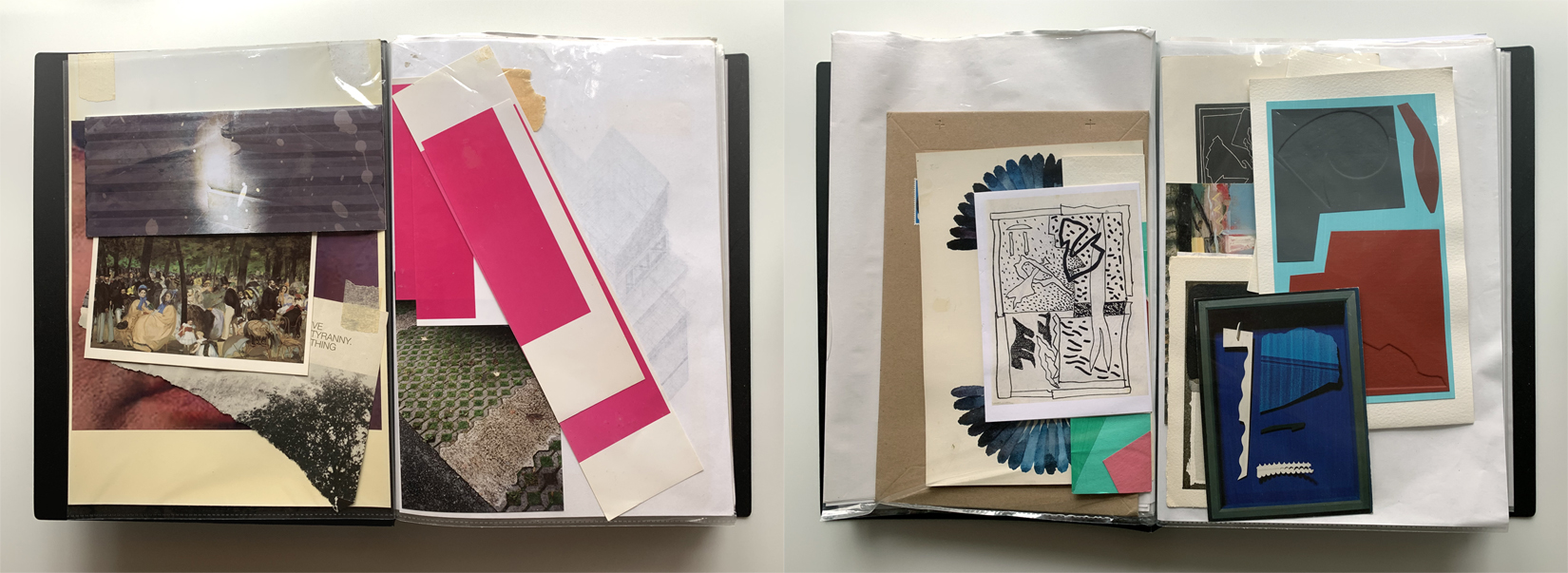

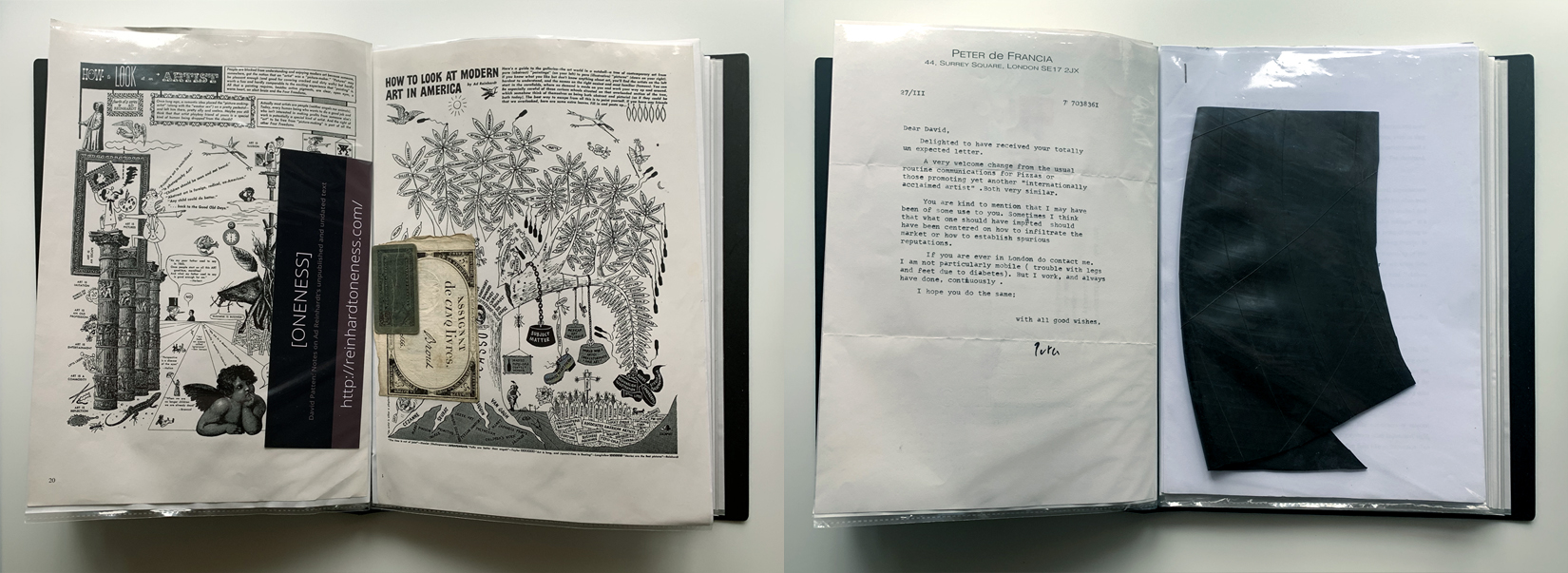
PDF: 28.08.2020 Statement | Notes
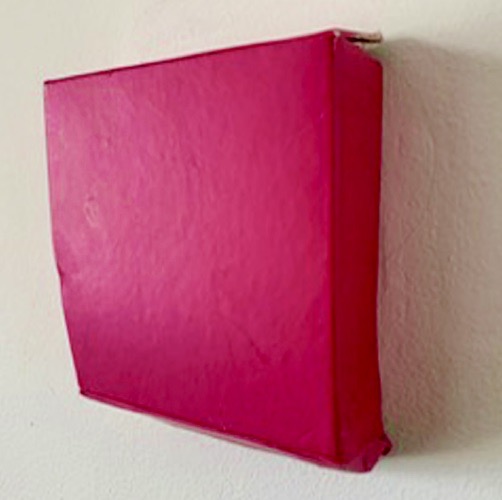
Unlikely happenstance and the aesthetics of coincidence.
“A highly coloured visit [where] less were charmed [and] whoever wrote the land spilled over [and] swirled, lushly underdressed.”
…the avant-garde attack upon the institution of art. The autonomous status and the concept of the work of art operative in the bourgeois institution of art imply separation from social life. This is essential for an art intending to interpret the world at a distance. For such an aesthetic project, a concept of the work of art as being a closed, albeit “complex” unity is appropriate. Avant-garde aesthetic praxis, though, aimed to intervene in social reality. The avant- garde saw that the organic unity of the bourgeois institution of art left art impotent to intervene in social life, and thus developed a different concept of the work of art. Its concept of art sees a chance to reintegrate art into social praxis if artists would create unclosed, individual segments of art that open themselves to supplementary responses. The aesthetic fragment functions very differently than the organic whole of romantic artwork, for it challenges its recipient to make it an integrated part of his or her reality and to relate it to sensuous-material experience.
– Jochen Schulte-Sasse: ‘Foreword: Theory of Modernism versus Theory of the Avant- Garde’ to Peter Burger’s ‘Theory of the Avant-Garde’, Theory and History of Literature, Volume 4, 1984
In this very precise sense, for Agamben Paul’s ὡς μή is not a nihilistic structure but rather concerns an attitude of a certain indifference that does not destroy the believers’ old vocations, but does show how the believers do not coincide with their vocations — these are not their identity — and thus allows them to use these vocations freely.
– Gert Jan van der Heiden, et al: ’Saint Paul and Philosophy: The Consonance of Ancient and Modern Thought’, De Gruyter, 2017

[26.12.2025]
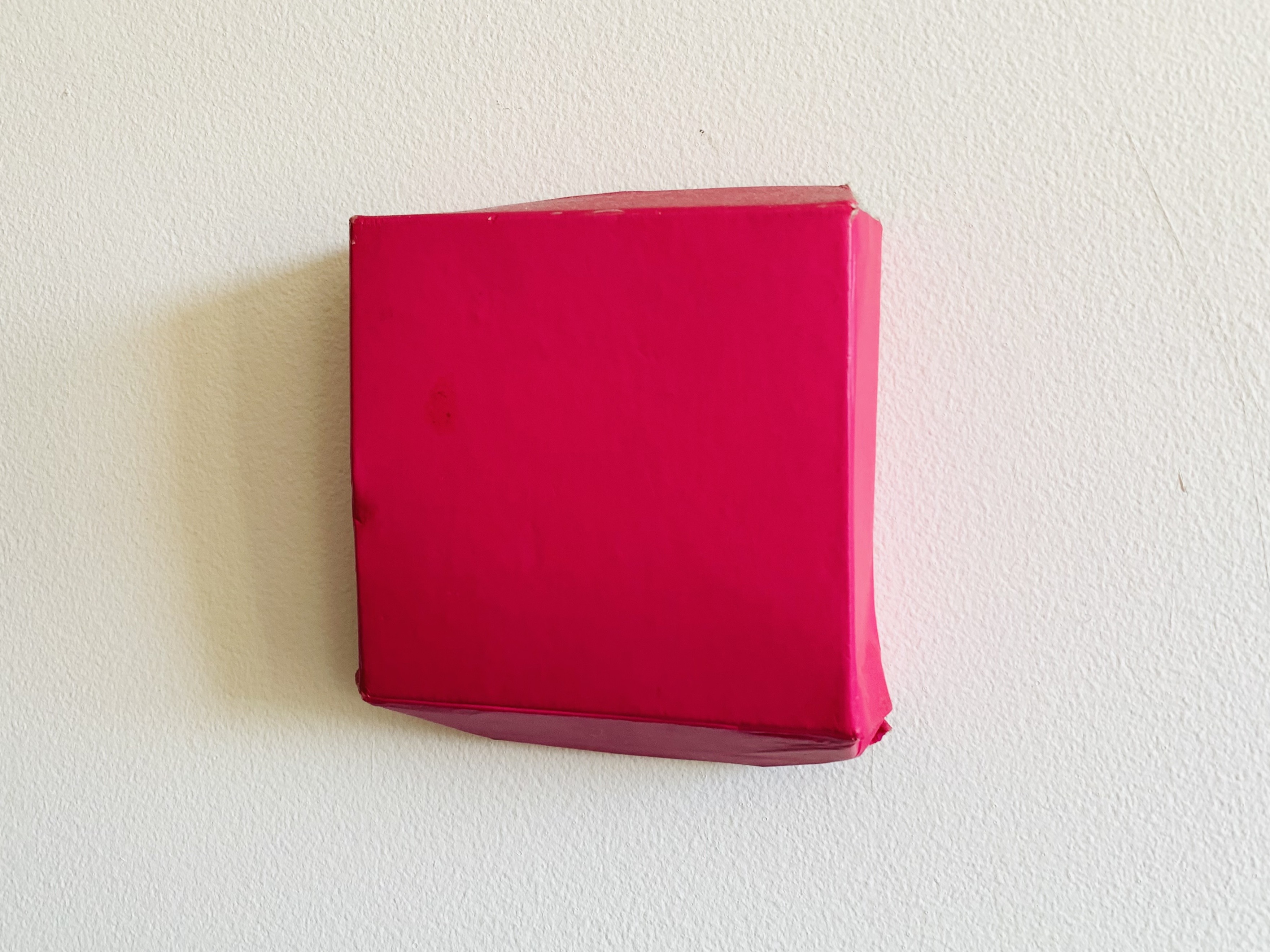
’Everything I know…(kenosis)’ 30.03.2020 | Small painting 1st November 2006 (Needess Alley, Birmingham)
chromatic complexity inseparable from the materiality of the painting’s support / the spacing between surface and depth / painting produces itself -> revealing an inner subjectivity / producing its own conceptual frame as it unfolds.
the act of applying colour is the production of the picture‑surface itself / the interaction between surfaces is not a simple unity / painting is an ongoing material process of spacing / it produces its own conditions of possibility / visibility and interpretation.
subjectivity is secondary to the operation of painting itself / subjectivity is an effect of painting’s material process / a doubling of the (coloured) surface / “the practice of spacing that constitutes the articulation of the movement of production (time) and pictorial space” / ‘spacing’ happens on and as the surface / has always‑already‑begun / painting produces the conditions of its own appearance / painting is active articulation — not synthesis of already present things = co‑production of surfaces = relational, emergent, and produced through the act of painting itself / subjectivity is not the source of meaning = painting’s material operations precede and produce subjectivities / painting = chromatic material practice / painting as an ongoing differential operation / painting that foregrounds its own physical and conceptual conditions of production = the substance of the painting itself / painting is always in process /
[Texts presented in summary, in Textes dispersés sur l’art contemporain / Miscellaneous Texts On Contemporary Art, Jean-François LYOTARD, Leuven University Press 2012]
1988
Representation, Presentation, Unpresentable. Published in L’Inhumain, op.cit., pp, 131-40). First translated by Lisa Liebmann as Presenting the Unpresentable: The Sublime in Artforum 20:8 (1988, pp. 64-69) and modified by Bennington and Bowlby as Representation, Presentation, Unpresentable for inclusion in the English translation of The Inhuman, op.cit., pp. 119-28). Lyotard argues that the metaphysical and political program of organising visual and social space through representation to painting, is now better fulfilled by photography (which both fully accomplishes it and thus brings it to an end). This frees painting from the task of documentation and allows it to turn to the question, “What is Painting?” Painting thus becomes philosophical in the sense that, like philosophy, it must seek its own rules of procedure, which are no longer given now that it has been liberated from a socio-political function. Such is the practice of the avant-gardes, who turn to the matter of painting and to the “infinity of plastic essays to be made” in order to present what photography (as documentation) cannot: that there is something unpresentable, i.e., outside the “legitimate construction.” According to Lyotard, this question of the unpresentable is the only one worth asking today because it reveals the fissures in the “singular infinite” of techno-science.
1989
What is Art? Originally a lecture entitled “Ceci est de l’art” [This is art] given at a symposium organised at the Centre de Beaubourg/ Collège International de Philosophie in 1989, the essay was published later as Désordre in Lectures d’enface (Paris, Galilée, 1991, pp. 109-126). The English translation by Robert Harvey appeared twice under the title What is art?: in Toward the Postmodern, op. cit., pp. 164-75, and in The Lyotard Reader and Guide (ed. K. Crome and J. Williams, Edinburgh University Press, 2006, pp. 339-350). The text consists in a critical account of the nominalist theory of art as encompassed in the sentence “this is art”, a statement which is proven aesthetically consistent even though epistemologically inconsistent. The sentence is inconsistent because incomplete, lacking the designator that corresponds to the subject “this”. Yet Lyotard’s question is whether art can be designated in cognitive phrases. Invoking both Valéry and Kant, art for Lyotard is not merely a cultural object to be categorised as a thing in time and space. As a “productive mind” (esprit producteur) the artist does not follow a determining procedure. “This” in the light of the creative spirit is not a mere thing but a phrase awaiting its rule, an occasion that is felt as “disorder”, an expectation without a purpose, eliciting an affect that brings about this very “this”. The relation between the work’s constitutive elements (words, lines, sounds) is not predetermined, since the form is not subjected to a pregiven project. Rather, it is indeterminate, as in the Kantian reflective judgment.
– Vlad Ionescu & Peter W. Milne: ‘Texts in Aesthetic Theory Presented in Summary’, 2012
“One can paint with anything, with pipes, stamps, postcards or playing cards, candelabra, pieces of oilskin, false collars, wallpaper, newspapers.”
– Apollinaire, 14 March 1913
 David Patten