
Now you can talk. Your smallest word is a poem.
“The mother tongue, spoken or written, expects an answer. It is conversation, a word the root of which means ‘turning together’. The mother tongue is language not as mere communication but as relation, relationship.”
– Ursula K. Le Guin: Bryn Mawr Commencement Address, 1986
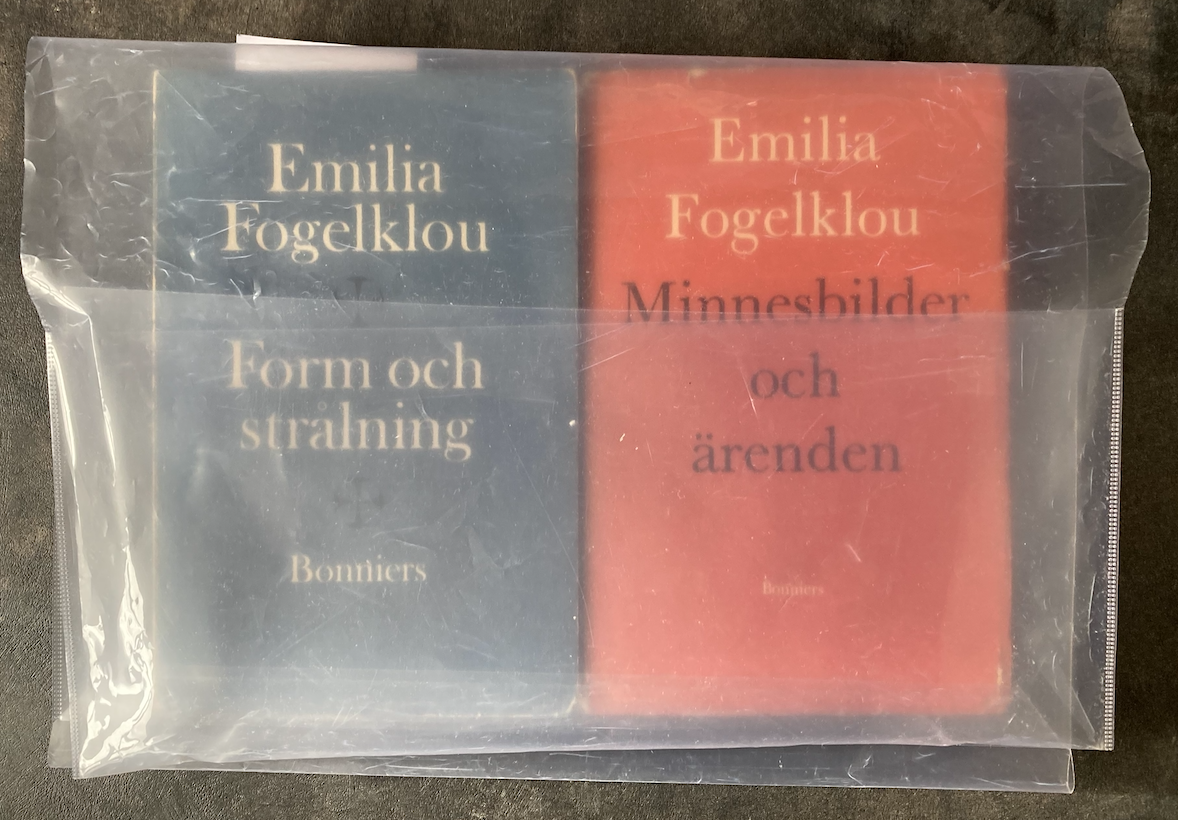
LINK #1: Åskådningsfragment 2022
Draft Version 16-18.07.2022 / Last Update 24.02.2023
Åskådningsfragment explores the 1958 work Form och strålning (‘Form and Radiance’), Åskådningsfragment (‘fragments of view’) by Swedish theologian and thinker Emilia Fogelklou. The book’s title points to the idea that form is not inert or merely material, but emanates, shines, or acts upon perception. It’s less about physics and more about how meaning, presence, or life “streams out” from form when apprehended contemplatively. The site is a mix of excerpts, rough translations, tables of contents, commentary, and related reflections on Fogelklou’s meditations, aesthetics, and spiritual-philosophical insights. It emphasises themes of perception, contemplation, creative experience and unity beyond dualistic thought, situating Fogelklou’s fragmented reflections as an invitation to new ways of seeing and engaging with art, spirituality, and life.
LINK #2: Emilia Fogelklou | Working Space 2023 / see:https://davidpattenwork.com/fogelklou-back-up/
Curated archive and reflection on the work of Swedish theologian and writer Emilia Fogelklou, especially her 1958 Form och strålning, Åskådningsfragment. It situates her reflections on perception, art, spirituality and the crisis of Western materialism within a broader intellectual context, linking them to related philosophical and aesthetic themes. The site presents key ideas as numbered “fragments,” blending quotations and notes that emphasise seeing beyond conventional forms, unifying art, life and contemplative practice. It highlights Fogelklou’s emphasis on creative perception and existential insight.
“The collection of quotes that she lets speak for the ‘crisis of art’ testifies to a familiarity that is of inner necessity for these sometimes perhaps puzzling radical attachments, is one of the authentically religious attitude’s inherent total freedom from preconceptions, a hesitancy to seek what it can speak to — regardless of preconceived ideals.”
– Birgitta Trotzig: ”En tänkebok” recension av Emilia Fogelklous Form och strålning, Bonniers litterara magasin med All varldens berattare, 3/1959, pp. 240-242.00. softcover, back page
LINKS:
01. gräns (noun)
02. “fragmented or exploded” | Erik Lindegren
03. fragments | Birgitta Trotzig
04. ‘a mosaic of quotations’ | Julia Kristeva
06. Gerald Heard | ‘Quaker Mutation’
07. “Nike, you are!” | pp13&14
08. Susanne K. Langer | pp13/14 & 54
09. Cologne Madonnas | “things that do things”
10. Teilhard de Chardin | Le phenomène humain, p63
11. George William Russell | [p9]
13. Piet Mondrian | “to see universally”
19. Karl-Birger Blomdahl | antisocial / “incisive, dissonant”
21. “strålning” #1
22. “strålning” #2
23. “strålning” #3
24. “strålning” #4
25. “the seeing”
26. explodera & atomsprängningar
27. Sprängd form #1
28. Sprängd form #2https://emiliafogelklou.wordpress.com/34-the-crisis-of-art-3/
29. Synsättens förvandlingar #1
30. Synsättens förvandlingar #2
31. ‘gripenhet’ | apprehension?
01. gräns (noun)
p24 gränsskillnader border differences p26 & p246 gränsgenomträngande border penetration p78 samhörighetsgränser affinity boundaries p120 & p124 gränsöverskridande cross-border p124 gränssättningar boundary setting p164 uteslutningsgränser exclusion limits p169 gräntsgenomstrålande borderline transmissive p243 gränsöverskridande cross-border
Swedish to English
# gräns, -en (gränslinje)
• border, the
• frontier, the
# gräns, -en (gränslinje)
• boundary, the
• restriction, the
• limit, the
# gräns, -en (gränslinje)
• borderline, the
# gräns, -en
• frontier, the
# gräns, -en
• bound, the upper or lower limit in a permitted range of values
# gräns, -en (inskränkningbegränsning)
• restriction, the
• limitation, the
# gräns, -en (barriärbomavspärrning)
• barrier, the
Machine Translations
# gräns border
# gräns frontier
# gräns limit
# gräns limit
# gräns frontier
# gräns frontier
gräns
noun
1. boundary
• limit; → gräns; begränsning;
2. mathematics: value greater (or smaller) than a given set
• bound; → gräns;
3. boundary, border of territory
• bound; → gräns;
4. the line or frontier area separating regions
- border; → gräns.
samhörighetsgränser
sam hörighetsgränser
sam hörighets gränser
samhörighets gränser
samhörighetsgränser | affinity boundaries
sam hörighetsgränser | cohesion boundaries
sam hörighets gränser | boundaries of unity
samhörighets gränser | boundaries of togetherness
p24
gränsskillnader border differences
gräns skillnader border differences
gräns skill nader border divides
gräns skillnader border differences
gräns limit
skillnader differences
p26 & p246
gränsgenomträngande border penetrating
gräns limit
genomträngande penetrate / pierce / permeate / pervade
gräns genom trängande border by crowding
gräns genom trän gande boundary penetrating
gränsgenom trän gande boundary penetrating
gränsgenomträn gande boundary penetrating
gräns limit
genomt through
genomtränga generate
rängande resounding
ande Spirit / mind / intellect / ghost / jinnee / genie / jinn
p78
samhörighetsgränser affinity boundaries
sam together
hörighets belonging
gränser borders / frontiers
sam hörighetsgränser cohesion boundaries
sam hörighets gränser boundaries of unity
samhörighets gränser boundaries of togetherness
p120 & p124
gränsöverskridande cross-border
gräns limit
överskridande exceeding
över skridande over crossing
p124
gränssättningar boundary setting
gräns limit
sättningar setting
p164
uteslutningsgränser exclusion limits
uteslutningsgränser
ute out
slutnings conclusion
gränser borders / frontiers
p169
gräntsgenomstrålande borderline transmissive
gräntsgenom strålande across the board brilliant
gränts bordered
genomstrålande translucent
genom by
strålande brilliant
p243
gränsöverskridande cross-border
gräns överskridande limit exceeding
gräns över skridande limit over progressing
gräns limit
över over
skridande steps / glide / pace
“…for mortals at least, time is also limited. If our existence in space is confined to the literal boundaries of our own bodies (e.g., we exist “inside” and not “outside” our corporeal envelopes), our existence in time is also restricted to our chronological lifespan (another physical boundary, as it were). This may or may not explain Newman’s cryptic statement about hoping to spark physical sensations of time, but, if this ambition went hand-in-hand with his desire to trigger our awareness of our own presence, then it stands to reason that time and presence are related. Namely, that a sense of our own presence also entails an awareness of where we are now, at this present moment, as well as how we are affected by remembering the past and by anticipating the future — a future that is finite.”
– Claude Cernuschi: ‘The Visualization of Temporality in the Abstract Paintings of Barnett Newman’, 2020
“Looking at the site you feel, Here I am, here […] and out beyond there […] there is chaos, nature rivers, landscapes. […] But here you get a sense of your own presence. […] I became involved with the idea of making the viewer present: the idea that ‘Man is Present’.” [p174]
“[presence] is the sensation of time — and all other multiple feelings vanish like the outside landscape. […] Only time can be felt in private. Space is a common property. Only time is personal, a private experience. That’s was makes it so personal, so important. Each person must feel it for himself. […] The concern with space bores me. I insist on my experiences of sensations in time — not the sense of time but the physical sensation of time.” [p175]
– Richard Shiff: ‘Barnett Newman: Selected Writings and Interviews’, Knopf, 1990
“The greatest, most profound feelings of the human spirit never arise inside a frame of space. They always arise around the concept of time”
– Barnett Newman: ‘Ohio, 1949’ [draft statement]
“In Newman’s thought, the space of external nature is determined by its opposition not only to time as personal […] private experience [p175], but also to place, a main concept of Newman’s instrumentality that is sometimes rendered by its Hebrew equivalent makom [double meaning of “a place” and “The Place” where the Holy One dwells]. Terminologically, place / makom is the locus where an individual becomes keenly aware of his own existence by consenting to be claimed by An-other. Thus, it is not surprising, that Newman regards the synagogue as a place, Makom [p181] and that in connection with the synagogal ritual he stresses the subjective experience in which one feels exalted by realizing the meaning of the Mitzwa: Know before whom you stand.” [p181]
– J. Edgar Bauer: ‘Barnett Newman: Iconoclasm, Heilsgeschichte and the Modern Mythology’, CESNUR International Conference, London School of Economics, 2001, refs: Barnett Newman: ‘Selected Writings and Interviews’, 1990
“Somewhere a portion of contemporary art has to exist as an example of what the art and its context were intended to be. Somewhere…a strict measure must exist for the art of this time and place.”
– Donald Judd: ‘Statement for the Chinati Foundation’, 1987
LINK: Donald Judd on Barnett Newman, Studio International, 1970
02. “fragmented or exploded” | Erik Lindegren
Exploded view
“Our old static world with all its form boundaries has been broken up by a new vision. The one we now live in is, to say the least, a world of movement. Almost breathless with anxiety, a sense of ignorance and eagerness, we seek to capture a species of life outside or inside our senses, with electrons, protons, neutrons, atomic explosions, radioactive radiation, time-space dimensions and other extrasensory phenomena, which through the daily press makes incessant demands on our attention. If we begin to understand some of this clerical Latin about omnipresent phenomena, which we cannot see, we are pushed out of our ingrained ways of viewing and habits of thought to try to orient ourselves before — or in — a universe, where change seems to us to be the only stable and where the dimensions go beyond all reason.”
– Emilia Fogelklou: ‘Form och strålning, Åskådningsfragment’ [‘Viewing fragments’], 1958, p33
“In the midst of the anxiety and impotence that leads in despair to drunkenness, neuroses, murder and theft, we suddenly hear voices of a different kind. Something that, after all, has to do with happiness — on the other side of despair. “Only when the terrifying flow of indignation and sorrow has flowed through my brain, can I from my complaint create a world of happiness”, says Erik Lindegren…”
– Emilia Fogelklou: ‘Form och strålning, Åskådningsfragment’, 1958, pp198 & 199
“All that seems to be left of mankind are fragments, feelings without bodies: despair and indifference. The word commits suicide and language is lost. There are explosions and the landscape that Lindegren paints reminds us of an anonymous waste land. Lindegren has stated that he wanted to compete with Eliot in his critique of our culture.”
– Daniel Pedersen: ‘Nelly Sachs’ Swedish exile – An encounter with Erik Lindegren’, La Conquête de la Langue, 2013
Erik Lindegren 1910-1968:
Mannen utan väg [The Man without a Way], Bonnier, Stockholm, 1946
Sviter [Suites], Bonnier, Stockholm, 1947
Vinteroffer [Winter Sacrifice], 1954.
“But the will to live, destroyed by war and brutal force, seeks new forms also this time. To experience a second, long predicted world war as a person compelled to neutrality makes one perhaps predisposed to a certain ambivalence, to a more cold-blooded despair than that of expressionism. . . . In its outburst of personal, human and neutralist feelings of anxiety, the new poetry takes on a somewhat nihilistic touch; it seems plausible, however, to regard it as a necessary purgation process…”
– Erik Lindegren, 1944
“You must realize that twenty years ago we felt the moral crisis of a world in shambles, a world devastated by a great depression and a fierce World War, and it was impossible at that time to paint the kind of paintings that we were doing – flowers, reclining nudes, and people playing the cello. At the same time we could not move into the situation of a pure world of unorganized forms, or color relations, a world of sensation. And I would say that for some of us, this was our moral crisis in relation to what to paint. So that we actually began, so to speak, from scratch, as if painting were not only dead but had never existed.”
– Barnett Newman, 1967
“…his is a poetry that depends above all on rhythm and alliteration, on the musicality of the verse; but, more importantly, it is a poetry in which imagery, cadence and thematic content depend on each other to such an extent that any translation seems bound to fail. The detailed imagery cannot be retained without changing the onomatopoeic and rhythmic quality of the verse, and the musicality of the poetry cannot be recreated without mutilating the metaphorical content.” [1]
“The form — the exploded sonnet — wants to convey something of the tension between the rational and irrational in the modern scientific world view; the metaphoric language, which does not avoid the grotesque, wants to emphasise the brutal moment of surprise in today’s reality. The author’s ambition has, briefly speaking, been to give an objective and factual form to painful and pathetic, uncertain and complicated matters.”
– Erik Lindegren: ‘Lyrical modernism’, Bonniers Litterära Magasin, Nr 6, Årgång XV 1946 [below]
“Mannen utan väg is an apocalyptic collection of poems, a descent into the realm of death, a journey through a contemporary purgatorio. But neither Beatrice nor Christ meets the wanderer. Miraculously, however, he emerges from his order, having reached a position beyond faiths and ideologies — a person independence. This attitude is reinforced in the collection Sviter, most notably in the poem ’The Seeker’: ‘I have crushed the central pillars in the house of self-evidence / in order to build me a smaller house which I can call mine.’” [1]
“Mannen utan väg is a collection of forty poems, all identical in form — i.e., written as a series of ‘fragmented or exploded sonnets’, each consisting of seven non-rhyming couplets. The volume combines stylistic rigidity and explosive imagery. The conventional sonnet form is broken to pieces; but a new pattern emerges, and the fragments ultimately convey a sense of utmost poetic discipline, imparting a view of the reality of war not unlike that of Picasso’s Guernica, whose series of shocking montage figures may very well have served as Lindegren’s model, according to Swedish critic Lars Bäckström. [1]
“Vinteroffer marks a return to Mannen utan väg in that it combines a sense of identification with a sense of distance from the subject matter. The central poem, ‘Ikaros’, takes a mythic figure often depicted by poets of all ages, from Ovid to Auden; but Lindegren’s pose is not the conventional one of a meditative observer, watching Icarus ascending toward the burning sun. Icarus travels in his own inner landscape, toward a sun that becomes “more and more cool, more and more chilly.” [1]
Reality overthrown
without reality born!
- Birgitta Steene: ‘Erik Lindegren: An Assessment’, Books Abroad Vol. 49, No. 1 (Winter, 1975), Board of Regents of the University of Oklahoma
Erik Lindegren: ‘Lyrical modernism’, Bonniers Litterära Magasin, Nr 6, Årgång XV 1946 [initial translation 01.03.2023]
[p463]
LYRICAL MODERNISM
A survey
ERIK LINDEGREN
Because I happen to know a person within myself who knows me only partially — and anything else is not possible — and because this Chronschough-like person sometimes arouses in me an interest that is inconceivable to others and quite comical, but sometimes also the most complete and most detached indifference, I have considered him at once sufficiently interested, sensible, and impartial to be entrusted with the task of saying a few words about a poem described as singularly incomprehensible. The poem reads:
the invisible within us tears apart all spaces and all completion courses amount to measurable nothingness
and the seconds petrify and the perspectives run into the suns of cruelty with the thirsty dwarves
of the shadows carving into their leathery flesh to give air to the skeleton and surrendering the scene to the waltz
of the breaking point until the vision calls them the darkness of the jagged peaks free the armchair of eternal rest: a denying continent
that on a shield of sun and madness raises its reflection in a favourable moment for our eternal blindness
that cradles the parasite of condemnation on the waves of positivity and writes in spit on the jealous rock of the future:
embalm the worn out of the galley slave Aro in the hall of astonishment embalm the sublimation and trago death in ultra-rapid
The above-mentioned person makes the following attempt at content analysis:
The invisible within us (cf. Pär Lagerkvist’s “The Invisible”) is very often but so far in vain mentioned and hidden as much as possible the aggression drive within us, as from time to time
[column break]
tearing apart all spaces, i.e. all hitherto known religions, gods, ideals, sublimations and superegos but also space in the astronomical sense, a space that crushes us with its greatness and indifference. This aggression thus not only protests against implanted “superegos”, but also against the fundamental conditions of human life. Therefore, it cannot be denied a certain Prometheus trait, but it also contains an element of the unintellectual’s instinctive hatred of the intellectual, here preferably directed at Einstein — after all, due to their intellectual limitation, most people are condemned to believe in [the] authority [of] Einstein’s universe much like the people of the Middle Ages believed in God. (After all, this hatred is considered one of the most important reasons for the success of Nazism, and the irritation that the occasional critic seems to feel at reading a modernist like Eliot is a faint reflection of the same thing.)
With all values, but also all unbearable facts about man’s cosmic situation torn apart, all competition courses (self-assertion, sports, liberalism’s free competition, etc.) amount to measurable nothingness (nihilism, relativism, the universe with its fixed lights, the Stadium with its chronometers and measures bands). This is the moment of rage and unbearable tension, the moment when the subjective sense of time changes (seconds petrify, “time stands still”), the moment when the lion crouches to leap and the young man on the dance floor throws himself the rock, and
[p464]
the hour of the attack is imminent. It is also the moment when the perspective (visual continuation of the drawn, narrowing the race tracks, real-symbolically, for tactical reasons, the drive to an objective overview of the situation) runs into the suns of cruelty (a projection of the damascus mixture that the above-mentioned invisible creates within us). The expression the thirsty dwarves of the shadows perhaps also needs, Chronschough thinks, an explanation. When the Sun of Cruelty stands as close to unity, from an optimistic point of view, people become monstrous shadows of themselves: when the Sun stands in this position, the forests are at their shortest, so they become the satirical dwarfs of their own shadows, thirsty for blood because they the oaks are deceived on “the dyke of life.”
Leather flesh — in a second these shadows of myself are burned by the sun of cruelty, they carve it partly to cool off and partly as an old war dance ritual but also to give air to the innermost wit — and the innermost part of man is the skeleton. This skeleton is actually the most permanent thing in our body, the one that survives us the longest, but at the same time it is an ancient symbol of death, the dwarves carve it to show their pride but also as a secret acknowledgment that destruction is ultimately directed at themselves. Now, then, the great untimely culmination of the breaking point has been reached: the fear-magnified “historical” moment has arrived, the lion takes the leap, the battle strikes its first blow, the attacking army surrenders at the will of God, chance, the commander-in-chief, megalomania or the silent the hand of humiliation, and the armoured columns rush towards Paris — until fatigue sets in (and it does regardless of victory or defeat) and man’s longing for life disguised as vision causes her to turn her gaze upward and call — not space she has probed — but the darkness of the jagged peaks. These peaks are
[column break]
tough because they appear hostile and difficult to climb: they also associate with Auden and Isherwood’s drama ‘Ascent F6’, they are dark because man has a feeling that they hide the real reasons for his action, the secret driving force, in short the unknown truth about herself. That the call is made from eternal rest the armchair returns to a vision — an armchair placed between a crevasse pit and a common, upturned open grave. The eternal rest is a well-known euphemism for the death, and during a war death, once fatigue has set in, can seem somehow comfortable. The call takes place, in my words, in a moment of reflection before death, in a moment of self-abandonment and passivity — here, with the help of the colon, the film-like verb flash into a negating tense — the energetic and progress-seeking Europe is passively self-abandoned in the face of its self-destruction.
The last three stanzas show the man trapped within the Western culture, as on a shield (mirror and protection of the god of war) of sun (desert sun, i.e. the faithless sun of sterile repetition, senseless vivifying sun, sun of cruelty) and madness (the disciplined chaos of war) lifts its mirror image its true face (thousands of reality-corrected books on the true essence of Western culture), lifts its mirror image its true face (thousands of reality-corrected books on the true essence of Western culture) for our rich blindness (even our blindness is relative and tangible: we see, but we do not understand what we see, in any case only for the briefest moment in question). This elusive, self- contained and anti-human continent or culture also cradles the parasite of denigration on the vagaries of the positive, which means that it sentimentalises the tired, failed and dead, whom it actually despises, and writes in sly red with an image that most closely associates to the famous scene at Belshazzar’s guests
[p465]
mockingly he was a sign on the jealous rock of the future. For most of the politicise systems of our time is the solid rock of faith identical with the future, it is its holy name to which all sacrifices are made, but this future is jealous of us, its past; it will only love itself and possibly dream of its own future; it will look down on our time in astonishment and wonder how it could live such a miserable life and make such meaningful sacrifices. So we get the cruel and mocking line to already build a museum and embalming and placing there the most distinctive grand units of the time: first and foremost the worn-out scars of the gall slave (in the promised time of conscription, total war, misinterpreted collectivism and time studies, we are all galley slaves; the plural form Aror suggests that the galley slaves of our time have it many times worse than the old warship rowers, who were, however, at best outnumbered by a macaw), secondly, the sublimation (here ironically understood as our anti-life idealism, our cowardice submission to the tyranny of certain ideas, etc.), and thirdly, the tragic death in ultra-rapid (it) beset us, the slowly but surely defeated, France of 1910, our painful but unfortunately not quite convincing, sometimes self-fulfilling tragic sense of life).
As far as this person’s attempt at elaborate yet abbreviated content analysis, He also asks to point out that the poem should be read in its thematic context, and that his analysis is a first-class example of how easy it is to plunder a poem with the help of the intellect all that even for him essential. He wouldn’t have done it either if he hadn’t been childishly annoyed by all the talk of tongue talk, bluff and the emperor’s new clothes. And now he wants to briefly suggest how it is that the poem took on this “somewhat eccentric” form.
First of all, he wants to emphasise that this poem does not need to be “understood” in the way that he himself understands it; it leaves instead
[column break]
deliberately a certain freedom of association for the reader. The main thing is that the reader “gets” the feeling, thus he has also understood its thoughts. Nothing ages as quickly as a poem’s “thoughts”, and if this man is to be completely honest, he gives e.g. Viktor Rydberg’s historically magnificent brooding poems not infrequently an impression of monstrous poetic banality. Nor can he ever forget the moment when, as a sixteen- year-old, he witnessed a singing teacher’s horrifyingly dramatic and fundamentally false declamation of “Dexippos”. His maybe semi-conscious reaction was that a poem that could be misused in this way must suffer from a seriousness. lied wrong. Nor does he consider it out of the question that one of the many contributing causes to the form of the poem analysed here is this experience. In any case, he eventually arrived at roughly the following line of reasoning, which could of course be rewritten in more objective and grandiose-sounding terms, but which for once he prefers to reproduce in its simplest form: What it is best to convey above all is that almost always complicated feeling — this is romance, it might as well be called emotional realism. It is the feeling that should be loaded with thoughts and not the other way around. The ideological superstructure should be demolished and go underground, only in this situation does it have the opportunity to assert itself in its full force. The poetic “image” should be freed from its subordinate, “decorative” position and become the main element of the poem. The mind should think in images, and the images of the feeling (or the subconscious) should occupy the thought, it is always an interaction. When thought and feeling (and sense impressions) have met in this way in the image and completely impregnated each other, a poem should at best emerge that has the stamp of a vision.
Why his goal was exactly this, I doubt he really knows, in any case space forbids etc. But as he says in his nevertheless sometimes obscure way: The main thing is the compulsion to express is stronger than the need for communication.
Exhibitions:
POSTWAR MODERN New Art in Britain 1945-1965, Barbican, London, 3 March – 26 June 2022 [seen 15.04.2022]
“Postwar Modern explores the art produced in Britain in the wake of a cataclysmic war. Certainty was gone, and the aftershocks continued, but there was also hope for a better tomorrow. These conditions gave rise to an incredible richness of imagery, forms and materials in the years that followed.”
EPIC ABSTRACTION, The Met Fifth Avenue, New York, 17 December 2018 – 4 February 2020 [seen 19.09.2022]
“Newman’s account rightly suggests the feeling widespread among artists of the period that traditional easel painting and figurative sculpture could no longer adequately convey the modern human condition in the wake of unprecedented misery and devastation, including the 1945 atomic bombings in Japan authorized by the U.S. government. In this context, artists such as Newman, Jackson Pollock, and others came to believe that abstract styles — often executed on a grand scale — most meaningfully expressed contemporary states of being.”
Other Sources:
Reidar Ekner: ’The Artist as the Eye of a Needle’, Scandinavian Studies Vol. 42, No. 1 (February 1970), University of Illinois Press, https://www.jstor.org/stable/40917033
Lars Bäckström: ‘Erik Lindegren’, Svenska bokförlaget (Bonnier), 1962.

— — —
5.01.2024
Emilia Fogelklou: ‘About Georges Bataille. Mystic and Critic’ 1963
By way of introduction, Petra Carlsson writes:
“…in Sweden there was a group of women writers and thinkers called Fogelstadgruppen [Fogelstadgruppen, an informal constellation of politically and culturally engaged women interested in societal change in the left-liberal direction.] who brought the spirituality of Bataille and Kandinsky into the center of the women’s movement. In the course of time, these influences were to help establish Sweden as a pioneering country with regard to equality between men and women in church life as well as in society. One of the group’s key voices, theologian and writer Emilia Fogelklou, was explicitly guided by Bataille toward a new account of Christian theology and spirituality and of ethics and societal formation.” [1]
“In 1963, the year after the death of the radical writer and eroticist Georges Bataille, Fogelklou wrote an essay on Bataille. (She writes the same year as the French philosopher Michel Foucault writes his essay on Bataille, “Préface à la transgression”, which can be read in parallel with Fogelklous.) Fogelklou thus writes an essay on the scandalous Bataille, which has then become everything more important to her thinking. Her essay is an introduction to his writing as a deep spiritual writing, but is thus also an introduction to Fogelklou himself. In the article, Fogelklou claims that if one as an individual strives away from oneself as a stable subject through continuous transgression of what appears to be impossible and forbidden, one can achieve a kind of diversity of the present and presence. By constantly violating the boundaries you do not think you can cross, you can meet the potential and unforeseen force that is hidden in what appears to be static. It is thus about a kind of artistic viewing and transcendence.
“With this insight in her luggage, Emilia Fogelklou, 84 years old, travels to a parish home in Härnösand to lecture about Bataille and his constant transgression as a spiritual approach for the people of Härnösand. “It’s not just Stockholm that needs new ideas,” she says.
“With the help of thinkers such as Bergson and Bataille, Fogelklou makes up for a dualistic opposite thinking. As long as we adopt a logic in which the world is divided into that which is present and that which is absent, that which is immanent and that which is transcendent, the difference between the one and the other will always appear as actual and absolute. Dualism will be taken for granted, and thus the distance between people will also persist. Empathy and compassion will be limited. But, says Fogelklou, this formal separation can be broken through, it can be exceeded by an inner force. The division between shell and core, of us and them, me and you, spiritually and secularly, can be transcended by an inner immanent force that is beyond the reach of simple divisions between the one and the other.” [2]
“In 1971 in Tunis, Michel Foucault held a series of lectures on the French painter Edouard Manet. One of Foucault’s sources of inspiration, Georges Bataille, had published a book on Manet in 1955, the same year Foucault left Paris for Uppsala where he arranged discussions on Manet in his home. One can sense Bataille’s presence in Foucault’s lectures over a decade later. As is often the case, Bataille’s indirect presence enhances the aspect of theological or spiritual negotiation taking place in Foucault’s work.” [3]
Refs:
1. Petra Carlsson: ‘Foucault, Art, and Radical Theology: The Mystery of Things’, Routledge, 2019
2. Petra Carlsson: ‘To see the world beyond categories’ [Att åskåda världen bortom kategorier], Tidskriften Evangelium, Issue 5, October 2013
3. Petra Carlsson: ‘Foucault, Manet and New Materialist Theology’, in ‘Literature and Theology’, Vol. 30, December 2016.
— — —
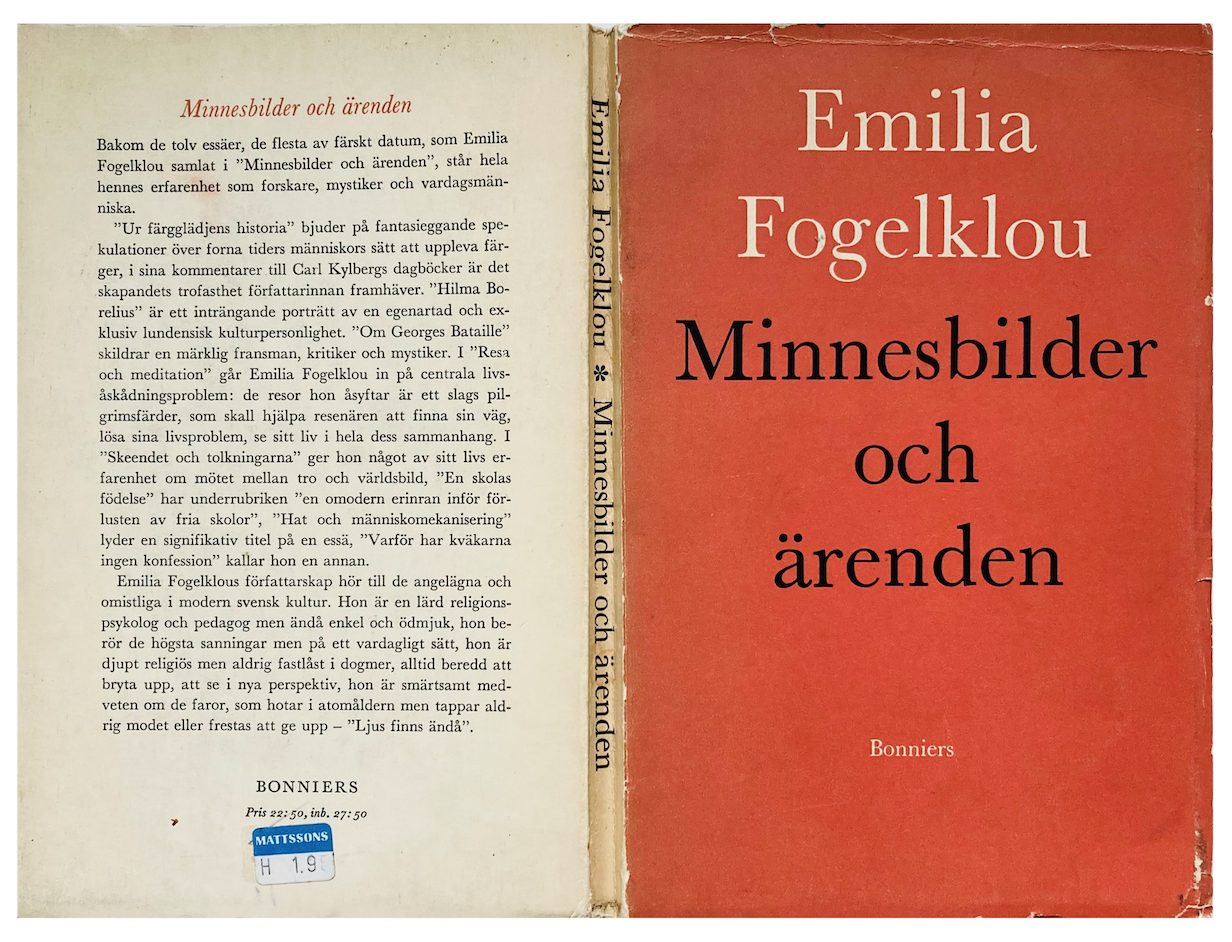
Emilia Fogelklou: ‘About Georges Bataille. Mystic and Critic’ 1963
‘Memories and cases’ [‘Minnesbilder och ärenden’], Bonniers, Stockholm, 1963, pp113-130
[113]
The first time I encountered the name Georges Bataille was in ‘Gaëtan Picon’s Panorama de la nouvelle littérature française’ (1949). It was under the heading “From sociology to mysticism”. Of his writing, L’expérience intérieure and the journal CRITIQUE were mentioned. The art history volumes on the Lascaux cave and Manet had not yet been published (Skira, Geneva).1
“He is unique in suffering through spiritual problems, as one would otherwise suffer through bodily pains,” it says. “He is his experience. — He seeks the source.” — Sartre calls him “a new mystic”.
I had no idea, when I (through the Västerås diocesan library) was allowed to borrow “L’expérience intérieure”, that this was the only copy in any public library in
1. Under the heading: Summa atheologique, the three books are listed later: inner experience, the guilty, Nietzsche Another early book, Haine de la poésie, is included in the new edition, l’Impossible (1962).
8 Fogelklou
[114]
Sweden (Gbgs stadsbibl.) [Gothenburg City Library]. Only after the author’s death (July 1962) was I able to get hold of some data and contemporary judgments (Bengt Holmqvist in D.N. 9/7, Michel Bernard in l’Art 24/7 1962).
After brilliant studies, Bataille had obtained employment at the Bibliothèque Nationale in Paris. He was among the early surrealists and was for a period a “democratic communist”. He belongs to those who most deeply realised the degradation of man and the human, which the Second World War made evident. It was in his 40s that his actual writing began with L’expérience intérieure (1943). Pulmonary tuberculosis had then forced him to leave his library position.
“Poet, mystic, philosopher, critic, deeply aware of man, his brokenness in an age that coldly enslaves him and where war itself has become a kind of watered-down scientific activity,” says Michel Bernard. — “Scandalously little known”, he adds. “Bataille was not suitable for the half-sleep of the novel-gluttons, because what they long for in advance is an even deeper sleep.”
Bengt Holmqvist calls him “a mystic of sex and death, possessed by the powers of creation and destruction, which our generation has such difficulty seeing in the eyes”.
Even though he was from France, it has been difficult to, through Copenhagen Library, to find some of the Bataille’s
[115]
books, several of which were out of date. The work La part maudite (The Fate of the Curse) with the somewhat paradoxical subtitle Économie Génerale fortunately in the Riksdag Library [Stockholm]. Through the bookstore I managed to get a novel, Le bleu du Ciel, Le coupable(diary, before the breakthrough) and La littérature et le Mal, a volume of essays from his valued journal. (I have not been able to get the book about Nietzsche.)
I return to the book about his inner experience, which had piqued my interest from the beginning. It is quite hard to read. “It is with sense and will that he writes chaotically,” says one of his critics. Bataille knows that only the dimensions of silence, “a presence that only the heart understands”, can reflect his mystical experience. Nevertheless, from his blazing certainty, he has to try to make himself known. It is difficult for this hyper-intellectual to de-philosophise and de-theologise himself. Out of fidelity to reality, he allows contradictions to take place.
I state: “By inner experience I mean what is usually called mystical experience, in a state of ecstasy, rapture or at least meditative rapture. I am thinking less of confessionally formulated experience, where at least until now one has felt bound by a certain confessional boundary. Therefore, it invites me against using the word mystic or that
[116]
to express myself in too narrow terms.1 The inner experience responds to the necessity in which I find myself: the whole of human existence from my point of view. The same kind of experience works within confessional religion,” he emphasises. “But dogmatic basic assumptions give undue limits. He who knows everything in advance cannot cross a familiar horizon line.”
Bataille later mentions his book on “The inner experience”: “a book out of despair”. “He who does not die of being human, never becomes human.” Like Sartre, he believes that life as a human being begins only beyond despair. He does not give any private reasons for despair in this work. In “Le Coupable,” whose diary entries were mostly written before the breakthrough, although it was published afterward, his “terrible (affreux) childhood” is mentioned once, also that his father was blind. It also shows how the during relocation within an occupied France looked into the war suffering of those involuntarily dragged along, of children, women, men, the elderly. “The
1 Cf. Hj. Sundén: “If the religious experience is given greater importance than the religious doctrine, for us Christians many worrying questions will be silenced.” (Man and religion p. 94.)
Paul Tillich: religious faith = “the state of being ultimately concerned” — a seriousness that was characteristic of G. Bataille.
[117]
one who now looks into the misery of the masses,” he says, “should be able to come with the simplicity of the gospel and the directness of tears. The anxiety should give his words transparency. For my part, I say everything as directly as I can, although then I am shaken by bitter irony. It is impossible for me to be more than anyone else. It is not [a] proclamation that I have. It is a secret, a renunciation of oneself,” he says (in Coupable). “We want to find what we seek, which is only to be freed from ourselves.”
Man’s notions of glory (gloire) or prestige are the worst thing about him. Caesar’s words about being the first in one’s small town rather than the second in Rome reveal precisely the most miserable thing: everything seems like nothing, unless there is someone one surpasses oneself. This in current protest against wartime gloire-talk, in all its endless horror. Bataille sees how those who stand there in the middle of the activity are put to sleep by it. “It can no longer be allowed to continue like this. I am the first to perceive man’s disgust for himself. Spiritual experience awakens.”
“All our life is burdened with death. — But in me this definitive death itself has the meaning of rare victory. It bathes me in its light. It opens within me an infinite bright smile: I may disappear. I do not imagine the world as a bounded and closed essence, but rather like that which is passed from one to the other, when we smile or when we
118
love.” (Cf. Martin Buber’s The Between, the living relationship.)
The human feeling of powerlessness breeds anxiety. Anxiety cannot be unlearned. But what do we do with it? Instead of getting to the bottom of one’s anxiety, one anxiously babbles on and escapes in various ways. Someone can, through anxiety, be called to the measure of their premonitions. This might just have been his chance. But what a mess it becomes inside the one who turns away: he suffers just as much, becomes stupid, false, superficial. It is necessary to remain, straight and motionless in dark solitude. (He testifies about his own avoidances in Le Coupable.)
“You god of despair, who crucified your son, give me your heart. My despair is nothing compared to what God must be. — But still. — — To me, idiot, God speaks out of the darkness with a voice of fire. You don’t understand the darkness in a soul stripped bare. I cry to heaven: I understand nothing.” Death is closely connected with his inner experience. (A Swede thinks of Gullberg’s lines: “Send over me a whirlwind that shatters the shape of my being”. Other things remind me of Pär Lagerkvist. I also think of a passage in Lars Gustafsson’s debut book, Bröderna (s. 47 ff) : “What happened? That’s just what I don’t really know. For a large part of my life I’ve thought about it almost daily. I think it means a lot, but I really don’t know
[119]
what it really was. Nowadays I am inclined to say that it cannot be known.”[)]
His defining experience of “what is”, becomes what G. B. then constantly inquires into, even as he states kinship with artistic inspiration, smiling, intoxication. “After this, I cannot have any other value or authority.” But when it comes to communicating experiences without borrowing Christian words, it becomes difficult. — He distances himself from philosophy. When Cartesius [Descartes] explains: I think, therefore I am, then he completely ignores the intuition that makes someone start to think for themselves at all! With Hegel, life is drowned in pure knowing (something that B. dwells on in several places). In the mind, as in the eye, there is a blind spot. Life eventually reveals this blind spot. Saints succeed best in their rendering, he says, they know with their hearts and live in the life of prayer. Our lack of ecstatic knowing is a loss. The one he lets speak the most is Angela of Foligno. But Master Eckhart and John of the Cross are also mentioned. Where some mystic marks the inability to reproduce such experience in words, Bataille recognises himself best: the inner experience has the peculiarity that, in the face of it, our negative expressions become truer than the repetition of traditional words. “I cry to heaven: I know nothing. But in rare moments I have touched the utmost.” “In the beginning, the traditional
[120]
regulations are the obvious starting point: they are wonderful . . . I am not ignorant of Christian exercises: they are in the most authentic way dramatic. But they lack a first movement (originality), without which the exposition remains subordinate.
Rare Christians have, from the sphere of speaking, reached into ecstasy, the mystical experience, despite a characteristic predilection for the discursive.”
B. distances himself from the asceticism of the mystics. “It does detach from things, but can kill connections with other subjects.” The whole of unmutilated humanity applies to it. Real asceticism is total simplicity, immediacy.
To have existence, to truly “be somebody”, cannot be attributed to a subject who isolates himself from the world but instead to one who becomes a point of communication for belonging.
When “The Inner Experience” came out in a new edition after ten years, it received a preface that criticises his book.
He had there “wanted to say everything at once”. However, it is not the boldness that displeases him. “But I hate its long-windedness and obscurity.” He has already called his style of presentation a “violent thinking”, (“high tension intellectuality” says Bengt Holmqvist). And probably it has an intensity and a seriousness that compels the reader
[121]
to stop and ponder. “Truth has rights over us. She has even all rights” (l’Impossible).
Despite the warning about an activity that without conscious criticism leads us into events that give “disgust to man”, B’s own life after the end of the war becomes a new, rich working time. Bengt Holmqvist writes: “The silent librarian on the fringes of Surrealism” became “a writer with rich and versatile productivity and a cultural critic with growing influence.”
La part maudite (1949) emphasises that the most important thing for the post-War era is not to further develop the forces of production, but to give, to share with the rest of the world. The general public demands that the predominant interest in acquisition be replaced in testing our expenditure types. B. sets the sacrifice in all its forms (even the most primitive) in opposition to our worship of work and tools. (He substantiates the slogan with sociological sections on partially new research on the nature of the victims — in Aztecs, Tibetans, in Islam, etc.). “Man searches in all myths and rites for an intimacy with life, which has been lost to us.”
B. references Max Weber’s views on industrialism (in connection with reformed religion) and quotes Benjamin Franklin’s words: [“Five Shillings turn’d, is Six: Turn’d again, ’tis Seven and Three Pence; and so on ’til it becomes an Hundred Pound.”] Nothing could stand in more cynical contrast
[122]
to sacrifice in a religious sense, according to Bataille. It is the commodity that reveals the rule of the thing, with the reification of the human and fellow human as well. “Where we could have reached the Grail, we settle for the bowl” (literally: “the cauldron”).
It became too detailed to go into B’s abundant comparative material. In the Marshall Plan, he suddenly meets his joy. (When B. wrote, it was a theory, which we now see working its way into practice with different problems than what could have been expected at the time.)1
I will not go into more detail about the art history volumes about Lascaux and Manet. The former is directly descriptive, but exudes rapture over the originality, directness of the cave paintings. They convey “the longing for the miraculous, in art as in passion, life’s deepest expectation”.
The monograph on Manet, in depicting the artistically new indifference to the “subject” — in contrast to the play of the sun and days around the phenomena — provides a certain parallel to Bataille’s own way of depicting inner experience.
Regarding Bataille’s “fictional” production, novels and poems, written before the breakthrough, but published much later, “at the request of friends”, I would like to give only brief mentions: “Le bleu du ciel” (printed in 1937), (as Michel Bernard calls
• Cf. Jonas Nordenson, Technology and freedom, D.N. 9/1 1963, together with Ulf Brandell, Keynes’ predictions in the same issue.
[123]
it “one of the most beautiful and purest novels”) and “L’abbé C” [sic]. In the preface to the former, the author writes: “Since 1936 I had decided not to think about it. The Spanish War and the World War made it meaningless. And I am now far from the state of mind from which the book emerged.” (I cannot share Bernard’s high estimation, but I ask: had the prestige-hater Bataille discovered his fellow man in the prostitutes early on — through all the humiliating details, which without embellishment were raised in the day? He reveals in some cases a marked tenderness, compassion. In the novel “l’ Abbé C” [sic] it is more of a psychological drama.)
About himself, Bataille says — in Le Coupable — “I want life to undress in me. I have lived without hiding anything. In me everything is violently damaged and cursed.” From L’impossible it was already stated: “Truth has rights over us. It even has all rights.” Bataille has “found the links of eroticism to be of a perishable nature, whoever the creature is with whom we have tied such links”. — — — “I say ‘love for the possible and the impossible, not for the woman.’ — — “Love — it is longing for an object of total desire.”
“Eroticism is cruel, leads to misery, requires ruinous expenses,” said Le Coupable. In other places, Bataille dwells on the mystery of nudity as an endless humiliation of human beings.
[124]
But in erotica, Bataille also sought a momentary liberation from the self with all its anxiety, yes, the death of the self, “a small death”. The most significant is that of communication. Realcommunication presupposes the encounter with some perceived lack: “like death, it happens through the crack in the armour. It requires the encounter between two wounds, my own and another’s. — — — The crucifixion is, after all, the blessing through which the believer is able to approach God.”
In his work L’Érotisme, written during pressing times of illness, he seeks to find the connection between erotic and religious life in all its different species, an investigation that seems to him of the greatest importance for our whole life. In the preface to this work (which probably never turned out to be what he hoped for), he enumerates all the many people who assisted him, including the procurer of photographs (although these give a misleading idea of the nature of the book upon superficial browsing). He has “been suspected of dubious intentions, which was very unfair” (Bengt Holmqvist).
In vain, one looks in Bataille for traces of the experience of love, where someone placed his life “in the hands of the only person in the world in whom his soul could find peace” (Poul Bjerre).
Bataille speaks warmly of friendship. (That’s what he learned from Nietzsche.) I find no trace of any maternal, sisterly or equal female essence in the memory images that sometimes appear today
[125]
in the diary entries in Le Coupable. He gives from his “terrible” childhood two different images of his father, none of his mother. “My blind father with hollowed-out eye sockets, long skinny bird’s nose, wailing cries, long silent smiles. I would like to be like him,” he continues. “I can never help asking questions of the darkness, and I shudder at the thought of having had before my eyes this anguished involuntary ascetic throughout my childhood.” But in the vigilance for grief in all its expressions, which characterises Bataille, he has seen even this blind man “with raised arms and wide-open eyes, while he stands and looks straight into the sun and himself from within becomes light”.
Despite the absence in the authorship of equal women, one notices not only the preference for Angela of Foligno as a mystic, but also his — one is almost tempted to say identification — with Emily Brontë in the first basic essay in La littérature et le Mal (1957).
Bataille’s conception of communication (in the real sense) gives his literature review its particular focus. In La littérature et le Mal we encounter it in different ways when treating different authors. Among the non-French, I mention, apart from Emily Brontë (who in the essay also gets her biography), Kafka and William Blake. The French writers he
[126]
includes in this selection of own articles (from Critique) are: Baudelaire, Michelet, Sade, Proust and Genet.
Le mal, evil, shall be redeemed, not condemned. We have solidarity with the wicked. Our privileged clumsiness exacerbates the evil. Real literature must see like the child the impenetrable simplicity of all that is. It must be reflected in seeing eyes, without idealisation or condemnation. The good is usually identified with submission and obedience. But freedomalways keeps some path open, where the good has put a lock. In the essay on Michelet, B. emphasises that the “le Mal” of the title does not refer to the evil that abuses its strength at the expense of the weak, but instead to the evil that goes against one’s own interest and presupposes a foolish desire for freedom. It concerns a pointed form of evil, which does not mean distancing oneself from morality, but a step towards deeper morality.
In the last essay on Jean Genet, this is highlighted very sharply. Despite the great importance Genet’s Journal du voleur etc. has from several points of view (psychological, social, etc.), Bataille — in some opposition to Sartre — does not count it as literature. Genet exalts himself above his crime and is locked in it in a kind of desire for superiority. It does not involve real communication.
Perhaps the strongest contrast to Genet is the interpretation of Kafka, the most interesting in my opinion
[127]
the essay. I am most critical of his essay on Blake, however unnatural it would have been for “the Bataille of inner experience” to avoid a confrontation with this prophet and mystic. — The opening essay on Wuthering Heights lingers longer than any of the others by Emily Brontë herself, who in her untouched ethical purity, however, expresses such deep experience of the abyss of evil. The author recalls how early she lost her mother, how the desolation of the heath and the dry severity of her father isolated her short life, while the heated anxiety of literary creation filled her own world and that of her sisters. She, the quietest of them, broke her silence only when she wrote, Bataille calls Wuthering Heights “one of the most beautiful books of all time”.
He refers to it more extensively than any other, with particular regard to the rare bond, which — without infidelity in the heroine’s marriage — connects her forever with the novel’s culprit, Heathcliff, the childhood friend from the heath, who becomes the cause of her own death. His evil had begun as a child’s response to his bitter life experience, a defiance that was also directed against the good.
How could the inexperienced Emily be able to portray this? Bataille asks himself. He cites some of her poems, but does not believe that on the basis of them it can be claimed that Emily had a direct mystical experience. But she promotes a new view of evil.
[128]
Not the kind that exploits others for profit, but the evil as a response to the incomprehensible injustice of someone’s existence. The essay on Emily Brontë ends with a section entitled “Literature, Freedom and the Mystical Experience”. Throughout the book, one is warned about this connected perspective.
“We cannot doubt the fundamental unity of all those movements, where we escape interest calculations and experience the intensity of a now . . . Contemplation, free from reasoning, acquires the same simplicity as a child’s smile.”
“There is,” Bataille quotes from the Surrealist Manifesto, “a certain point in the soul from which life and death, the real and the imagined, the past and the future, cease to be inexorable opposites.” And “I add”, continues Bataille: “also the evil and the good, the pain and the joy. This point is felt both in dynamic (violent) literature and in the power of mystical experience. The way there matters less: it is the point alone that is the important thing.”
What George Bataille writes is born of sadness, with death in sight. Without an understanding of “L’expérience intérieure” he is difficult to approach. It seems to me to be his most important contribution. He looks at life, at religious experience and literature from different viewpoints than the generally accepted or group-shared. His language
[129]
is imageless, his poems mostly unpleasant. His utterances can have stinging sharpness. They can also — after voluntary, sometimes [be] long-winded, stripping away of intellectualistic, art-wise or religiously historically formulated expressions — leave the reader with a certain sense of loss. He does not interpret the mysterious event, but out of all his certainty of conviction he states its existence. At some point he simply cannot dispense with the inherited religious language, despite the asceticism he imposes on himself on that point; he wants to assert his poverty by using only the words to which he is entitled. Similes and images are not for him. He is not a poet. And although he has written several pages in praise of the spirit of play — he knows its kinship with inner experience — that spirit is missing in his own way of writing. He knows himself to be “child of a cursed time”. And from that background — “la part maudite” [“the cursed part”] — his message gets its shocking seriousness.
But for French people with distinct formal requirements, Bataille becomes difficult to define. Even his friend and admirer Michel Bernard captioned his obituary: La folle chevauchée de G. B.
In the Dictionnaire des auteurs français (1961) the final verdict on Bataille is given: “— — through his taste for extreme experiences, through his knowledge of intoxication and through the deliberately chaotic nature of his writing style, he belongs to the genre
9 Fogelklou
[130]
of writers which seems to write only to earn the silence.”
As a complement to this scornful view, which derives its ironic point from Bataille’s own view of silence, I still want to recall on his behalf a few lines from Paul La Cour’s Fragment af en Dagbog:
“When your ambition is defoliated, the tree of your will overturned, you wake up one day alone with yourself and are sincere.
Sincerity does not require Courage. It does not have fearless eyes. It is Childhood before Anxiety.
Now you can talk. Your smallest word is a poem.”
[e n d]
trans. David Patten, January 2024
 David Patten