Positioning 02.04.2026
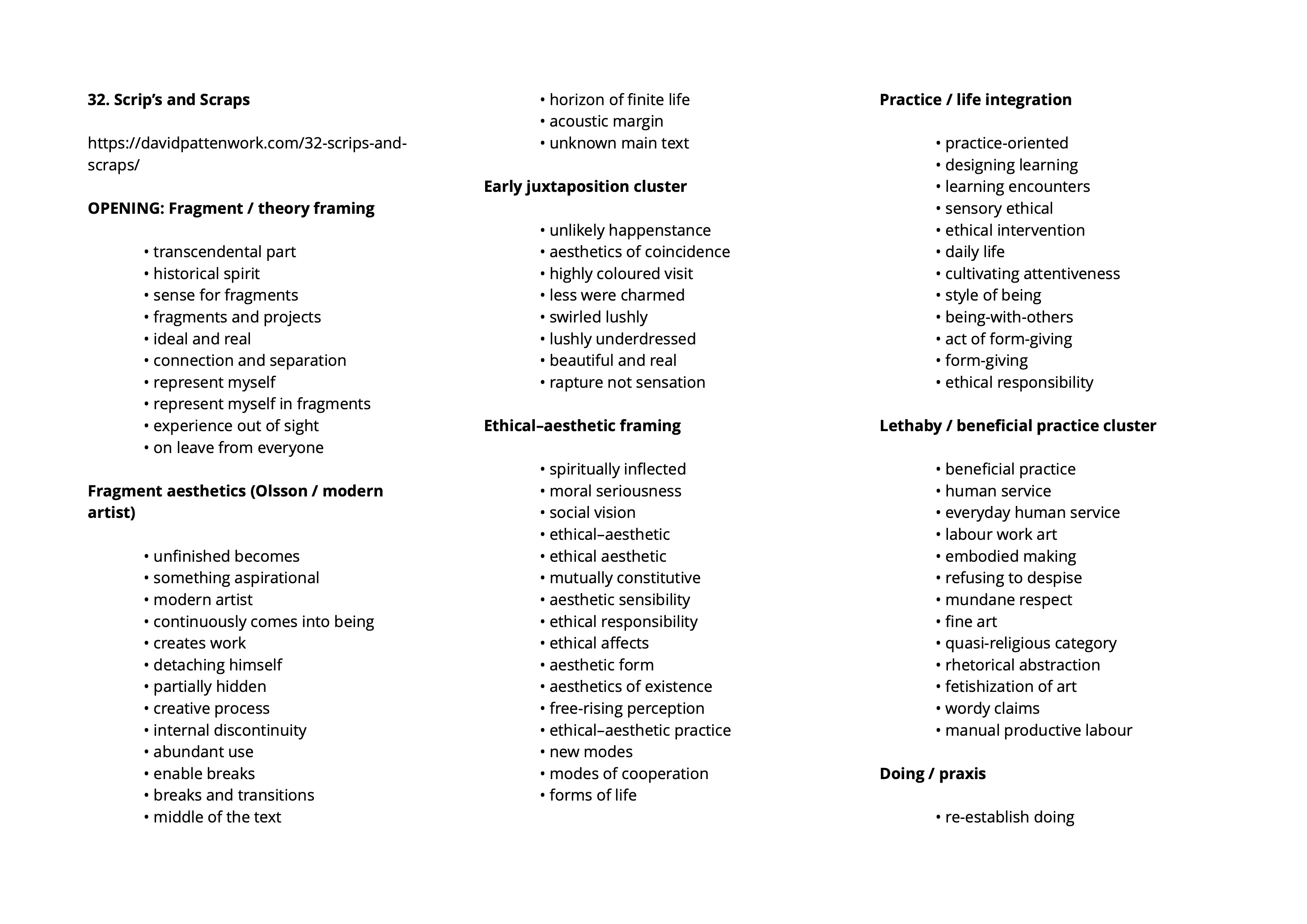
“What matters is the ability to simultaneously idealize and realize things immediately, to complete them and carry them out partly within oneself. Since the word ‘transcendental’ refers precisely to the connection and separation of the ideal and the real, one could easily say that the sense for fragments and projects is the transcendental part of the historical spirit.”
– Friedrich Schlegel: ‘Athenaeum Fragment 22’, 1798
“…why not, under the inspiration of the decor, represent myself in fragments, as an experience, out of sight and on leave from everyone.”
“…pourquoi pas, sous l’inspiration du décor, me représenter par fragments, à titre d’expérience, hors la vue et dans un congé de tous.”
– Stéphane Mallarmé: ‘Oeuvres complètes’, ed. H. Mondor et G. Jean-Aubry, Bib. de la Pléiade, Paris: Gallimard, 1945, p403
[ref: Georges Braque: ‘Bouteille et instruments de musique’, 1918, crayon, charcoal and white chalk on collaged paper and corrugated cardboard, 53 x 75 cm]
“Det oavslutade blir något strävande, eftersom den moderna konstnären intrikat och kontinuerligt blir till när han skapar verk. Han blir sig själv genom att frigöra sig som ett objekt…” / “Fragmentet svarar på hans syn på tillvaron som gudlös men styrd av en delvis dold kreativ process…” / “en sorts ars combinatoria” / “…denna nya, interna diskontinuitet, som kommer att stödja oss längre fram är den rikliga användningen av streck som möjliggör avbrott och övergångar i mitten av texten.” / “fragmentet skrivs in i det ändliga livets horisont” / “Fragmentet framträder här som en akustisk marginal till en okänd huvudtext.”
“The unfinished becomes something aspirational, as the modern artist intricately and continuously comes into being as he creates work. He becomes himself by detaching himself as an object…” / “The fragment responds to his view of existence as godless but governed by a partially hidden creative process…” / “a kind of ars combinatoria” / “…this new, internal discontinuity, which will sustain us further on, is the abundant use of dashes that enable breaks and transitions in the middle of the text.” / “the fragment is written into the horizon of finite life” / “The fragment appears here as an acoustic margin to an unknown main text.”
– Anders Olsson: the art of writing in fragments in Skillnadens konst (2006; ‘The Art of Difference’)
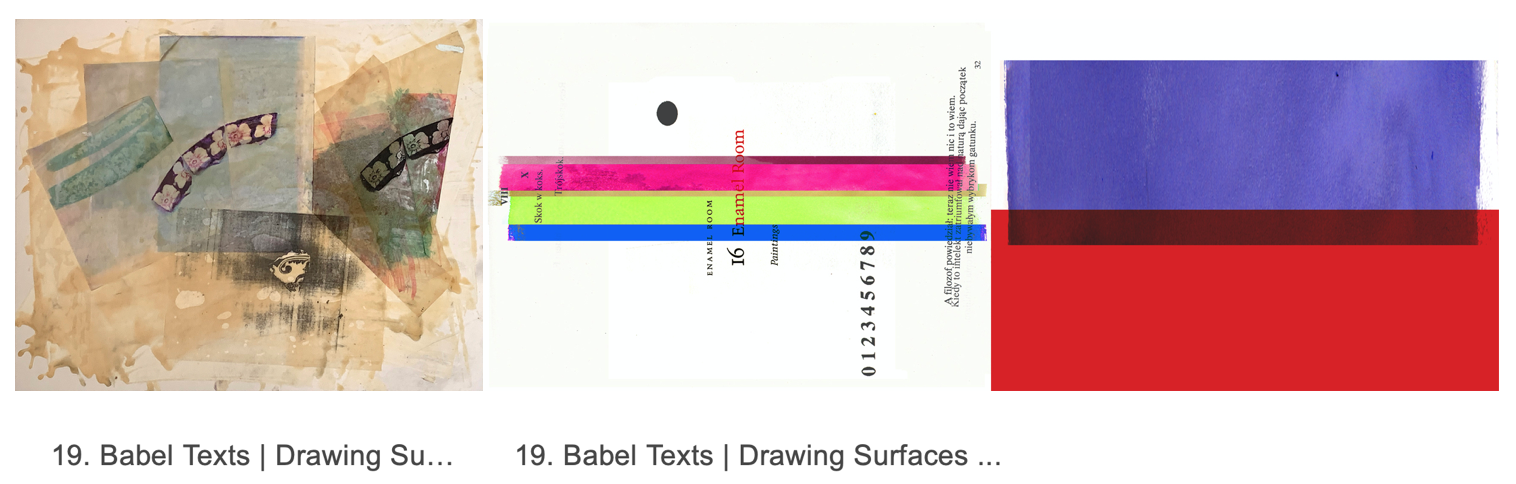
Unlikely happenstance and the aesthetics of coincidence. “A highly coloured visit [where] less were charmed [and] whoever wrote the land spilled over [and] swirled, lushly underdressed.” [1986 & 2006]
“Beautiful, beautiful, and real! If you feel it, it will be in rapture, not in sensation — such a difference!” – W. R. Lethaby: ‘Scrip’s and Scraps’, p40
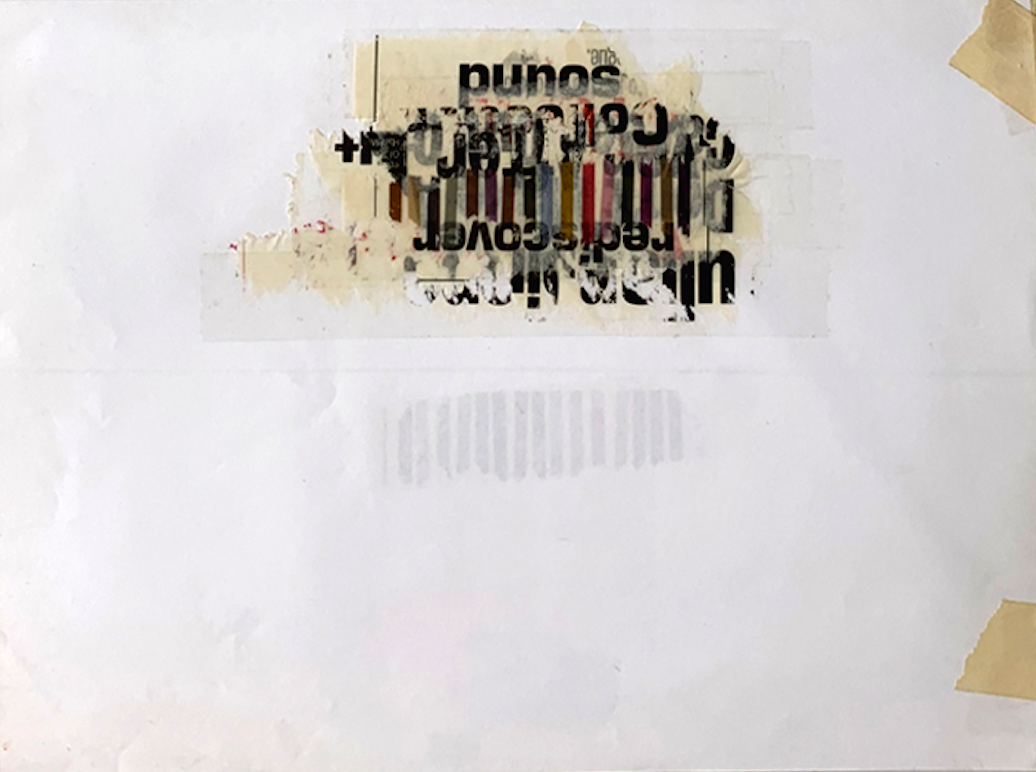
W. R. Lethaby’s thought is often described as spiritually inflected, though not conventionally religious. He was deeply shaped by the Arts and Crafts movement’s moral seriousness, William Morris’s social vision, and a broad Christian cultural context, but his orientation was more ethical–aesthetic.
The term “ethical–aesthetic” is often used to point to a space where ethics (how one ought to live, act, and relate)and aesthetics (the experience and cultivation of beauty, style, form, and sensibility) are not separate domains, but mutually constitutive.
1. Beyond Moral Rules
- Ethical usually points to values, responsibility, or obligation.
- Aesthetic points to perception, affect, and sensibility.
When combined, “ethical–aesthetic” suggests that the good life isn’t just about following moral codes but is embodied in how one perceives, feels, and shapes life.
2. Form as Ethical Expression
The way we form life, relationships, or even institutions is always simultaneously ethical (implicating others) and aesthetic (shaping sensibility).
- A community’s rituals, art, and pedagogy are not just decorative—they generate ethical orientations.
- For example, an artwork or practice can cultivate empathy, awe, or attunement—ethical affects through aesthetic form.
3. Philosophical Roots
- Foucault spoke of an “aesthetics of existence”—life as a work of art, an ethical project of self-formation through style.
- Guenther’s Dzogchen emphasis on free-rising perception and luminosity can be seen as ethical–aesthetic: cultivating perception (aesthetic) is inseparable from compassion and liberation (ethical).
- In Negri’s thought, the multitude creates forms of life that are simultaneously aesthetic (new styles of being) and ethical (new modes of cooperation, solidarity).
4. Practice-Oriented
Ethical–aesthetic is not just theory—it’s a mode of practice:
- In pedagogy → designing learning encounters that feel alive, beautiful, and just.
- In politics → enacting protest not just as demand but as performance, a sensory–ethical intervention.
- In daily life → cultivating attentiveness, presence, and style of being-with-others.
The ethical–aesthetic is about living as if every act of form-giving—how we shape perception, relation, or experience—is also an act of ethical responsibility.
— — —
Lethaby positioned himself between Ruskin and Morris—picking up their insights but resisting their polarizations. If we think in terms of beneficial practice, here are some key layers to draw out:
1. Humanist Grounding
- Lethaby wants to pull “art” down from the clouds and re-situate it in everyday human service.
- He sees “labour, work, art” as a continuum rather than stratified categories—each imbued with meaning and dignity.
- Beneficial practice = refusing to despise the “mundane” and instead cultivating respect for embodied making.
2. Critique of “Fine Art” Exceptionalism
- Ruskin elevated architecture into a quasi-religious moral category; Morris wanted it integrated into a revolutionary social transformation.
- Lethaby resists the rhetoric of “Architecture as chief of the arts” or as Fine Art. For him, this abstraction detaches making from need and human service.
- Beneficial practice = resisting fetishization of art. He saw danger in “wordy claims” and in aesthetics that revile manual, productive labour.
3. Re-establishing Doing
- Lethaby’s call—“We have to re-establish doing”—is a call to praxis: hands-on engagement, not just “bookish” abstraction.
- His critique of education being “too abstract, too bookish” anticipates today’s critiques of overly discursive, detached academic learning.
- Beneficial practice = learning through making, where doing is not merely instrumental but a way of knowing, cultivating care, and staying connected to the material world.
4. Ethics of Work and Service
- By framing all production as “human service,” he anchors aesthetics in ethics: the value of work is not in its “poetical content” alone but in its serviceability, universality, and relational role.
- Beneficial practice = seeing work not as brute labour vs. elevated art, but as a shared field of meaningful activity where beauty, necessity, and ethics intertwine.
5. A “Middle Path” Pedagogy
- Lethaby’s position is pragmatic and reformist: he doesn’t retreat into Ruskin’s moral idealism or Morris’s revolutionary politics, but insists on an education of doing, grounded in respect for material engagement and accessible to all.
- Beneficial practice = cultivating students who can integrate hand, head, and heart—resisting alienation from the world of production while also resisting the abstraction of “culture” from lived work.
Summary: For Lethaby, beneficial practice meant restoring respect, dignity, and meaning to doing itself—to making, working, and serving. He saw art, not as an isolated sphere, but as the luminous dimension of all human labour. This makes his pedagogy a kind of ethical–aesthetic practice: training perception and imagination through work, not apart from it.
TEXT: Scrip’s and Scraps
Scrip’s and scraps / by W. R. Lethaby / gathered and introduced by Alfred H. Powell, with a Preface by Viscount Esher, printed by Earle & Ludlow, Cirencester, 1937.
Near fine copy in the original title–blocked cloth over paper–covered boards. Spine bands and panel edges very slightly dust-toned as with age. Remains particularly well-preserved overall; tight, bright, clean and strong. Date is suggested. Physical description: 56 p., [1] leaf of plates….. [purchased 19 April 2019]
[p48]
The following lines were occasional random sayings of W. R. Lethaby’s, which his sister-in-law, Miss Grace Crosby, wrote down during his life. They are of interest here as another glimpse of the trend of his thinking.
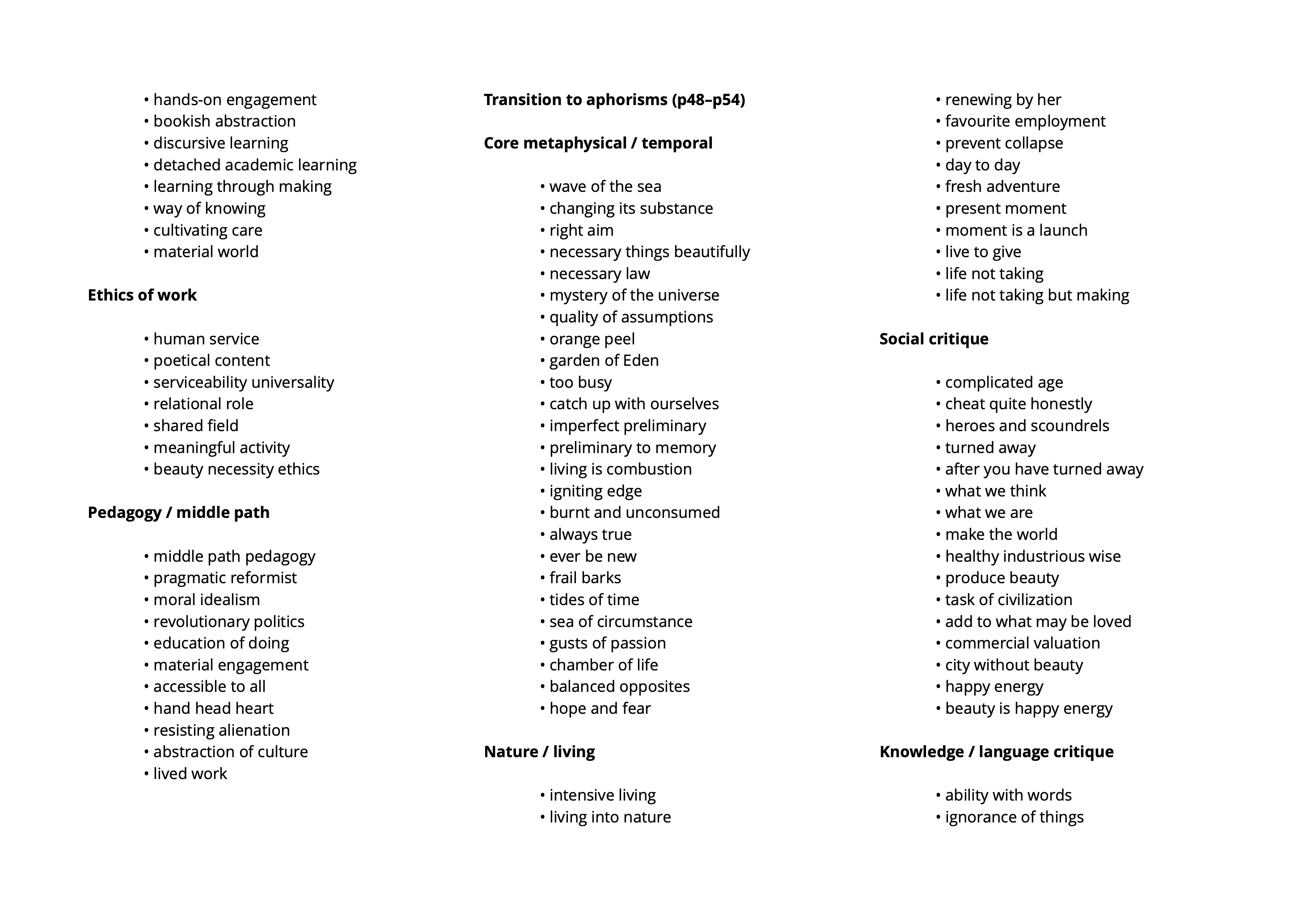
“Our life, like a wave of the sea, seems to keep identity but is all the time changing its substance.”
“The right aim is to do necessary things beautifully.”
“It is often said you cannot go back: nor can you avoid the smash of going on.”
“Mystery is a necessary law of the Universe: if it were not so that too would be a mystery.”
“Little can be proved: what matters is the quality of our assumptions.”
“The orange peel by which you fall has come down from the Garden of Eden.”
“We go so fast that we can’t catch up with ourselves, too busy to do anything.”
“Tomorrow there will be less time than to-day.”
“If we knew everything we should at once ask why that was all.”
“If the ship is sinking it is not pessimism to say so, but only if it is not.”
“Experience is only an imperfect preliminary to memory.”
“Living is combustion, ‘now’ is the igniting edge between the burnt and the unconsumed.”
“That which is always true must ever be new.”
“We are frail barks on the tides of time, in a sea of circumstance, driven by gusts of passion.”
“The chamber of Life is at the centre of balanced opposites, east and west — dark and light — hope and fear.”
[p49]
“We need some intensive living into Nature and renewing by her.”
“Our favourite employment is underpinning just enough to prevent collapse from day to day.”
“Every day is a fresh adventure into the unknown: the present moment is a launch.”
“Live to give. Life is not taking but making.”
“Our age is so complicated that we cheat quite honestly.”
“This is a wonderful age for heroes and scoundrels: difficult for people in between.”
“The important thing is what you see after you have turned away.”
“What we think, we are: what we are, we do what we do, we make the world.”
“Civilization should mean a society in which the people are healthy, industrious, wise and produce beauty.”
“The task of civilization is to add to what may be loved.”
“Supposing it in the nature of things, we should measure improvement by Beauty, not by so-called wealth, mere quantity of stupid things and stupid people; can you think how I, while bound up with the amusements which London offers in the way of bright friends and the British Museum and so on, yet hate it, with a profound and frightened hatred? This city without beauty, which is the type of what all other cities are to be while the age of commercial valuation of things lasts?”
“Energy is life. Beauty is happy energy.”
“All forms of life are breaths of the Universe.”
“History is written by those who survive, philosophy by the well-to-do; those who go under have the experience.”
[p50]
“Ability with words often goes with ignorance of things.”
“The world has developed through the stone, bronze and iron ages, to the present paper age.”
“Everything is limited by the teller and the hearer.”
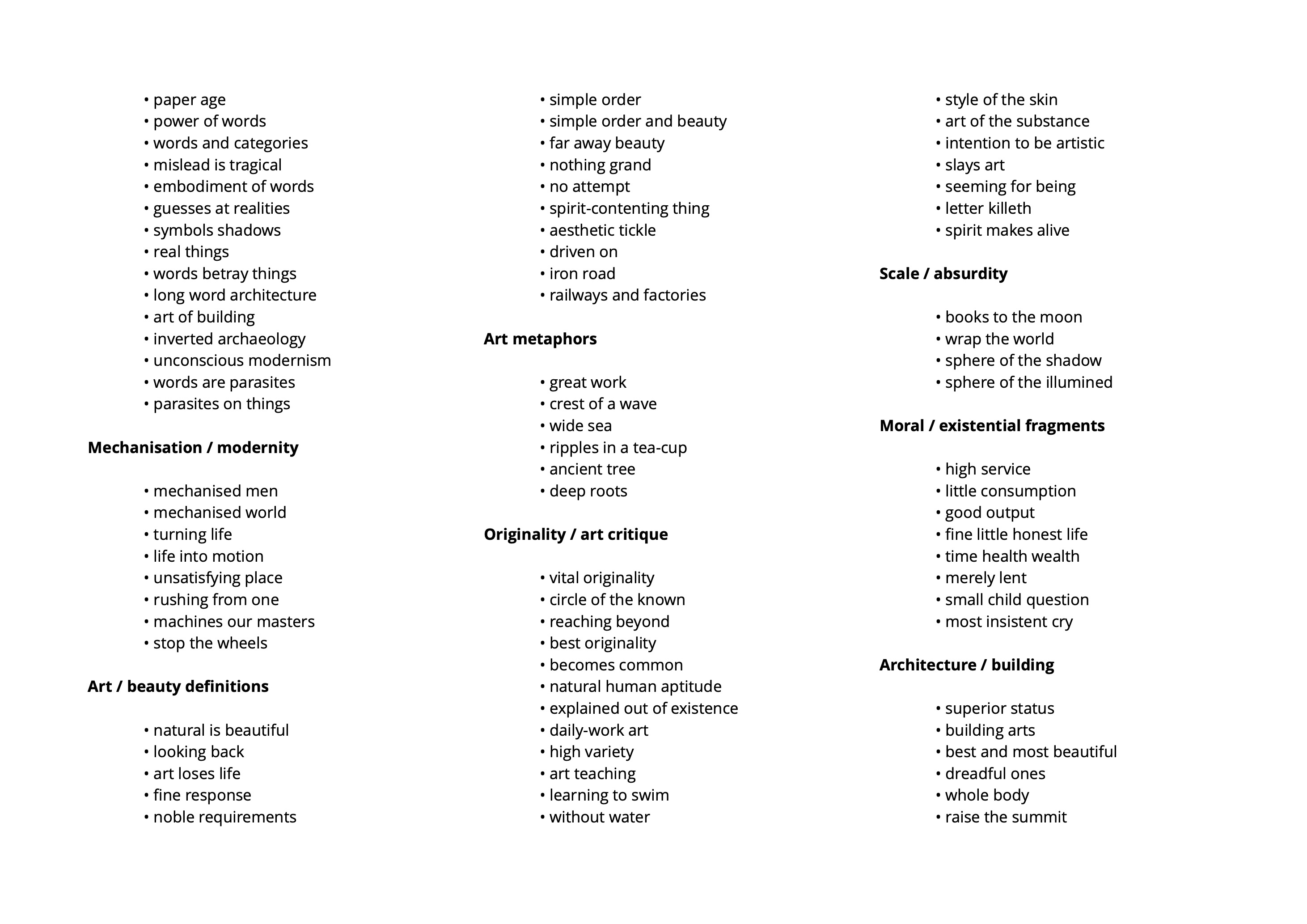
“The power of words and categories to mislead is tragical. Things are not the embodiment of words: words are only guesses at realities. I think that most people suppose that ‘the love of money is the root of evil’ in a sort of ‘in consequence’ way, selfishness and the like; but I have a dim sort of idea that the root of the evil of money is even more intrinsic, most of the effort of the world being devoted to obtaining and exchanging symbols, shadows, instead of real things.”
“Words betray things: the long word Architecture has destroyed the art of building.”
“Modernism conceived as a style is only inverted archæology, it will not be real until it is unconscious.”
“He owns most who loves most.”
“That I would wish for me which all could have and be.”
“The poor are gentle, the rich call themselves so.”
“You must go out and lift up your heart at things more and more, and read the everlasting things.”
“Words are parasites on things; give a lie a good name and live by it.”
“We must beware lest we become mechanised men in a mechanised world.”
“We are turning life into motion, rushing from one unsatisfying place to another.”
“Machines have become our masters — we cannot stop the wheels.”
“I am sure that the normal and the natural is the beautiful.”
“In looking back, art loses its life: remember Lot’s wife.”
[p51]
“Art is not shape and appearance: it is fine response to noble requirements.”
“Viollet-leduc somewhere says that as a child he was carried into ‘Notre Dame’ when the organ played and the sun shone through the great Rose, and he thought that was the source of the music.”
“I was coming through St. Paul’s Churchyard to-day when the bells were being rung very softly, sweetly, and jangly. There was something so drowsy and soothing in it (especially as the great height seemed to help with the vibrations up together) that it touched me again with a far away beauty that I felt some time ago while listening to some street players in Exeter. There was no ‘attempt’, nothing ‘grand’, but some simple order and beauty. Can you realise how the old people of Florence and of Bruges must have loved their City? Can you think what it must have been when people invented chiming bells three hundred feet up in the air, and city almost called to city right across Europe?”
“The only thing I know is this, that beauty is the measure Providence has given us to judge of life by, not the mere aesthetic–tickle kind of beauty, but the spirit–contenting thing which we all know in part, instead of being driven on, nobody knows where, by railways and factories, the ‘iron road’.”
“It is a difficult world to be alive in! It makes one long for a sort of balcony to the world, so that one could go outside and get a breath of fresh air.”
“All literature, all music, all painting, sculpture, talk, life, activity, must be related to a worthy purpose and become spontaneous and developing before it is Art, and then the art will be forgotten in the message. The five senses are the five doors for God.”
“A great work of Art is the crest of a big wave in a wide sea. Many modern pictures and poems are ripples in a tea-cup.”
“Great Art is an ancient tree with deep roots.”
[p52]
“Vital originality is standing in the circle of the known, reaching out to what is beyond.”
“The best originality is that which becomes common afterwards.”
“Art is a natural human aptitude which has been explained almost out of existence.”
“Only daily-work art is worth a button: all the High variety is disease. All that art–teaching is like learning to swim in a thousand lessons without water.”
“Style is of the skin, art of the substance.”
“An intention to be artistic slays art: putting seeming for being.”
“In art the letter killeth: ’tis the Spirit that makes alive.”
“This absurd printing these books which would pile to the moon and newspapers which would wrap the world up like an orange once a year: can they be explained in any other way (unless the world is mad) than that they are to bring the sphere of the shadow into the sphere of the illumined?”
•
“Still, the right is high service on little, little consumption and good output.
If ever we begin again, we want fine, little, honest life.
“For those who toil the struggle too keen,
For those who don’t the escape too mean.”
•
“All we possess
Is merely lent
Time, health and wealth
Full soon are spent.”
•
“This evening passing pensive by,
I heard a small child question ‘Why?’
Such is, and will be till I die
My own heart’s most insistent cry.”
•
“Who can say if by and by
There may be another try?
This might seem a reason why
We’re such babies when we die.”
[p53]
“It is impossible to draw any line giving architecture superior status to building that does not result in defining it in such a way as may leave some of the best and most beautiful buildings in the ‘non’ class while retaining some of the most dreadful ones within the fold. It is thus we use the word in regard to the building arts of past times. It is only by bettering the whole body of building that we shall be able to raise the summit.”
“Our towns should be pleasant to live in not delightful to get away from.”
“A building which poses as imposing is an imposition.”
“Architecture should be full humanity in building.”
“Art has to broaden out from use to use until it is everywhere.”
“True art is not a style, a pattern, a taste, it is a spirit: the spirit of full and happy labour.”
“Everyone would produce art if so much had not been written about it that only professors dare to profess.”
“Aesthetic theories can only be understood by experts, and they only think they understand.”
“Communion of the inner mind is the only basis of the closest friendship, the only comradeship.”
“Beauty is the complexion of health.”
“Beauty often ends where ornament begins.”
“Strikes and lock-outs. Of course, the great thing is how to bring back the thought of work into minds high and low (which end is which?). This strike or lock-out (for as usual we be ambiguous) is a tremendous business yet doubtless if it had been foreseen it could have been guided. All these things gradually open up our minds to what Morris deeply saw of work — that it was life and service and art and joy, or horror and slavery.”
[p54]
“A London road up. Scores of digging men plodding at the stiffest of labour and spitting on their hands. It is wonderful! more and more I get to reverence that they are mysteries, their patience and their cheerfulness. Some terrific labour as when four men strike one after the other on a cutting edge with heavy sledges. Why are not golfers put to this work? This roughness, too, is beauty I fancy.”
“Half politics is two-thirds antics.”
“Man, a question-asking animal, is becoming a tax–paying machine.”
“Parliament has much procedure, but too little proceeds from it.”
“To live softly one has to be hard hearted.”
“Our property often becomes our proprietor.”
“The cult of comfort is the curse of civilization.”
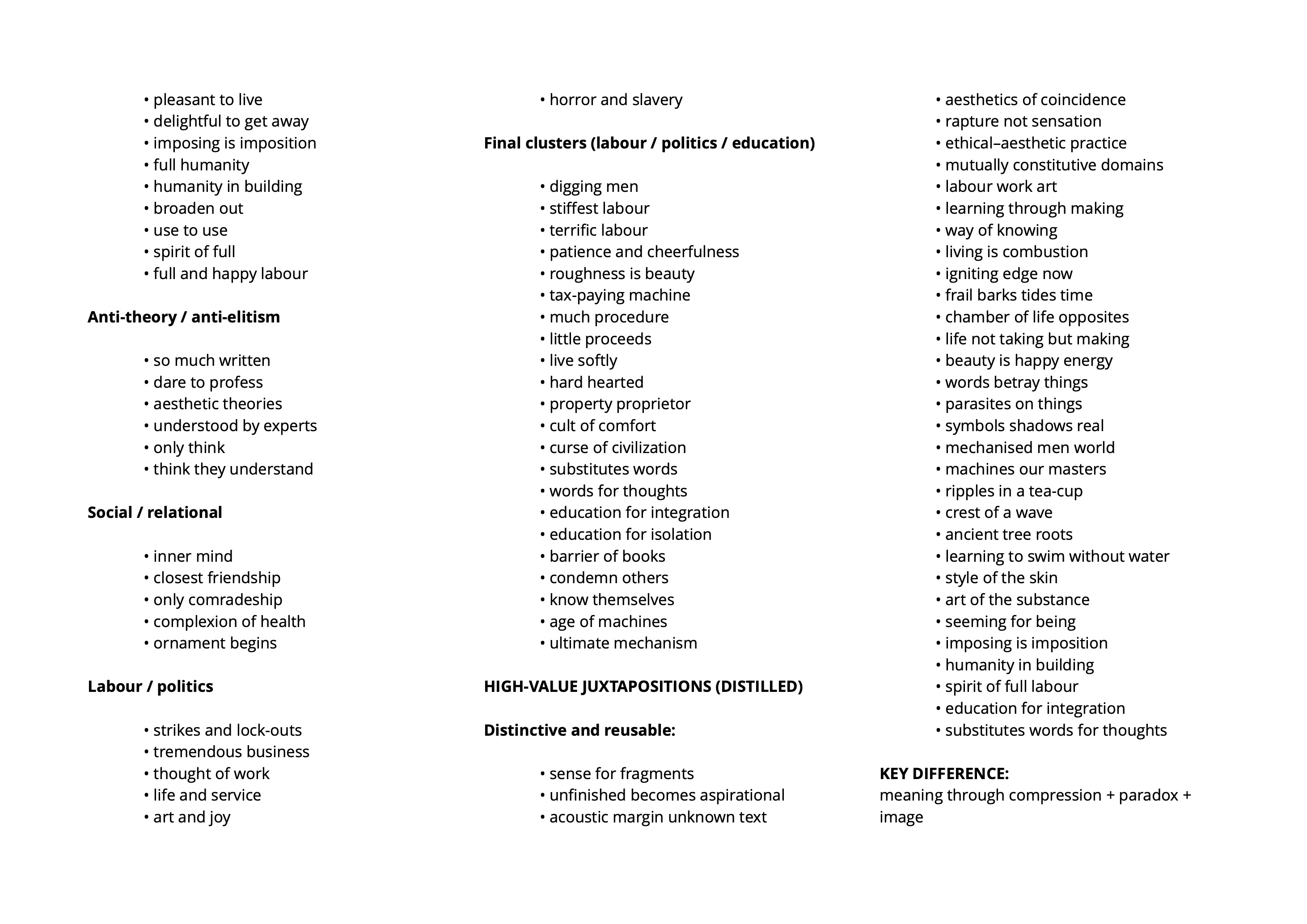
“Much education only substitutes words for thoughts.”
“Education should be for integration: it has been for isolation.”
“Education is better underdone than overdone, Education must look beyond the barrier of books.”
“A critic defines himself the Last Judgment will be the sum of our own judgings.”
“Those who condemn others least know themselves.”
“In the age of machines the ultimate mechanism is man.”
[e n d]
15.04.2022
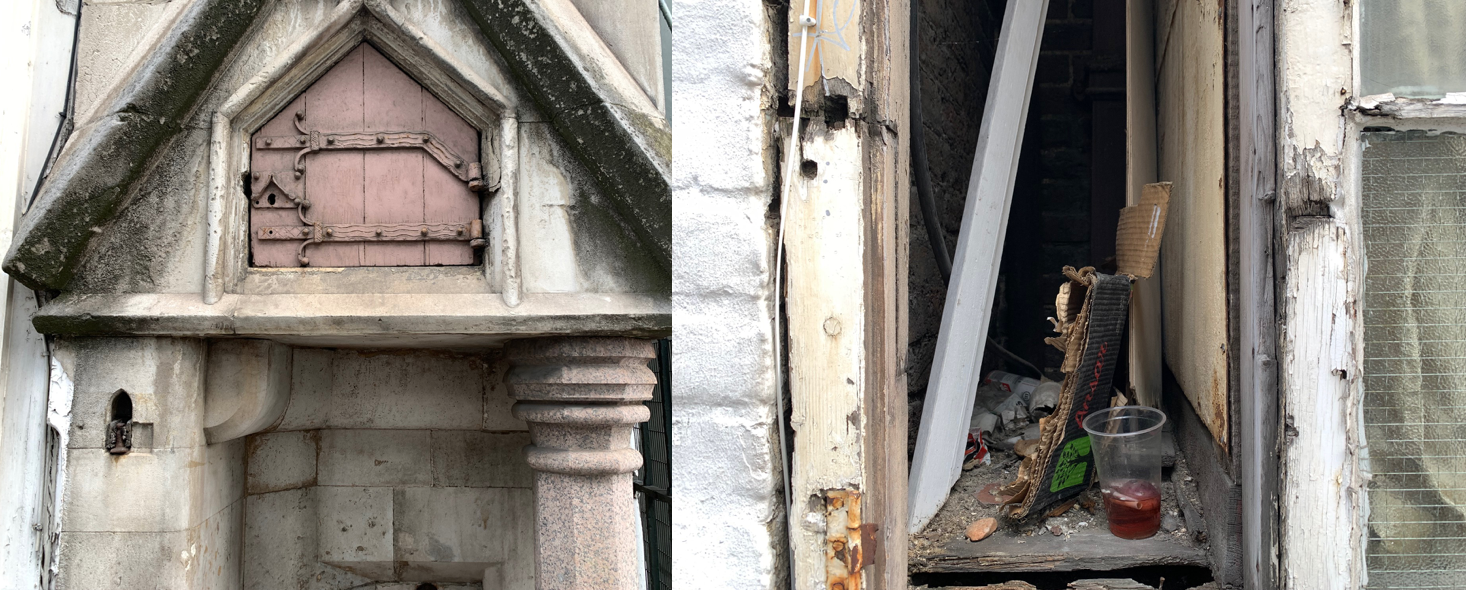
2022 | W.R. Lethaby writings on Philip Webb, ‘The Builder’, 1925
“He was little known, but that, as the spinster said, was ‘by choice’; few ever heard of him just because he was so great a man. [. . .] I write not because I can judge Philip Webb, but rather that in this life I find a means of judging my own.” [Part I]
Part I: Issue 4275, 9 January 1925, pp.42-43
https://archive.org/details/sim_building-uk_1925-01-09_128_4275
Part II: Issue 4279, 6 February 1925, pp.223-228
https://archive.org/details/sim_building-uk_1925-02-06_128_4279/mode/2up
Part III: Issue 4283, 6 March 1925, pp.381-383
https://archive.org/details/sim_building-uk_1925-03-06_128_4283/mode/2up
Part IV: Issue 4287, 3 April 1925, pp.530-532
https://archive.org/details/sim_building-uk_1925-04-03_128_4287
Part V: Issue 4291, 1 May 1925, pp.676-677
https://archive.org/details/sim_building-uk_1925-05-01_128_4291
Part V: Issue 4291, 8 May 1925, pp.734-735 & Correspondence: Issue 4293, 15 May 1925 p.752
https://archive.org/details/sim_building-uk_1925-05-08_128_4292
Part VI: Issue 4296, 5 June 1925, pp.870-872
https://archive.org/details/sim_building-uk_1925-06-05_128_4296
Part VI cont: Issue 4297, 12 June 1925, pp.904-906
https://archive.org/details/sim_building-uk_1925-06-12_128_4297
Part VI cont: Issue 4298, 19 June 1925, pp943-944
https://archive.org/details/sim_building-uk_1925-06-19_128_4298
Part VII: Issue 4301, 10 JULY 1925, pp76-77 & Note: Issue 4301, 10 July 1925, p40
[not found]
Part VII: Issue 4302, 17 July 1925, pp.98-99
https://archive.org/details/sim_building-uk_1925-07-17_129_4302
Part VIII: Issue 4305, 7 August 1925, pp.220-222
https://archive.org/details/sim_building-uk_1925-08-07_129_4305
Part IX: Issue 4309, 4 September 1925, pp.360-362
https://archive.org/details/sim_building-uk_1925-09-04_129_4309
Part X: Issue 4318, 6 November 1925, pp.672-674
[not found]
Part XI: Issue 4322, 4 December 1925, pp.811-814
https://archive.org/details/sim_building-uk_1925-12-04_129_4322
Part XII: Issue 4324, 18 December 1925, pp.888-890
https://archive.org/details/sim_building-uk_1925-12-18_129_4324
Part XII: Issue 4325, 25 December 1925, pp.922-924
https://archive.org/details/sim_building-uk_1925-12-25_129_4325
LINKS:
- W.R. Lethaby and All Saints’ Church Brockhampton by David Patten, Tinsmiths, 2019
- 23. WORKING NOTES | WELL-MAKING
- 24. LETHABY ON WEBB, 2022 | ‘The Builder’ 1925
- W. R. Lethaby: 122 & 124 Colmore Row, Birmingham
 David Patten