“Durate et vosmet rebus servate secundis” (Carry on and preserve yourselves for better times).
– Virgil
“For Patten, Baskerville is Birmingham, and when he returned to the city in 1983, Baskerville was one of five key reference points that he began working with.” [The other reference points were the poet John Freeth, the painter Samuel Lines, the historian William Hutton, and the missing parts of Richard Westmacott’s ‘Statue of Horatio Nelson’.]
– ‘Joanna Jarvis: ‘Industry & Genius’, The Baskerville Society Newsletter, Vol. 5, No. 1, May 2017
– David Patten: ‘Approaches to Public Art’, Ikon Gallery Touring, 1990 / video 07.08.2025

Study for ‘Monument to John Baskerville’, later-cut steel, Ikon Gallery, Birmingham, 1989
What makes Patten’s sculpture so unusual and effective a public work is its address to the significance of Baskerville as typographer, its identification of the typeface as the focus for public celebration. For what has been more important to the development of social, cultural and political awareness in the modern age than the clarity of good printing and the vernacular translation of great texts? That is the democratic significance of Baskerville’s work, and to recognize that is the quite proper work of this sculpture… / …Patten has moved beyond the purist abstraction of modernist sculpture, combining word and motif to bring history and narrative back into the space of the city: a story is told; a history is implied.
– Mel Gooding: ‘PUBLIC : ART : SPACE’, 1997
PDF: 100 Birmingham Sketchbooks (1987)
1990 ‘Monument to John Baskerville’, Birmingham
“Centenary Square in Birmingham has welcomed back its first piece of public art – an iconic sculpture, created to celebrate the work of the famous 18th century printer John Baskerville.”

PDF: Baskerville | The Poem (A Fable), 2013


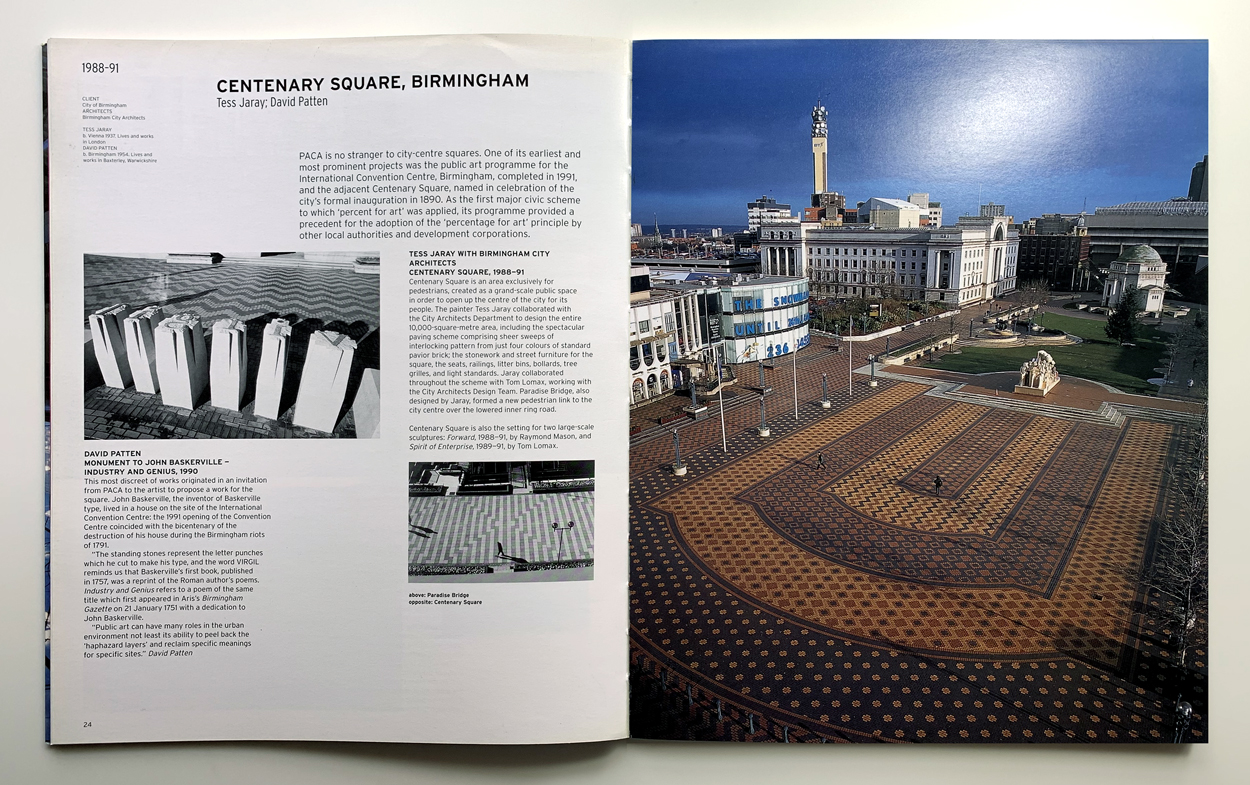

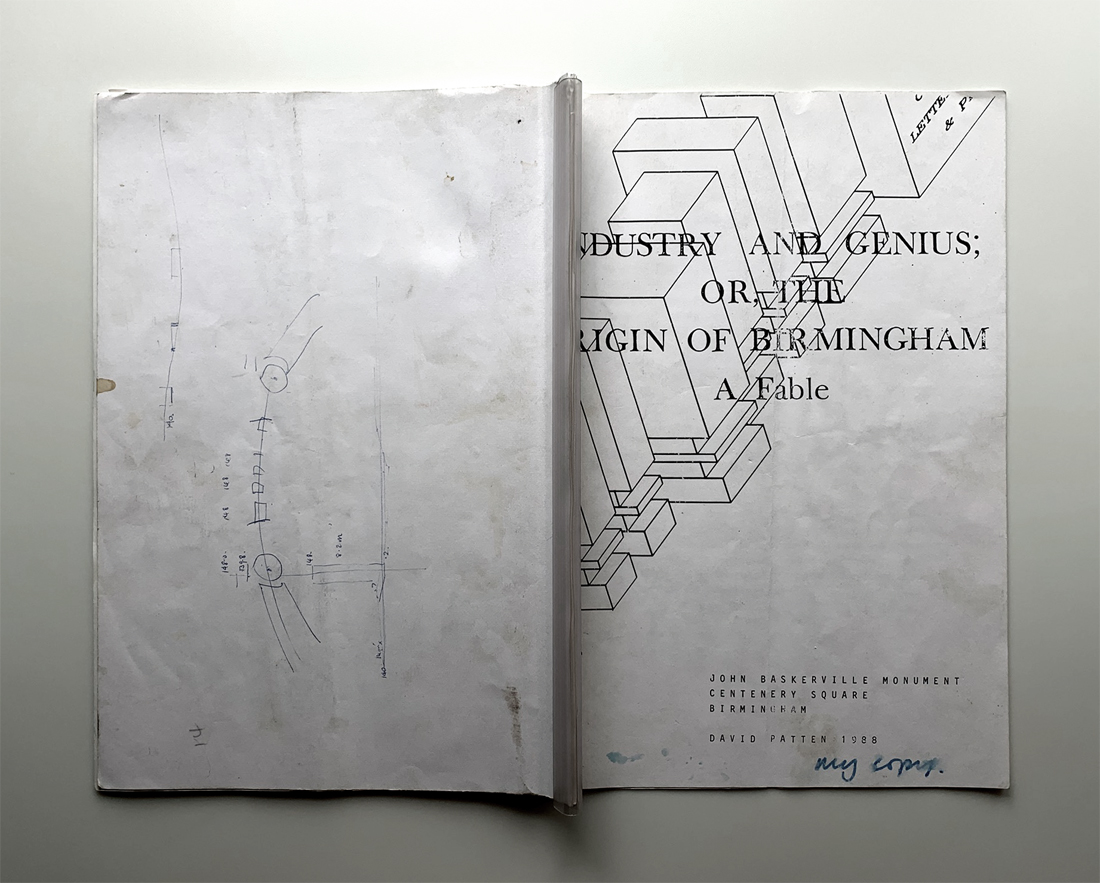

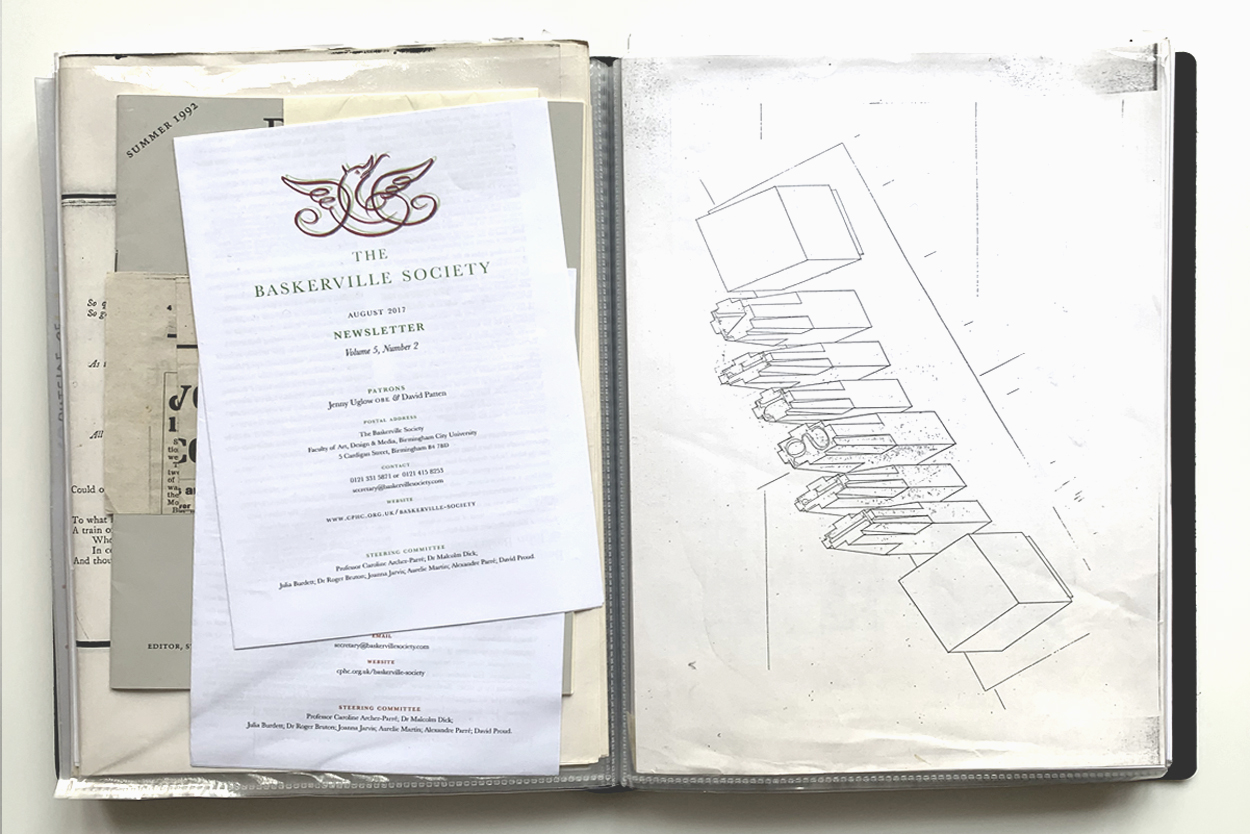
MONUMENT TO JOHN BASKERVILLE – INDUSTRY AND GENIUS
PORTLAND STONE AND BRONZE
‘Approaches to Public Art’, Ikon Gallery Touring, 1990
In 1745 John Baskerville, with the profits from his japanning business, built a house and later a printing works half a mile west of Birmingham town centre. He named the area ‘Easy Hill’ and, as William Hutton’s ‘History of Birmingham’ comments, “…the town, as if conscious of his merit, followed his retreat and surrounded it with buildings.” Over two hundred year later, with the International Convention Centre and Centenary Square developments, it is as if Birmingham’s city centre, and possibly the whole world, has arrived at Baskerville’s Easy Hill.
Birmingham has been gradually moving west for hundreds of years and this is how its sites and their meanings are found, lost and rediscovered.
“It is a vast repository of times, the discarded times of all the men and women who have lived, worked, dreamed and died in the streets which grow like a wilfully organic thing, unfurl like the petals of a mired rose and yet lack evanescence so entirely that they preserve the past in haphazard layers…built over the deep-down, dead-in-the- ground relics.”
– Angela Carter: ‘The Infernal Desire Machines of Doctor Hoffman’, 1972
But this recent move of the city centre to the Easy Hill site is not evidence of Birmingham’s consciousness of Baskerville’s merit John Baskerville’s merits have always been obscured by the glare from the three gold men examining wallpaper (Boulton, Watt and Murdoch) and other metal-bashers and their like. An unknown poet in the early 19th century declared:
“O Baskerville! the anxious wish was thine,
Utility with beauty to combine;
To bid the o’erweening thirst of gain subside;
Improvement all thy care and all thy pride:
When BIRMINGHAM – for riots and for crimes,
Shall meet the long reproach of future times,
Then shall she find amongst our honor’d race,
One name to save her entire disgrace.”
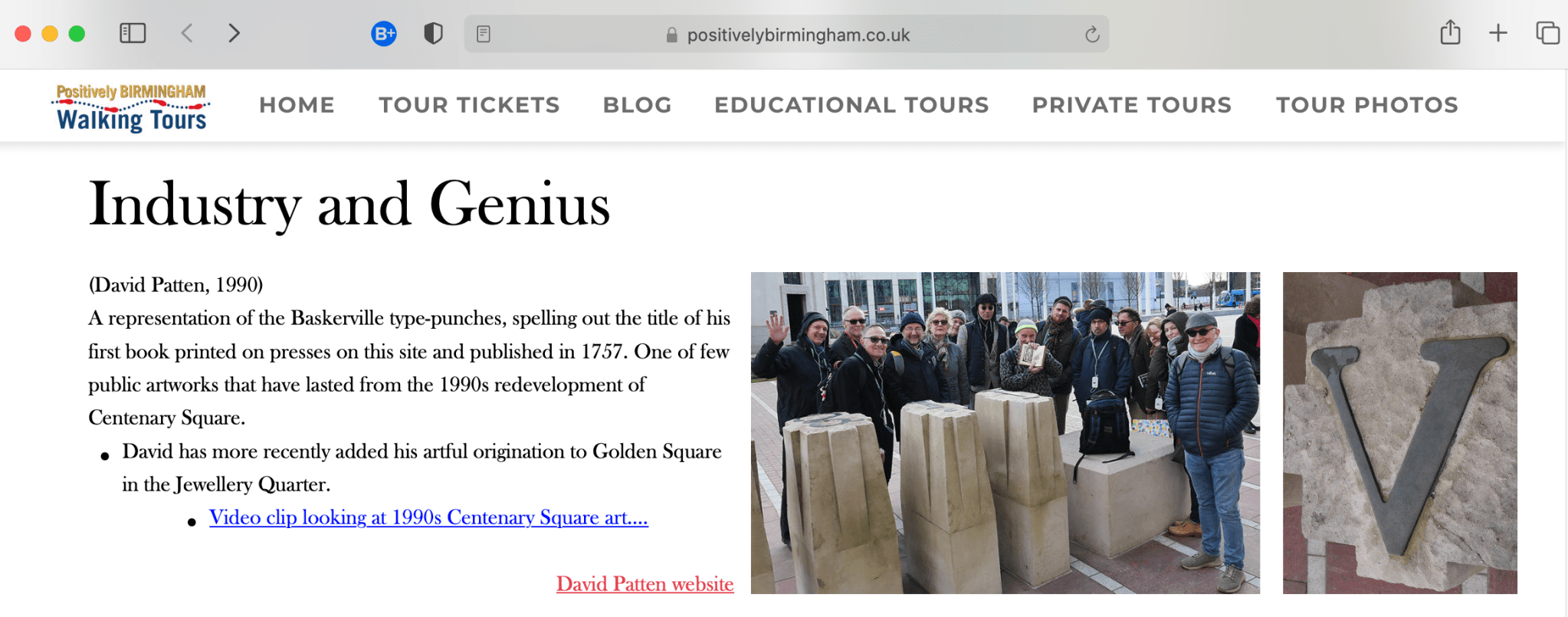
Industry and Genius is a monument to John Baskerville who lived and worked between 1748 and 1775. The standing stones represent the letter punches which he cut to make his type, and the word virgil reminds us that Baskerville’s first book, published in 1757, was a re-print of the Roman author’s poems. Industry and Genius refers to a poem of the same title which first appeared in Aris’s Birmingham Gazette on 21st January 1751 with a dedication to John Baskerville.
Public art can have many roles in the urban environment not least its ability to peel back the ‘haphazard layers’ and re-claim specific meanings for specific sites. In doing so, it avoids the dangers of creating Disney Worlds and adventure playgrounds and operates to the maxim that “if it doesn’t look like art you can sit on it.”
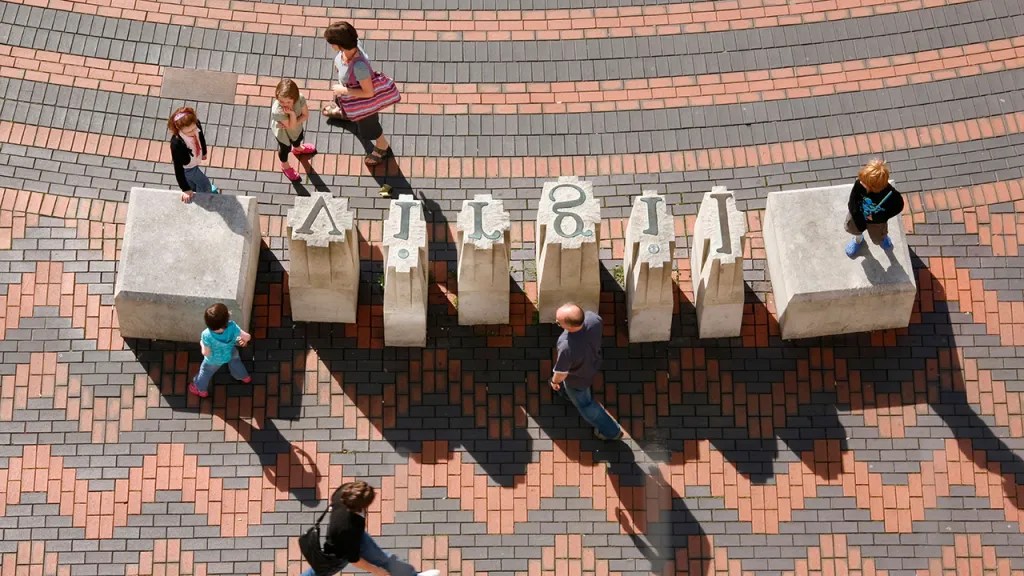
‘True to type’, TLS 13.09.2024 | ©Images of Birmingham Premium/Alamy
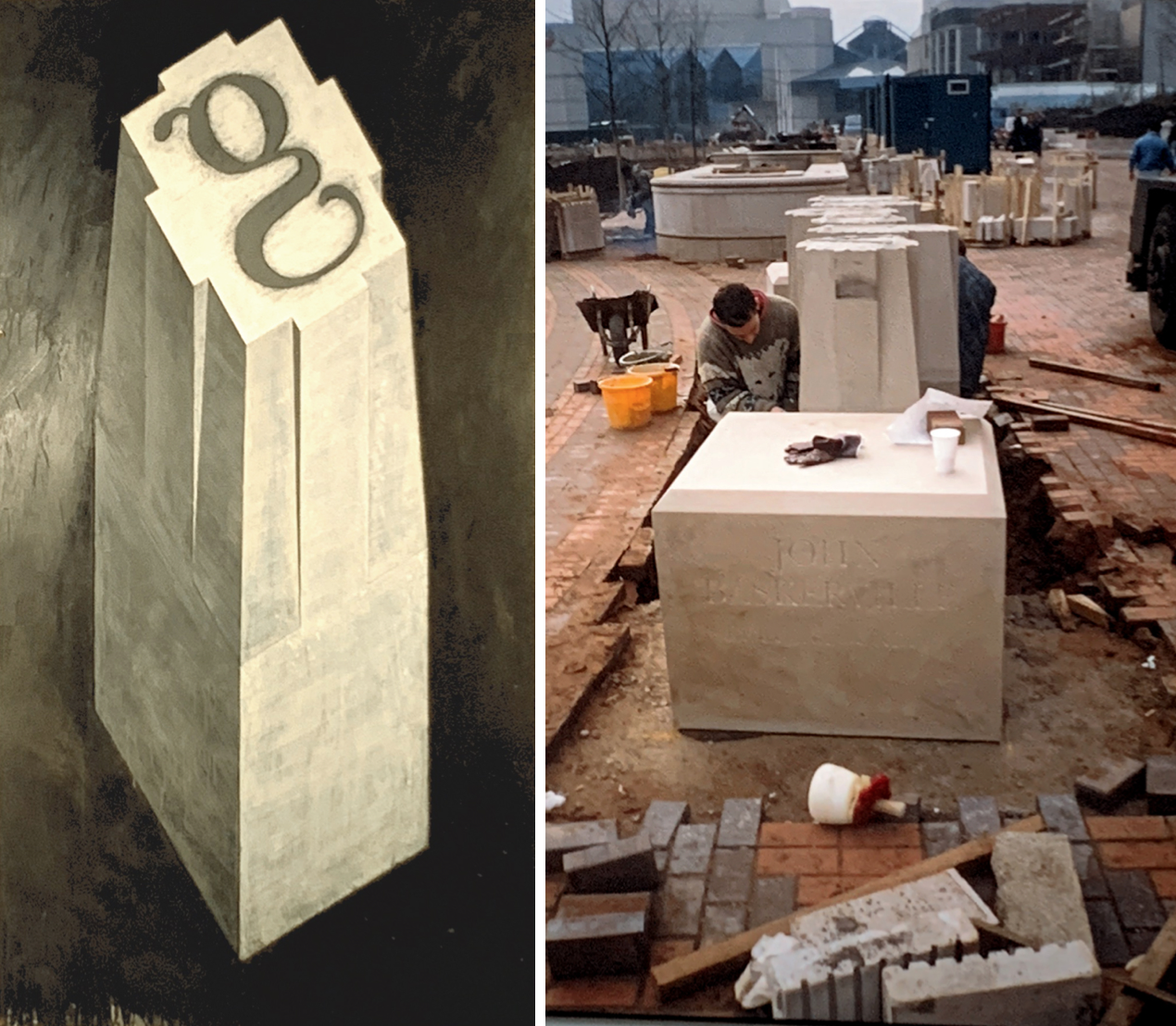
PDF: 1990 Baskerville Drawings & Installation
PDF: Mel Gooding | PUBLIC – ART – SPACE, 1997
PDF: 2000 The City of B
Working Note 31st January 2007
We have received a request under the Freedom of Information Act 2000 (FOIA) for the following:
The big poll tax demonstration and files relating to the recent anti-globalisation riots in London over the last few years.
Files held on the policing of the anti-globalisation protests in London over the last few years.
We released the following information on: Date: Wed Jan 10 00:00:00 GMT 2007
Due to the size of the documents this information is available in hard copy only. If you would like copies of the released information please contact Information and Record Management Services (IRMS) on 020 7035 1029 quoting ref FOI 698.
[www.homeoffice.gov.uk]
Riot (Sacheverell) in 1715; Riots of 1791, what led to the, 220; Riots of 1791; The “Revolutionary Dinner” 226; Spies bring out false reports of the proceedings, 227; “Church and King” 227; The riot commenced, 227; Attack on the Meeting Houses, 228; Dr. Priestley’s house, 228; The second day, 232; Baskerville House sacked and bunt, 232; Attack on Bordesley Hall, 233; Hutton’s Shop, High Street, 233; The third day, 235; Attack on Hutton’s house at Bennett’s Hill, 235; Catherine Hutton’s narrative, 235; Mr. Humphreys’ house at Sparkbrook, 238; Mr. Russell’s, Showell Green, 238; Miss Russell’s narrative, 238; Moseley Hall, 243; The fourth day, 244; Miss Hutton’s narrative, continued, 244; Address of the Magistrates to the rioters, 245; End of the Riots, 246; Conclusion of Miss Russell’s narrative, 247; Dr. Priestley’s Address, 248; Aris’s Gazette and the riots, 249; Conclusion of Miss Hutton’s narrative, 250; Trials of the Rioters, 253; Claims of the Sufferers, 253; The Union Meeting House, 256; Rebuilding of the Meeting Houses, 256; “The Little Riot” (1793), 298; The Scarcity Riots, 300, 302 – in the market-place and at Edgbaston, in 1810, 331; (Religious) in 1813, 364; in Moor Street (1816), 352; in front of the Royal Hotel (1837), 454 – in the Bull Ring (1839), 457-61; at Snow Hill Flour Mills (1847), 556; “Murphy Riots” (1867), 569.
PDF: Raymond Mason’s Hands, 2011
PDF: 14.09.2020 Birmingham Building Stone Trails
“…a volume of Virgil’s poetry being the first book that Baskerville printed in 1757. The letters and inscriptions are in bronze, but once again Portland Whitbed is used to construct the monument. This too has many broken fragments of oyster shell but also contains the floret-like heads of a reef forming algae, Solenopora portlandia which was endemic in the Portland seas. Fragments of S. portlandia observed here have broken off the reef and have accumulated in amongst the shell debris.”
LINK: Fonts In Use: Poem at Golden Square, Birmingham
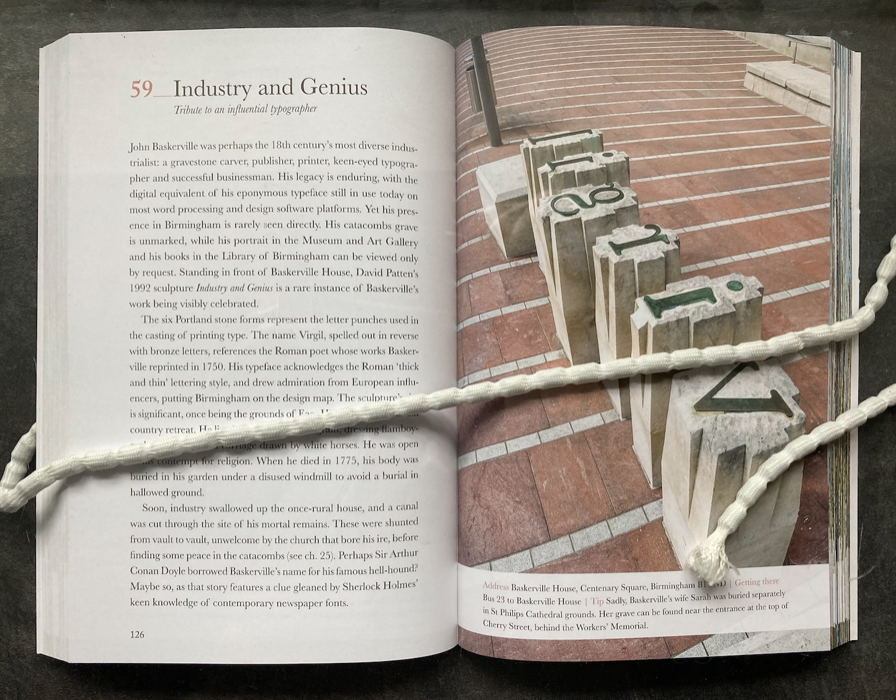
Ben Waddington (author), Janet Hart (photographer): ‘111 Places In Birmingham That You Shouldn’t Miss’, 2023
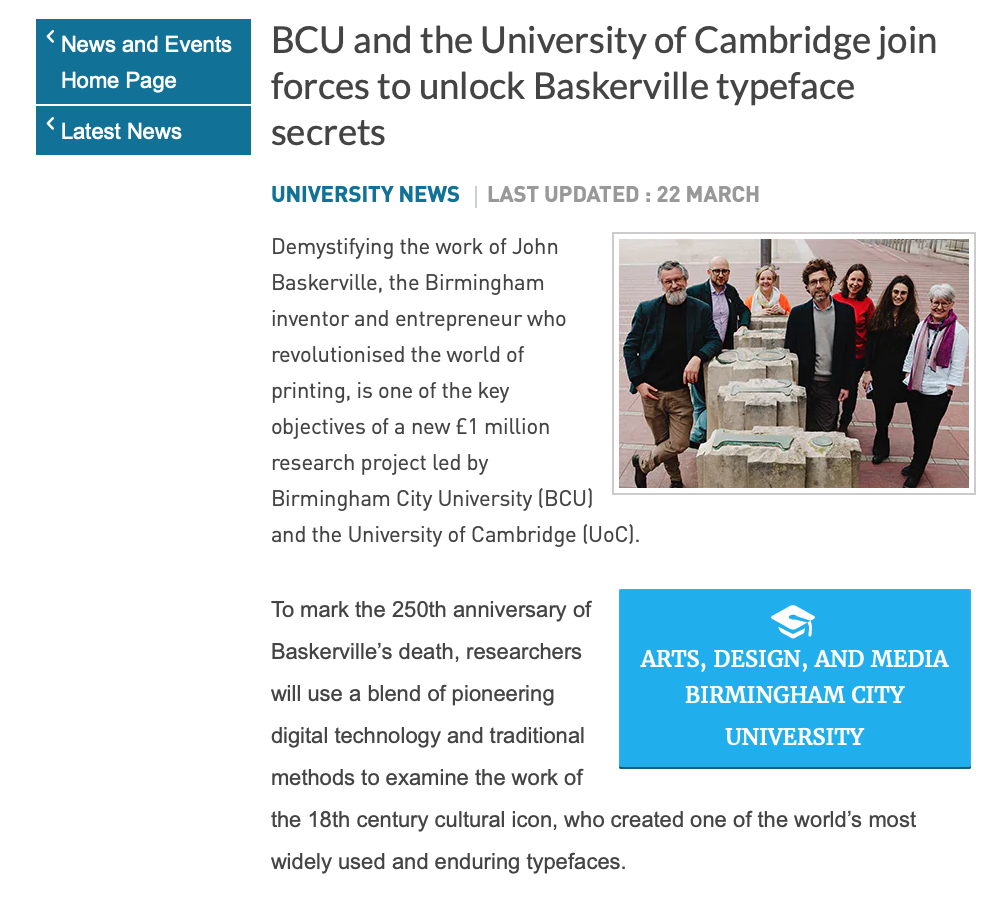
22.03.2024
“Very much in Baskerville’s footsteps, we are disregarding disciplinary boundaries between art and craft, humanities and sciences. / Baskerville’s master punches are the only evidence we have of his workshop. Yet hidden within those punches are the clues to their manufacture.”
LINK: Birmingham City University
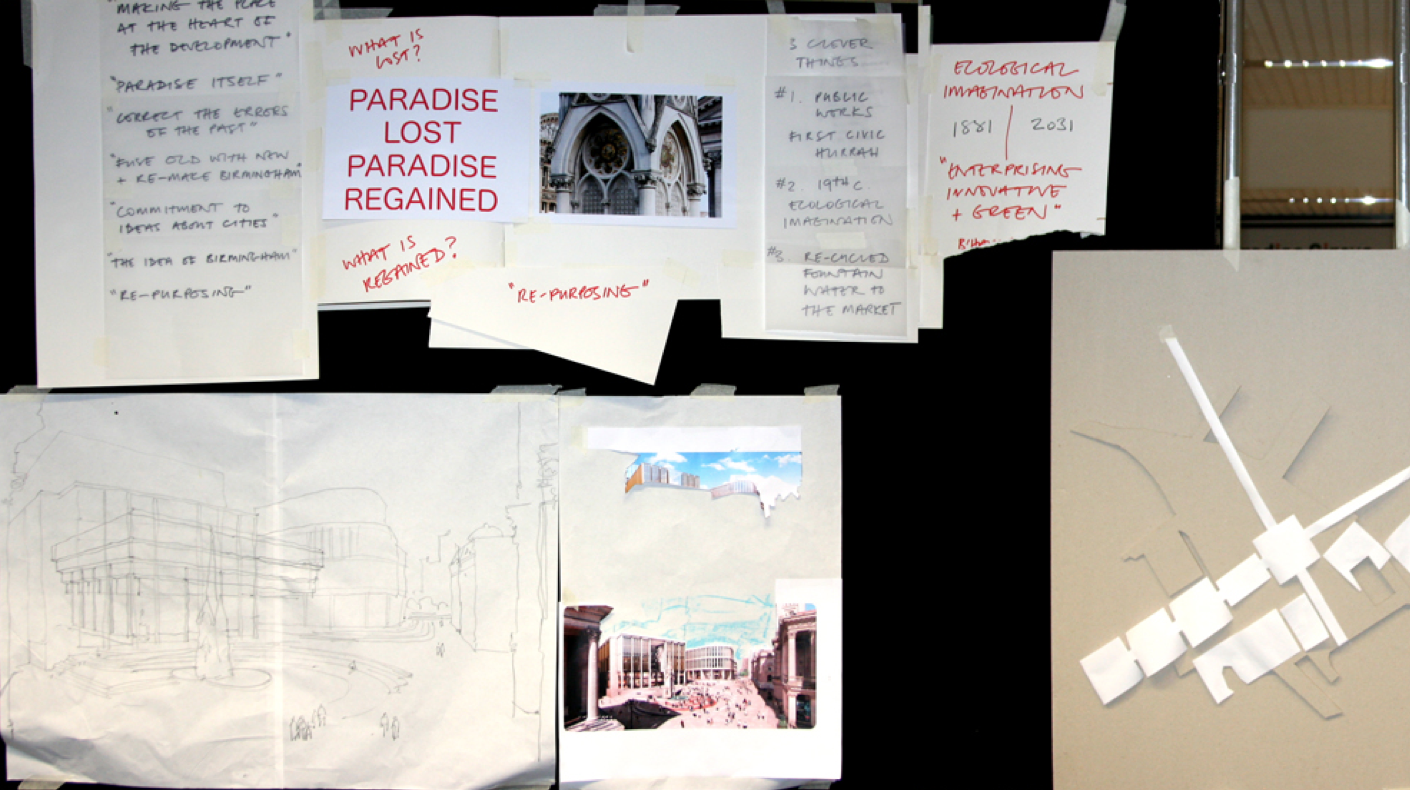
2013 Paradise Circus, Birmingham | Architects’ Journal & Argent Design Charrette
PDF: 2013 Paradise Forum

2017 The Baskerville Society
PDF: Industry & Genius Baskerville Newsletter
PDF: 14.09.2020 Birmingham Building Stone Trails
1991 (& on-going) ‘[small] Monuments’

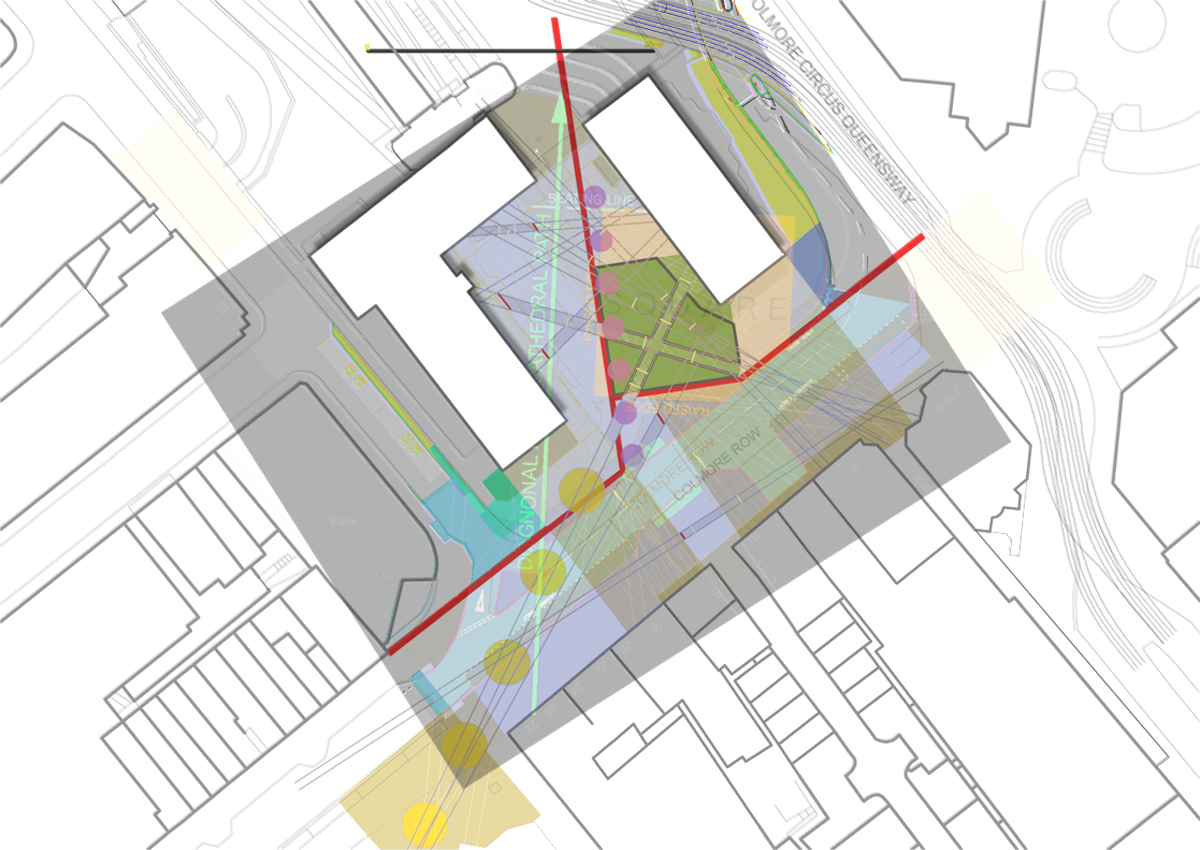
2012 Snow Hill Gateway, Birmingham (Define)
PDF: Snow Hill Red #3
PDF: Snow Hill Stories #6
PDF: enough | Brummagem
2001 Birmingham Public Art Framework
PDF: 2000 Birmingham Welcomes the World

PDF: 2001 Birmingham Public Art Framework (unadopted)
PDF: 2001 Birmingham City Council Public Art | Process
PDF: 2020 artist | place & time
2008-2010 Big City Planners

‘Change a Street Name’ [Big City Planners]
A poetic, speculative intervention in urban planning discourse that blends historical research with artistic provocation and playful interactivity, and which highlights a tension between administrative seriousness and creative re-envisioning. Focused on renaming the streets of a “new bigger and better Birmingham,” the proposal suggests replacing traditional street names—often associated with historical figures or referencing old industrial landmarks—with lines of poetry or evocative phrases to better reflect the city’s modern cultural and demographic identity.
PDF: 2008–2010 Big City Planners
Hermann Broch’s famous “no longer and not yet.” [1984]
PDF: 2018 Berlin | Apollinaire ‘Calligrammes’ 1918
“modern cities inscriptions”
PDF: 2008 Beorma Artists
PDF: 2008 BCU Art–Landscape–Place

PDF: enough | Brummagem
 David Patten