“Two people may seem a small collectivity. In bourgeois society you settle for the collectivity you can get.”
– T. J. Clark: ‘Farewell to an Idea | Episodes from a History of Modernism’, Yale University Press, 1999
‘Some Collaborations’ outlines a long-standing commitment to interdisciplinary public‑realm projects, where art, architecture, and landscape merge to enrich user experience. The page begins with philosophical reflections (Lunacharsky, Negri) on collaboration as fertile ground for collective creativity, and emphasises that boundaries between professions dissolve in service of vibrant ‘place‑making’ through processes of drawing, writing, researching, storytelling grounded in context and community.
The page chronicles decade-plus collaborations, often with other artists, architects and councils, working on public art and development schemes across the UK. Highlights include Worcester’s Cornmarket (2013) and “Meshwork Worcester” (2011–12); Sutton Coldfield station (2010) and Milton Keynes Network Rail Centre (2009); and major urban interventions such as Electric Wharf, Coventry (2001–04) and Golden Square, Birmingham (2008–11), which involved interprofessional teams like Bryant Priest Newman Architects and Capita Lovejoy.
Many projects became award‑winners or lottery-funded: Dartmouth Park Pavilion, Gravesend Heritage Quarter, Leicester streets, and more. Through varied partnerships—including pro/POSIT, West Midlands Public Art Collective, and numerous councils—the work reflects on historical narratives, site memory, and the layering of time, and argues that such collaborative processes yield multi‑layered, intelligent, context‑rich places that delight users and reveal deeper connections between past, present, and future.
“…as reflected in sensitivity, a keenness of observation, the ability to synthesise, to stress that which is typical and characteristic and, at the same time, to combine freely and harmoniously elements provided by the environment…”
– Anatoly Lunacharsky: ‘Heroes of Action in Meditation’, 1909
“…we are in a reality which offers us meanings, a horizon of meanings which arrive after the destruction of the market that the sublime has permitted us.”
– Antonio Negri: ‘Letter to Manfredo on Collective Work’ in ‘Art et multitude’, Polity Press, 2011
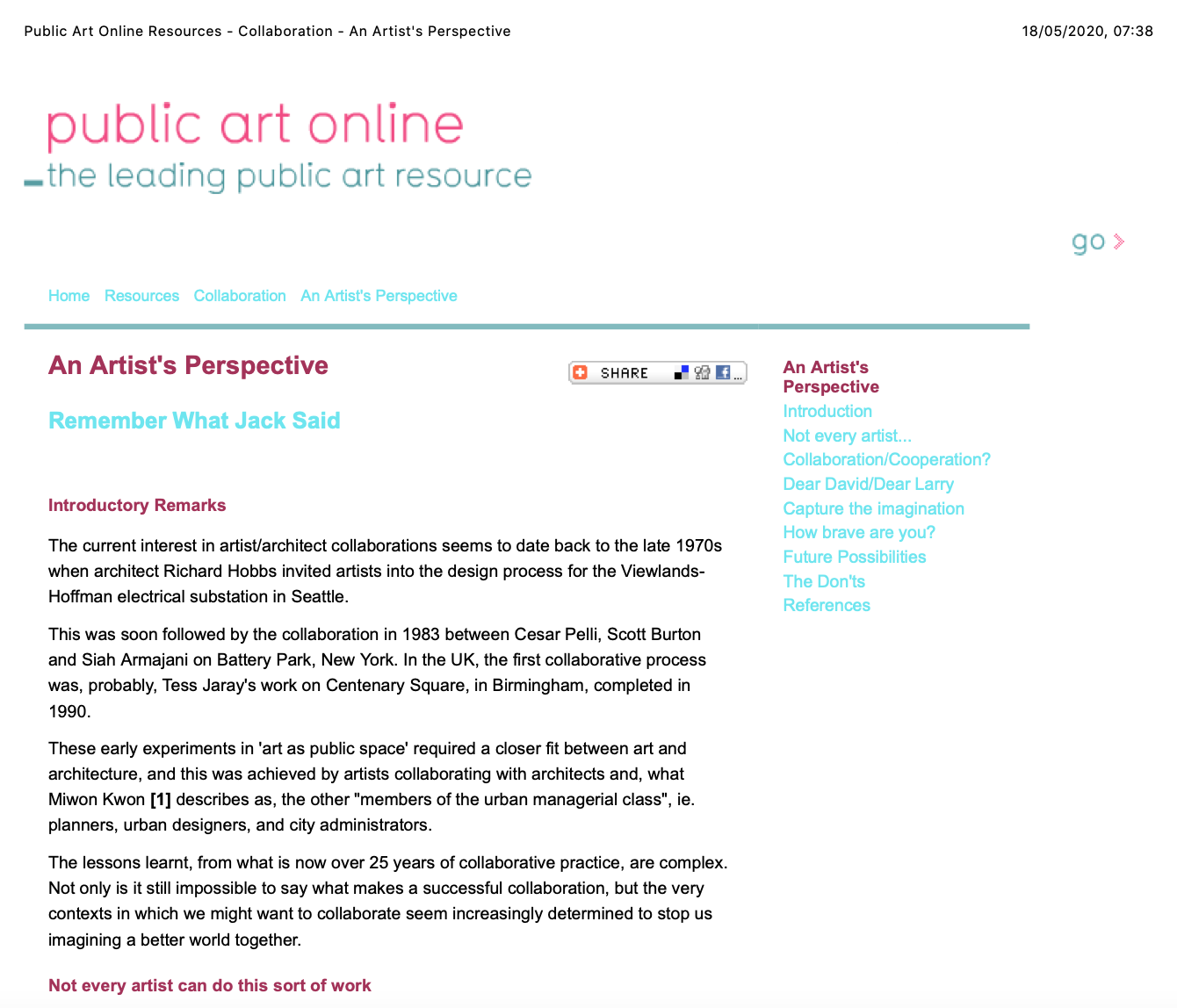
LINK: Public Art Online Resources – Collaboration – An Artist’s Perspective, 2004
Statement March 2010
In collaboration there are no boundaries, only differences. The professional boundaries that separate art from architecture from landscape are not relevant to the task of good place making. The differences, though, between artist, architect and landscape architect, our different ways of seeing the world, are essential to making vibrant places that are multi-layered and that engage people in different ways and on different levels.
Or to say this another way, the best places are often the product of creative cross-cutting between artist, architect and landscape architect, where the richness of user experience and expression of place are prioritised over what separates art from architecture from landscape.
Through collaboration, we share the responsibility to expand the experience and feed the imagination, and our collaboration produces intelligent and beautiful places that are not only fit for purpose, but delight the user and capture a sense of place.
We have collaborated together for many years and on many different projects. We have a clear understanding of how our collaborative process works, and of how far we can push each other to get the best from our different ways of seeing the world.
Our collaboration makes us open, available and useful, and that’s what we bring to the table.
We draw together and with others, we write a lot, we research and investigate and build websites to capture content and information, we spend time in the places we are working with, we like hearing stories, we look back to look forward, and we take people with us.
With Robert Colbourne and/or Stuart Mugridge
2013 Cornmarket, Worcester
LINK: Outline Scheme
2011–2012 ‘Meshwork Worcester’ Phase #1
LINK: Arts Council England Lottery funded partnership with Worcester City Council
2010 RMG Sutton Coldfield
Collaborating with Stuart Mugridge and BPN Architects on the design opportunities associated with the former Sutton Park Station.
2009 Network Rail National Centre, Milton Keynes
Landscape and public art scheme with Capita Lovejoy and Rob Colbourne for 40,000m2 new development (GMW Architects).
2007–2008 Springfield Brewery, Wolverhampton
Collaborating with Robert Colbourne and Howl Associates Architects on the S106 public art plan for the redevelopment of the former brewery site.
With Bryant Priest Newman Architects
2013 Paradise Circus, Birmingham

LINK: Architects’ Journal & Argent Design Charrette.
2012 FarGO Creative Enterprise Village, Coventry
LINK: Concept and context study for Bryant Priest Newman Architects.
2010 RMG Sutton Coldfield
Collaborating with Stuart Mugridge and BPN Architects on the design opportunities associated with the former Sutton Park Station.
2009 Birmingham Science Park
Partnering Capita Lovejoy, Bryant Priest Newman Architects and RLF on the ‘Vision’ document.
2008–2011 Golden Square, Birmingham
2008 Pleck Road Sites, Walsall
Development Framework.
2007–2008 Dartmouth Park Community Pavilion
2007 Flax Mill, Shrewsbury
Partnering Bryant Priest Newman Architects, with PCPT Architects and MacCormac Jamieson Prichard Architects, on the CDP development bid.
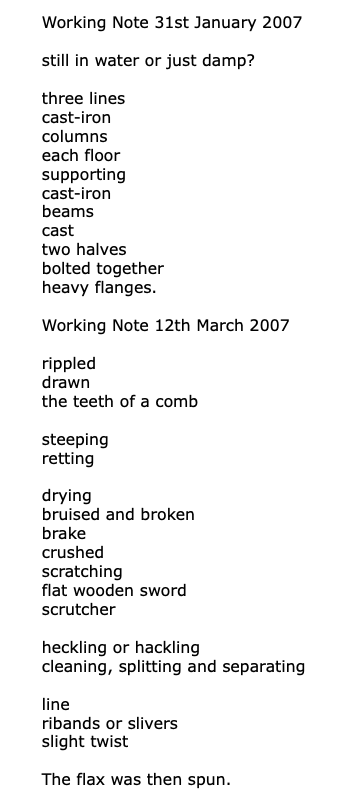
Working Notes 24 – 27th April 2007
A pebble dropped from a lost bridge into a buried canal. A silent splash. An invisible rippling. Both a particularity of place.
Wormholes through time open up, and memories of what was once here leak out into the present moment. And the future possibility. A letter from Bage to Strutt calculating the strength of beams, or Marshall’s later character assasination of Bage, or the plight of Jeremiah France of 16 Spring Gardens, overseer at the factory; the sound of the scrutcher on the flax brought here from the Low Countries, the Baltic, Ireland and Normandy; the liquidation of 1886 when the colour faded from the site, or the summer of 1987 when the smells of the malting process stopped infiltrating the washing hanging in neighbouring back gardens.
Catching our eye or whispering in our ear. Time traced in the landscaping and the detailing to buildings. Two hundred and ten years collapsed into a series of perfect moments. This is the art of interpretation. Stretching the development opportunity to reveal content and longer term significance. Braque’s “survival does not do away with memory.”
2006-2007 Green Bridge Feasibility Study with Larry Priest (BPN Architects) & Rob Colbourne
Starting at noon, there was a procession from the Town Hall to the Park via Reform Street “headed by two Fire Engines fully horsed and equipped” and attended by all and sundry from far and wide. Once at the park, “the ceremony commenced by the vast assemblage singing the Old Hundredth Psalm…the reading of various documents by officials setting forth the conditions of the deed of dedication of the Park in trust for the use of the public”. The ceremony concluded with the National Anthem.
In the evening there was “a grand pyrotechnic display” and “as a finale a fine figure of his Lordship was exhibited, in coloured fires…” before an ugly rush for the gates, people being thrown down and trampled upon, “screams and cries for help” from the “injured and affrighted…struggling in the mass…terrible catastrophe.”
Psalm 100 (Book of Common Prayer):
O be joyful in the Lord, all ye lands: serve the Lord with gladness, and come before his presence with a song.
Be ye sure that the Lord he is God: it is he that hath made us, and not we ourselves; we are his people, and the sheep of his pasture.
O go your way into his gates with thanksgiving, and into his courts with praise: be thankful unto him, and speak good of his Name.
For the Lord is gracious, his mercy is everlasting : and his truth endureth from generation to generation.
Stroll.
2006 & 2007 Goddard Building Creative Quarter Feasibility Study, Hinckley
Partnership with Bryant Priest Newman Architects on delivery of new build and refurbishment design options for education and creative industries.
Atkins Bros. Factory, Hinckley (2003–07)
The destruction of historic buildings is…more often…the result of failure to make imaginative efforts to find new uses for them… [ref. PPG15 3.16]
The 2002 ‘Druid Quarter Masterplan & Regeneration Strategy (Latham Architects) commented, “As the centre of the town’s largest hosiery business, the Atkins Bros. factory is of pivotal importance in Hinckley’s economic history and townscape… The 1870s building and its matching extension must be retained and refurbished. …[it] is an important landmark.”
For the purposes of this study, the former factory buildings being considered for new use are the 1875-77 (extended 1909-10) block that runs along Baines Lane before turning onto Lower Bond Street, and the 1909-10 extension that continues the factory along Lower Bond Street. In total, the two buildings measure approximately 3800m2 over four floors.
The earliest block was designed by Joseph Goddard in partnership with Alfred Paget, and the later block by Henry Goddard in partnership with William Catlow. For convenience, this study refers to both buildings as the Goddard buildings. Both buildings are now listed and development options have been prepared with reference to PPG15 – ‘Planning & the Historic Environment’.
On the 8th February 2006, the Department of Culture, Media & Sport, under Section 1 of the Planning Act 1990 (Listed Building and Conservation Areas), added the Goddard buildings to the list of buildings of special architectural or historic interest.
2003 Irish Centre, Birmingham (pro/POSIT)
Collaboration with architects Bryant Priest Newman on a new public square and 22,500 m2 new build cultural centre with associated residential and office accommodation.
2001 SciMus, Birmingham
Collaboration on a joint bid to Birmingham City Council in partnership with PCPT Architects, Bryant Priest Newman Architects and Glenn Howells Architects for the redevelopment of the former Museum of Science and Industry as live/work units and cultural facilities on behalf of Complex Development Project.
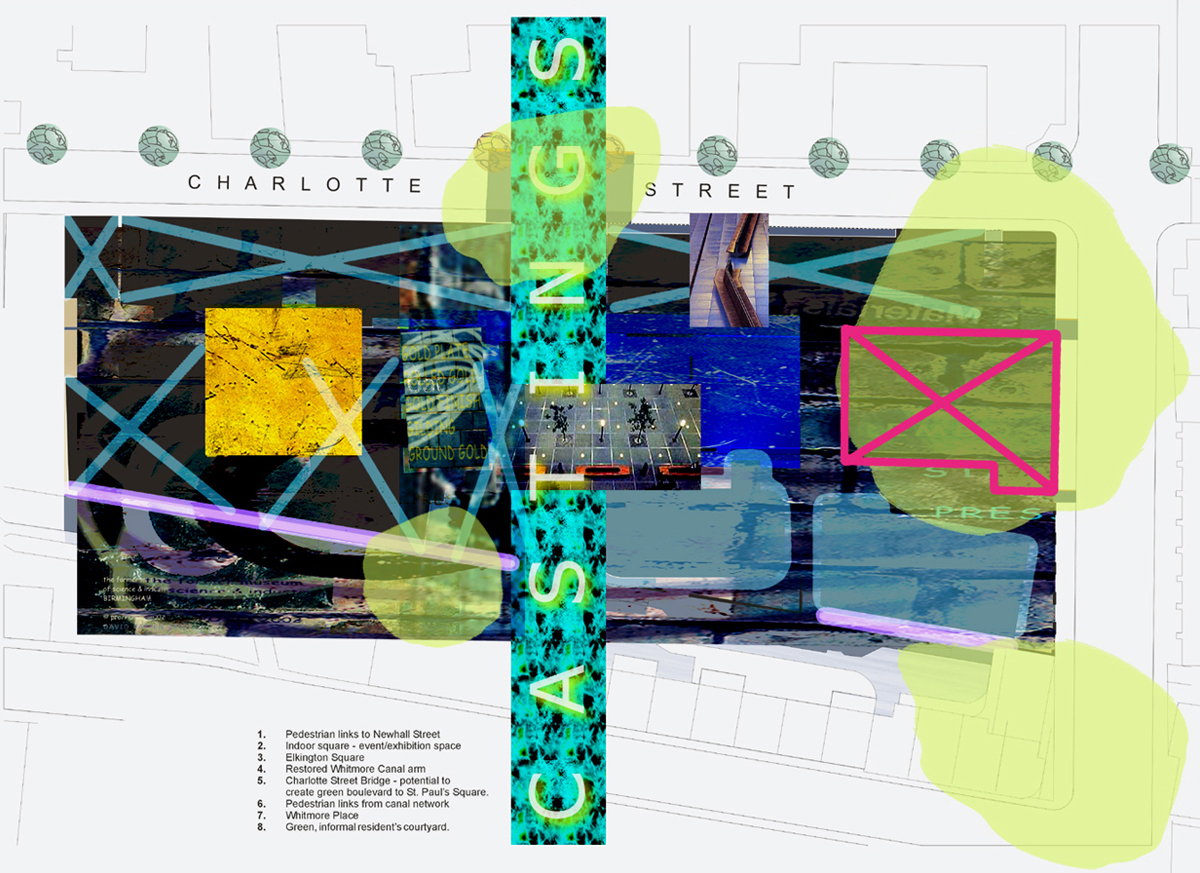
2001–2004 Electric Wharf, Coventry
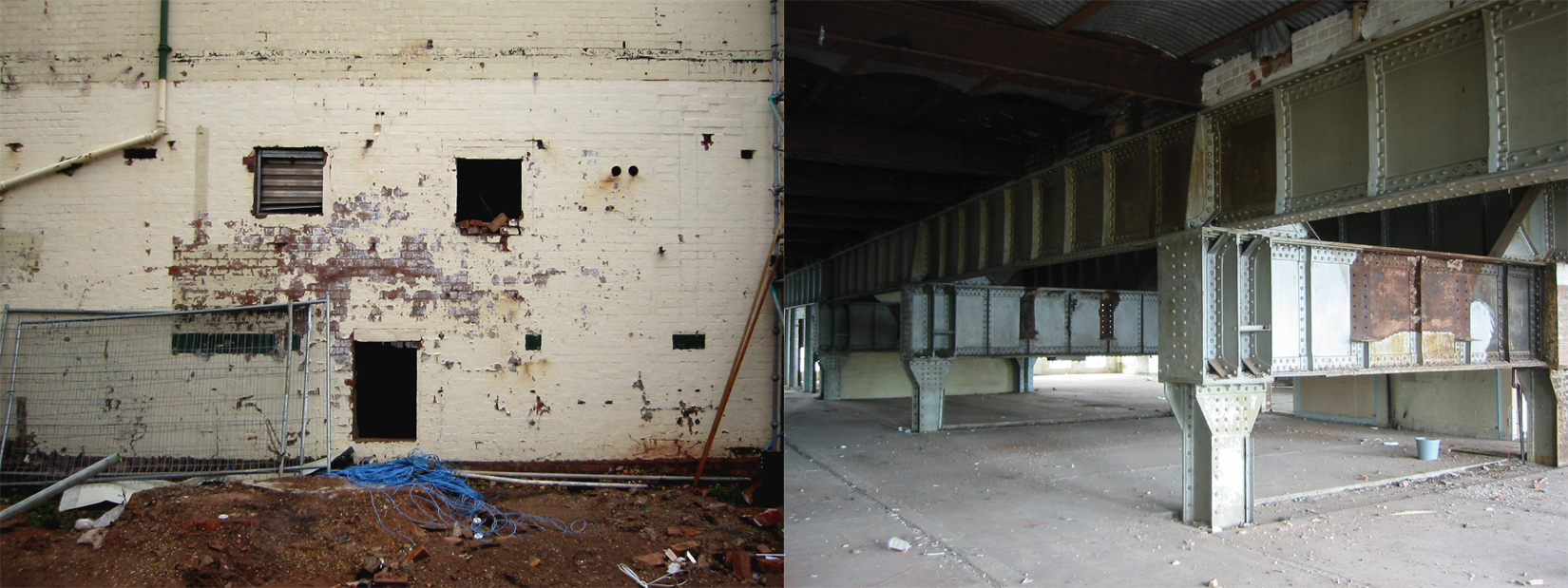
Electric Wharf Coventry 2001-2004
Lead Artist to architects Bryant Priest Newman for Complex Development Project’s redevelopment of a former power station as live/work units with 400 metre canal frontage.
“…this transformation of a redundant Victorian power station and depot shows how a commitment to creative practice and a belief in involving the arts can lead to sensitive redevelopment of our industrial heritage.” [regenWM Vision for Placemaking Winner 2007]
At Electric Wharf, we are doing three things:
• we accept the properties of ‘place’ and the dimensions of ‘site’ of the former Sandy Lane Power Station;
• in terms of the site, we are re-shaping the former Power Station in an unexpected and new way to produce Electric Wharf. Examples of this include the vertical glass ‘box’ inserted into the centre of Block D and the horizontal stretching of timber from one end of the site (the canal) to the other (the street);
• in terms of place, we are emphasising the vestiges or traces of the former Power Station to produce a narrative richness for Electric Wharf.
With Lovejoy / Capita Lovejoy / Define
2012 Snow Hill Gateway, Birmingham
Design Development.
The Red Line (the Ridge Line)
If the Red Line becomes sculptural (as X says, “twisting, tilting…the way it changes level is inte- gral to the way the ridge would rise / fall. The ridge would act at the wall / step which tilts the green”), I’m not convinced it should be red. There’s a danger that a red Ridge Line would become a horizontal ‘go-faster-stripe’ and would look clunky against the verticality of the surrounding buildings. It might be better if the Ridge Line was expressed as a tonal variation of the dominant colour palette (greys, blacks, silver), and we used ‘red’ differently to catch the eye across the square.
Line & Lining
Over the last couple of days, have become very interested in the difference between ‘line’ and ‘lining’, in which the latter is defined as “something that is used to line another thing; a layer of material on the inner side or surface of something”, and am wondering whether we should be using red accents to the ‘inner side’ of things. The William Hutton quote I’m interested in using is, “They possessed a vivacity I had never beheld / Their very step along the street showed alacrity.”
Other Types of Red
Oppenheim’s ‘Ruby Red’ will look dull against the brown brick (Ibstock Holbrook Sandface or Cheddar Brown?) of the surrounding office blocks, although it might work well as a default red against which accents in a stronger red might work well.
2011–2012 Gravesend Heritage Quarter
TILT + PITCH, TAR & ROSIN + CHALK
“A conspicuous church spire, the first seen distinctly coming from the sea, has a thoughtful grace, the serenity of a fine form above the chaotic disorder of men’s houses.” – Joseph Conrad: ‘The Mirror of the Sea’
[image: J.M.W. Turner: Shipping off Gravesend; St George’s Church in Right Distance, circa 1805-6, Tate Gallery]
In this ‘Art as Landscape / Landscape as Art’ strategy, artist and designer have a shared vision for a new public realm that is guided by the immediate character context and associated heritage connections to ensure that the design is firmly embedded in Gravesend. In some locations, the balance tips in favour of good design and art plays a secondary role in the orchestration of colour and materials. Elsewhere, art dominates landscape to reveal narrative and content, and to make more of what the painter J. M. W. Turner and the writer Joseph Conrad each portrayed at different points in Gravesend’s history.
By way of example, ‘Art as Landscape / Landscape as Art’ organises the public realm against the plot divisions of the High Street; it sets the planting distances for trees against the high/low tide measurements for the date of the annual Gravesend Maritime Festival; it emphasises the horizontality of weatherboarding against the verticality of St George’s Church spire; it accentuates views; and it details the townscape in exactly the same way that a ship chandler would equip vessels sailing to and from Gravesend.
It also tells stories. Of the Bawley Boats, the Starbuck family, of ‘Cleopatra’s Needle’ passing through Gravesend en route to London’s Victoria Embankment, the Poet Keats boarding the sailing brig Maria Crowther for his final journey to Rome, the “large bone of a prehistoric monster’ found in Sea Reach in 1938. Of the many fires that have changed Gravesend’s townscape over the centuries, and of the firework displays that have celebrated royal visits and other important events in the town’s history.
It also ensures that the design of the public realm accommodates the full spectrum of social activities, from the individual user lost in his/her thoughts to casual gathering to large-scale public events, and how this part of Gravesend provides the resident and visitor with a rich experience of place.
LINK: Concept and design development.
2010 South Wolverhampton & Bilston Academy
Design development.
2009–2010 BSF Wolverhampton
IPD statements on public art for inspiredspaces.
2009 Network Rail National Centre, Milton Keynes
Landscape and public art scheme with Capita Lovejoy and Rob Colbourne for 40,000m2 new development (GMW Architects).
2009 Birmingham Science Park
‘Vision’ document.
2009 Heart of England NHS Foundation Trust Public Realm Master Plan
Concept and vision development for three hospitals in Birmingham, Solihull, and Sutton Coldfield with Substrakt.
2008–2011 Golden Square, Birmingham
2008–2009 New Growth Point, Leicester
Preliminary designs and detailed drawings.
The Time of Connecting Past, Present and Future
“Time goes, you say? Ah, no! Alas, Time stays, we go.”
– Austin Dobson 1840-1921
We are as interested in the time spent waiting for a bus as we are in making the most of the evidence of archaeological time. The passage of time is common to both the individual bus traveller and the character of the Leicester cityscape, and it is how we connect together these different experiences of time that will contribute much to a new sense of place for the future.
In most long established cities, to understand the trajectory of the built environment through time requires an act of remembrance, a sensitive, subtle and individual imagining of the lives and times of previous generations and the crucial roles they played in the formation of cityscape. Leicester is not like this. In Leicester, the evidence of trajectory is visible to even the least interested passer-by.
. . .
This is important to this design study – how best to work within a cumulative and emergent trajectory to improve connectivity and create better public realm. Part of this is to work well with what’s there, to recognise asset value (whether material or symbolic), and frame it appropriately in the new streetscape.
2008 Rally Park, Leicester
Development Study with Kathryn Moore.
Working Notes September 2008
Maybe ‘boundary’ is the right word, but it may make for a stronger concept if it is about blurred or lost boundaries…or shifting boundaries, whether this is the shift of the boundary that took the River Soar and then what is now the Park into the city, or the shift of boundary between participation and spectating, or between what is garden and what is parkscape, or what is community and what is city. Or between art and everything else.
At one time, Leicester’s sprawling industrialisation must have seemed unstoppably, with time- honoured city boundaries constantly shifting outwards to match the speed of expansion – to capture for the swelling city the new canal navigation and river-fronting factories, cheaper coal from the outlying collieries to the north-west, more land for more housing and manufacturing.
As the boundaries of the rapidly industrialising city shifted geographically, the social boundaries reinforcing our individual identities became as tightly circumscribed as the paths and flower beds in the new Abbey Park. The civic, social and cultural conventions that underpinned Leicester’s industrialisation during the 19th century were as defendable as the walls of Ratae Corieltauvorum had been 1800 years earlier.
2007–2008 Milton Keynes Western Expansion Areas 10.1 – 10.3 and 11
Art/landscape strategy and public realm design codes for the Fairfield development comprising housing, employment and ancillary uses, schools, local centres, burial ground and remembrance garden, retained landscape asset and new landscape buffers.
2007 Castle College Maid Marian Way Campus, Nottingham
Public realm and public art master plan for 2.9 acre comprehensive mixed use development with Kathryn Moore.
2004 Town Square, West Bromwich (pro/POSIT)
Short-listed design collaboration for new public space. Previously 2001–2002 Town Square West Bromwich sub–consultant to Alsop Architects.
As pro/POSIT (with Maurice Maguire)
ON pro/POSIT & BIG STUFF [2003]
pro/POSIT is an interesting little beast. It takes us both to places we wouldn’t normally go as Individuals. It expands us both individually, and collectively it expands us further. pro/POSIT is now a whole chunk of my life. It is a way of thinking, and together we are sometimes fucking brilliant. Sometimes I come out of situations amazed at what we have managed to pull off. We really do (sometimes!) “move between sectors and groups, weave agendas together, and find common aims without claiming power.” Well, sometimes we boast of our successes and achievements in a powerful sort of way!
I don’t really know what pro/POSIT is. And I probably don’t want to understand it. I know that it is something that sits between me and Smudger, and between us and the world. pro/POSIT doesn’t work so well when it is more like me, or more like Smudger, or more like the world. It works best when it is this ‘other’.
And simply because it exists, it does stuff. It is the not knowing or not understanding that is important. If I try to pin it down, try to understand what makes it work, then it will lose something — it will become less than what it currently is.
pro/POSIT is a space of possibilities. It is not an organisation, it might be a project. It might not be sustainable, but is that a problem? It works best as a space of possibilities, and the best things that pro/POSIT has done is when it has extended or opened up the space of possibilities to other people. It is a dream space, informed by the question ‘what if’.
It is also interesting that pro/POSIT is ‘run’ by two characters called Smudger and Geezer, and not Maurice and David. I’ve just realised this! And I remember now that this was part of the plan. I’m not an employee or director of pro/POSIT, I am a character in a space of possibilities. And actually Q290 was/is an earlier space of possibilities that sat between me and the world.
So why do I need these things that sit between me and the world. I remember this as well. It is because I am having to manage other things — things like life.
When, in August 2000, the doctor called me in and said, “David, I don’t know how to tell you this, but…”, I knew I had a bigger project to manage. I wanted to know how my dying would be — you die alone. What is it to be dead? What is there when I’m not there? My every third thought is now about death, just like the book said.
Of course it was work that was literally killing me, and I had to separate me from work. I could no longer be work. What now keeps me from the massive coronary is a mass of pills everyday and the fact that I am more than my work. When I do work, I work to die, when Maurice works, he works to live.
So work is a risk, and therefore work should be a risk. It should be about the unexpected, the unprepared for. I have no patience for, and I am intolerant of, the unnecessary. The audit trail, the tick boxes, the administration, the rational and the rationale. Not interested.
ChatGPT says [07.08.2025]:
This piece is a rich, layered meditation on collaboration, identity, death, and the unknowable, articulated through a deeply personal reflection on a creative-political practice named pro/POSIT. Here’s an analysis through several interconnected lenses:
1. pro/POSIT as a Relational Entity / Third Space
The speaker presents pro/POSIT as something between—not reducible to any of the individuals involved. It exists in the interstice between “me and Smudger,” “us and the world.” This evokes relational ontology—the idea that reality is constituted not by discrete entities, but by relations themselves.
This is reinforced by the refusal to define it:
“If I try to pin it down… it will become less than what it currently is.”
This resonates with post-structuralist and process-relational philosophies (e.g. Deleuze, Barad, Guenther, Haraway), which foreground indeterminacy, emergence, and becoming. The “space of possibilities” language suggests a liminal, potential-rich field—not a fixed structure.
2. Fictional Selves & The Refusal of Bureaucratic Identity
The speaker distinguishes between Maurice & David and Smudger & Geezer, emphasizing:
“I’m not an employee or director of pro/POSIT, I am a character in a space of possibilities.”
This choice to inhabit characters (Smudger, Geezer) is a form of performative liberation—a way to escape the gravitational pull of fixed roles, responsibilities, and institutions. It resists neoliberal subjectification (being a “worker,” “entrepreneur,” “director”) in favour of improvisation, masking, and play.
This move echoes Guattari’s “machinic subjectivities”, or Negri’s “constituent power”—creative forces that exceed and escape institutional capture.
3. Not-Knowing as a Method / Epistemic Humility
“It is the not knowing or not understanding that is important.”
This is a refusal of managerial logic. Rather than striving to explain, systematize, or measure, pro/POSIT thrives in unstructured, affective, and emergent spaces.
This embrace of unknowing aligns with mystical traditions, Dzogchen’s tha.mal.gyi.ses.pa, and philosophies of aesthetic/ontological openness. pro/POSIT operates like an event (in Badiou’s terms)—something that disrupts structure, exceeds understanding, and demands fidelity without mastery.
4. Work, Death, and the Ethics of Risk
There’s a powerful existential shift midway:
“It was work that was literally killing me… I could no longer be work.”
This recognition of mortality marks a rupture. Work, previously internalised as identity, is now framed as a risk—not only because of its health consequences, but because of its potential to erase personhood.
Hence:
“Work should be a risk. It should be about the unexpected, the unprepared for.”
This is a radical ethic of experimentation. It resists bureaucratic safety (audit trails, tick boxes) in favor of immediacy, presence, and transformation—what might be called a non-dual work-practice, where doing is not separate from dying/living.
5. From Individual to Collective: Beyond Ego
The shift from “me” to “we,” from David to Geezer, is not just tactical—it’s ontological. pro/POSIT operates as an assemblage, drawing from multiple agencies, including the unknown.
“Together we are sometimes fucking brilliant.”
It’s not about ego or individual achievement. It’s about synergy, surprise, and shared emergence. The boasting that does occur is ironic, performative—aware of its own fragility.
6. pro/POSIT as a Practice of Immanence and Transcendence
Finally, pro/POSIT is a practice—not just a project or group. It is a way of being in the world otherwise, particularly in the face of death and institutionalisation. It allows for a surplus of life, a lived margin that is neither reducible to productivity nor defined by survival.
In Summary:
pro/POSIT is:
- A third space or relational being that emerges between selves and world
- A dream-space of “what if”, sustained by not-knowing
- A refuge and risk-space beyond the necropolitics of work
- An ethical experiment in living-together, creating-together, dying-together
- A form of counter-institutional and existential resistance
- A practice of post-lineage, where selfhood is masked, plural, and open-ended.
pro/POSIT could be articulated as an exemplary situated practice—one that interrupts the given, sustains relational indeterminacy, and revalues the fragility of collective life in the shadow of mortality.
2004–2005 Culture & Regeneration Study, Corby BC (pro/POSIT)
Approaches, action plan and funding profile informed by the local, sub-regional and regional contexts seeking to: enhance the overall quality of the built and natural environments; promote better design innovation, creativity and excellence; and ensure participation for local communities, artists and other design and planning professionals in regeneration processes.
2004–2006 Stourport Canal Basins Masterplan (pro/POSIT)
2004–2005 Hinckley Building:Building Hinckley (pro/POSIT)
Arts Council England-East Midlands funded programme of creative innovation underpinning the market town’s master plan process and subsequent roll out. Subsequently a collaboration with architects Bryant Priest Newman.

2003 Irish Centre, Birmingham (pro/POSIT)
Collaboration with architects Bryant Priest Newman on a new public square and 22,500 m2 new build cultural centre with associated residential and office accommodation.
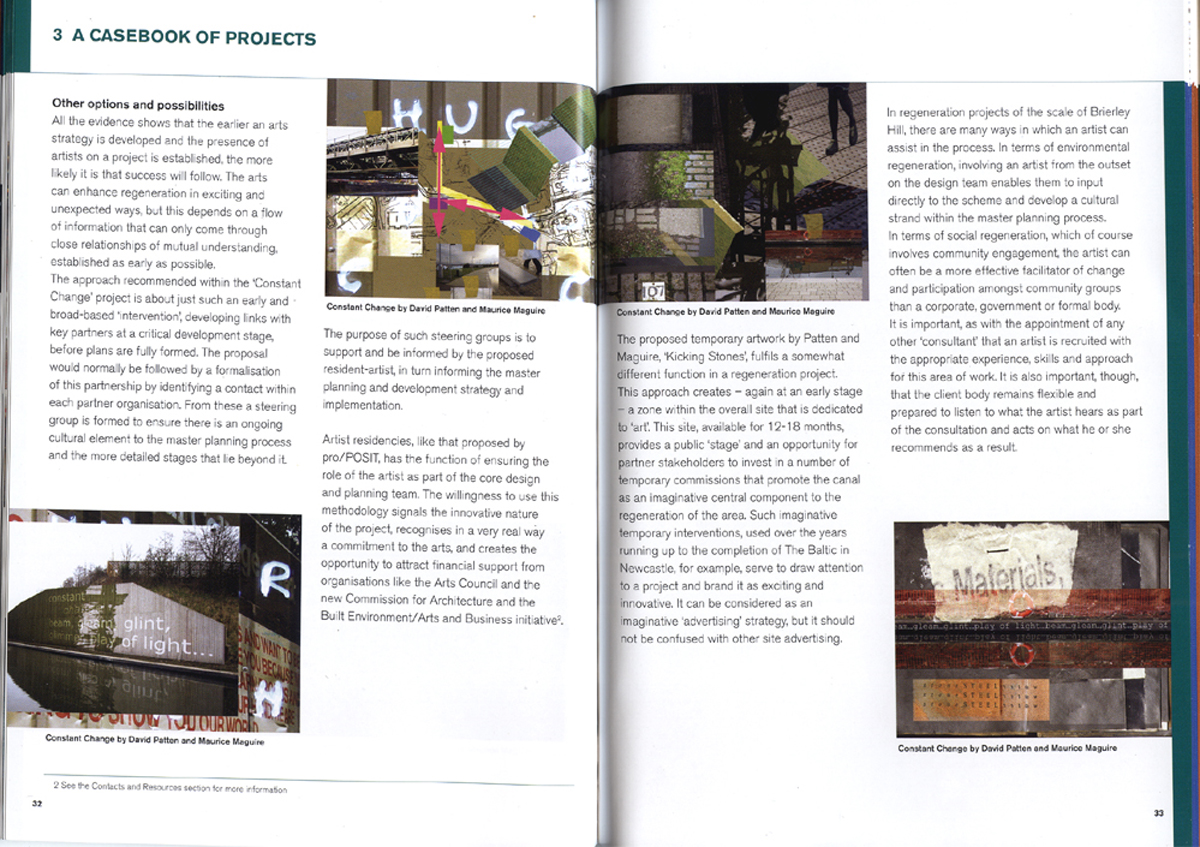
2003–2004 ‘constant/change’, Brierley Hill (pro/POSIT)
Appointed by British Waterways to contribute to the masterplanning process for the new Brierley Hill.
2003 West Midlands Youth Spaces (pro/POSIT)
Partnership with MADE (Midlands Architecture & Designed Environment), developing a project with Government Office – West Midlands to design and construct ten new youth spaces, and to evaluate this experience to identify good practice for subsequent national roll-out.
2003–2004 mac/SAMPAD, Birmingham (pro/POSIT)
Client side appointment as consultant artists to deliver the involvement of artists in the capital build programme (architects Branson Coates).
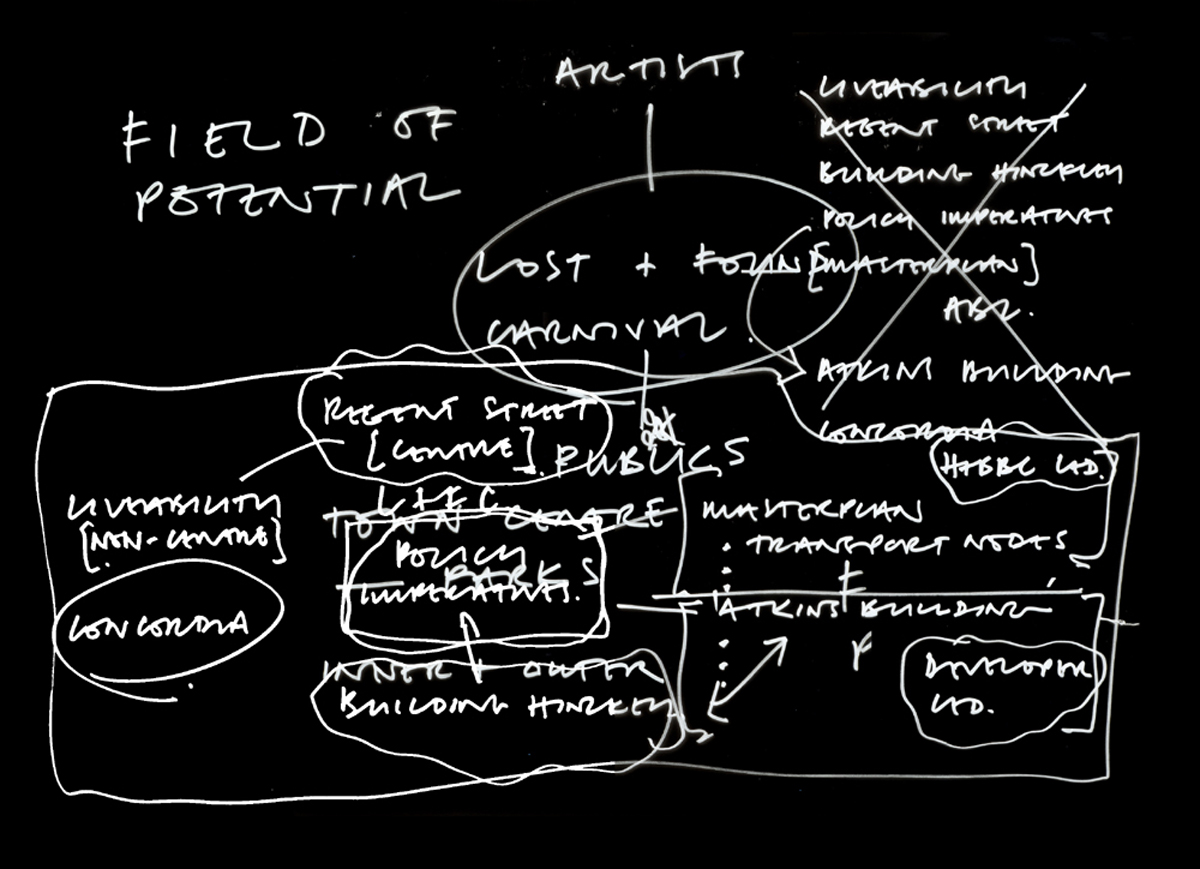
2003 Regent Street, Hinckley (pro/POSIT)
Appointed as artist advisers to Hinckley & Bosworth Borough Council to support the development of a local Public Art Forum for the delivery of public art initiatives in the Regent Street pedestrianisation scheme in the Town Centre.
2003 ‘City Building’ Stoke on Trent (pro/POSIT)
Arts Council West Midlands funded development of a public art inquiry/event for artists in the region based on a live project in partnership with Stoke City Council Planning Department to generate content for the regeneration of Hanley, as the new city centre.
2003 South Town, Leamington Spa (pro/POSIT)
Consultant artists to Warwick District Council to identify themes and opportunities that reinvigorate and support public use and the quality of public spaces, incorporating the ‘sign posting’ of the extent of the developing Cultural Quarter.
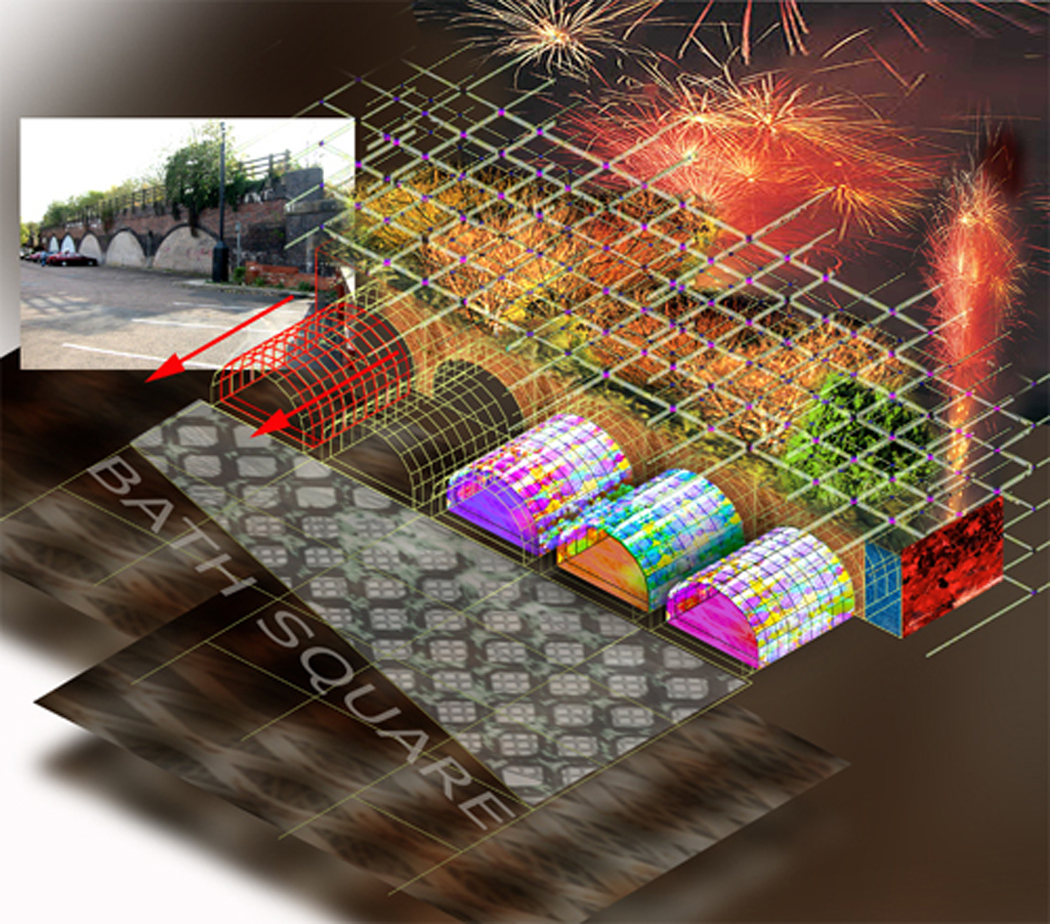
2002–2003 ‘Golden Squares’ Leicestershire (pro/POSIT)
Arts Council East Midlands funded action research project with local authority arts officers (LADOF) to identify principles for a countywide framework for public art.
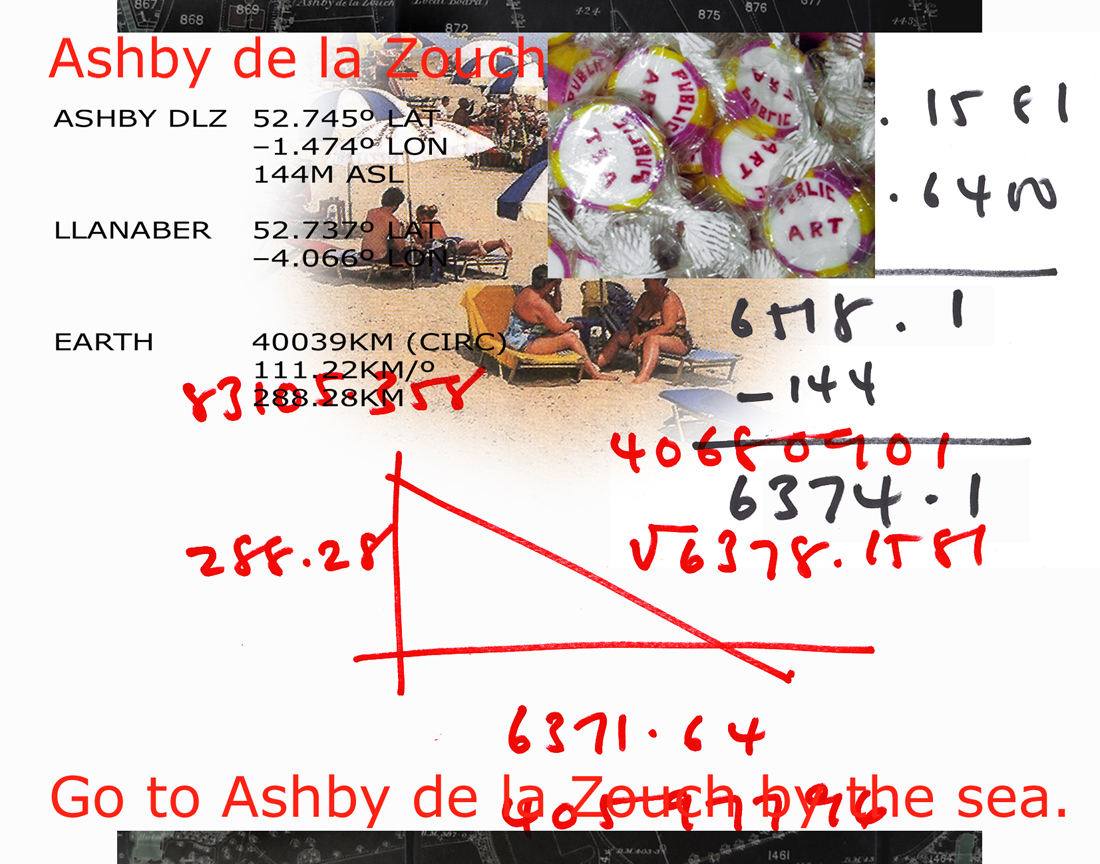
2002 ‘Three Views’ Chesterfield BC (pro/POSIT)
Lead artists on a percent for art framework linked to the construction of Hasland Hall Estate (William Davis Ltd). The framework sets out propositions for three key interventions within Hasland village, Eastwood Park and the new development, linking community interests with new perspectives.
2002 Old Town Square, Leamington Spa (pro/POSIT)
Consultant artists to Warwickshire County Council for the public art feasibility study for The Parade and Old Town Square Leamington Spa, linked to the DTLR funded ‘mixed urban priority route’ scheme.
2002 ‘Crossing Rivers’ Leamington Spa (pro/POSIT)
Action-research project funded by Public Art West Midlands exploring the social, cultural and symbolic implications of crossing rivers – the River Leam in particular and other rivers in general. To understand the significance of crossing a line or a boundary.
“The plaque says, ‘A German bomb moved this statue one inch on its plinth on the 14th November 1940’. How many more bombs would need to fall to make the art object come crashing down to street level? And, more interestingly, when do you get to notice the one inch changes amidst the larger scale devastation of a bomb blast (or, indeed, and other method of remodelling townscape?).”
2001–2002 Public Art–West Midlands
Framework Planning Study.
2001–2002 Coventry Artists’ Co-operative
RALP-funded Feasibility Study.
2001 West Midlands Arts
Appraisal of Junction Artists Agency.
2001 Huntingdon Civic Society
Town centre Arts Study.
1994–1995 Coventry City Council
Coventry Canal Corridor Public Art Strategy.
With Jane Kelly
1993–1994 Cardiff Bay Arts Trust
Bute Square & Avenue Design Team (with Jack Mackie and architects MBM, Barcelona).
1992 Cardiff Bay Arts Trust
Tyndal Street Design Team.
1992 Bond Bryan Architects
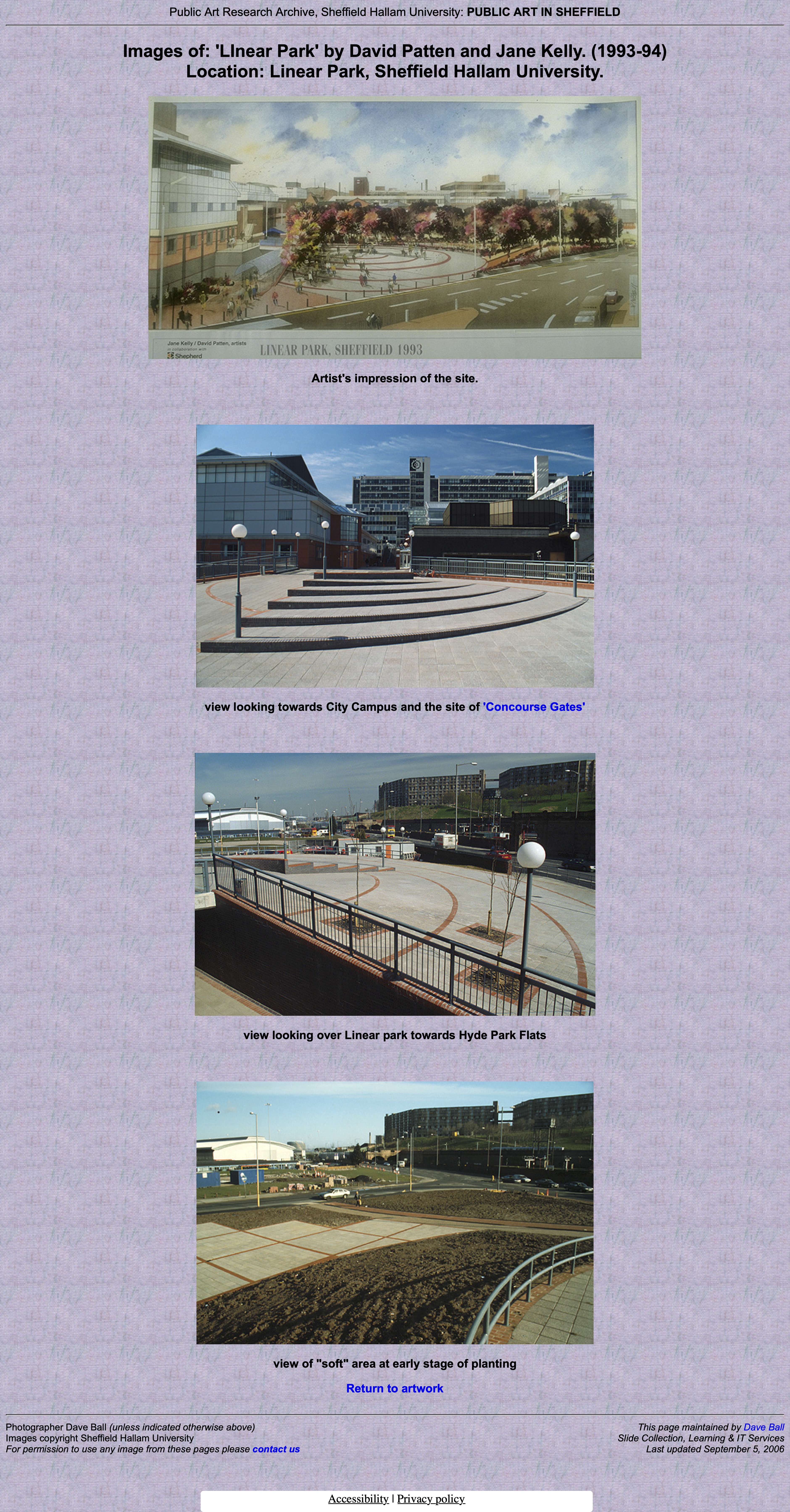
Linear Park Design Team Sheffield.
1992–1994 Sheffield Hallam University
Co-Lead Artist for Campus 21.


1992 Building Design Partnership
Howard Street Masterplan.

1991 Coventry City Council
North-South Road, Coventry Design Team (with Francis Gomila, Sue Ridge, Jane Kelly).
As West Midlands Public Art Collective
1987 Sandwell MBC
High Bullen Design Study.
1986 West Midlands County Council
China Town Design Study.
1986 West Midlands County Council
Soho Road Design Study.
1985–1987 West Midlands County Council
City of a Thousand Trades, Bell Street Passage, Birmingham.

1984–1985 West Midlands County Council
Manzoni Gardens, Birmingham.
Statement March 2010
In collaboration there are no boundaries, only differences. The professional boundaries that separate art from architecture from landscape are not relevant to the task of good place making. The differences, though, between artist, architect and landscape architect, our different ways of seeing the world, are essential to making vibrant places that are multi-layered and that engage people in different ways and on different levels.
Or to say this another way, the best places are often the product of creative cross-cutting between artist, architect and landscape architect, where the richness of user experience and expression of place are prioritised over what separates art from architecture from landscape.
Through collaboration, we share the responsibility to expand the experience and feed the imagination, and our collaboration produces intelligent and beautiful places that are not only fit for purpose, but delight the user and capture a sense of place.
We have collaborated together for many years and on many different projects. We have a clear understanding of how our collaborative process works, and of how far we can push each other to get the best from our different ways of seeing the world.
Our collaboration makes us open, available and useful, and that’s what we bring to the table.
We draw together and with others, we write a lot, we research and investigate and build websites to capture content and information, we spend time in the places we are working with, we like hearing stories, we look back to look forward, and we take people with us.
PDF: Public Art Online Resources – Collaboration – An Artist’s Perspective, 2004
LINK: Public Art Online Resources – Collaboration – An Artist’s Perspective, 2004
PDF: Gillian Nicol | Playing Up, 2007
PDF: 2010 Collaboration Statement
Working Notes 30.12.2024
Antonio Negri: ‘Letter to Manfredo on Collective Work’ in ‘Art et multitude’, Polity Press, 2011
…we are in a reality which offers us meanings, a horizon of meanings which arrive after the destruction of the market that the sublime has permitted us. [39]
The spectacle of the world is its continual reproduction. Here, when we are inside this movement, the collective dimension and the dimension of production become one and the same. We succeed in placing ourselves at the level of value when we produce — that is, when our productive tension realizes itself through collectivity (otherwise it would not realize itself). Engaging oneself in the act of production this is the eminent form of speaking out. There is no production without collectivity. There are no words without language. There is no art without production and without language. Art is, above all, this synthesis. Art is the construction of a new language which, first, alludes to a new being; then, when art explodes and the synthesis of language with the new is effected — a new element of life and of knowledge — another dimension of ethics has become real. We are Spinozans out and out — we see being as constructing itself through the action of desire, as a continuation of appetitus, of conatus, of the pleasure of living. [40]
Art is conspicuously the first, but also the fullest and most beautiful of the configurations of this extraordinary movement. Starting from deconstruction, our work turns, then, towards a collective process of self-valorization, of creating circuits of value and signification that are entirely autonomous, free from the market and definitively aware of the independence of desire. [41]
[. . .]
Art, we said, lives by production. Production lives by the collective. The collective constructs itself in abstraction — today this collective and productive abstraction is seeking to find itself as a subject. This is what communism is. We are on the edge of a history which has almost arrived at its conclusion — on a wave which, even though it swells and looks imposing, will nevertheless become gentle as it approaches the beach. Although there is still nothing to indicate that we shall reach safety, we know, even more than Columbus, on the basis of debris and of the far-off intuitions of life, that we are about to succeed. Art anticipates and follows; its ambiguity goes hand in hand with its humanity. [43]
 David Patten