Wikipedia Version #4 | 05.09.2025
West Midlands Public Art Collective
Working Space 2025
The West Midlands Public Art Collective (WMPAC) was active in Birmingham, England, between 1984 and 1987, and became known for its collaborative approach to place-specific public art. Its work reflected broader shifts in British cultural policy during the 1980s that intersected with contemporary cultural debates about the role of art in shaping society.
History
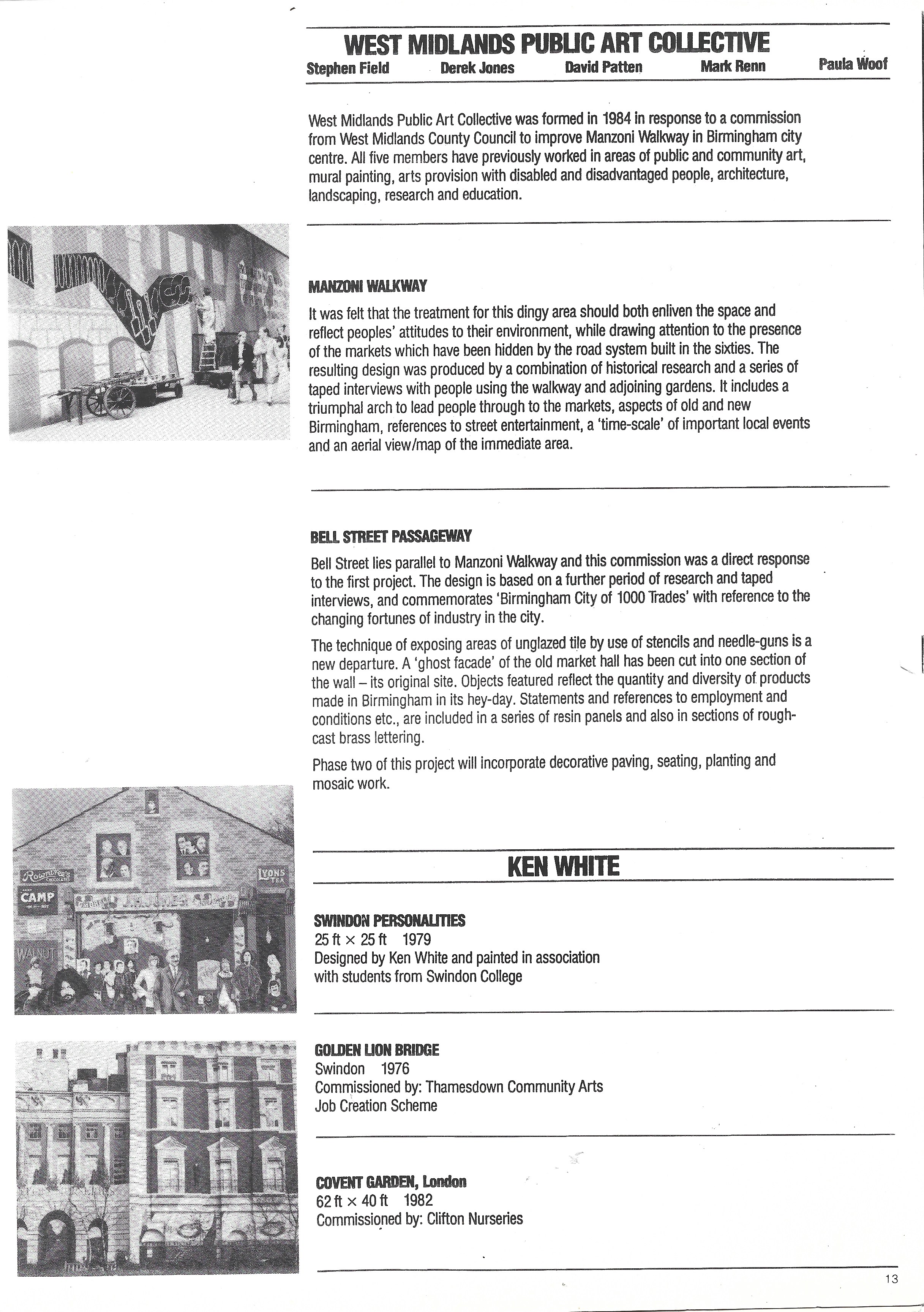
West Midlands Public Art Collective (WMPAC) was initially formed in 1984 in response to a commission opportunity (managed through the regional art association, West Midlands Arts) for a site in Birmingham city centre owned by West Midlands County Council. Its founding members were: Steve Field [https://en.wikipedia.org/wiki/Steve_Field_(sculptor)], Derek Jones [https://axisweb.org/artist/derekjones], David Patten [https://publicartonline.org.uk/casestudies/regeneration/electric_wharf/biog_patten.php.html], Mark Renn [https://en.wikipedia.org/wiki/Mark_Renn], and Paula Woof [https://en.wikipedia.org/wiki/Paula_Woof].
West Midlands Public Art Collective (WMPAC) exemplified the shifting landscape of UK public art policy in the 1980s and 1990s, particularly in terms of cultural democracy, regionalism, and urban regeneration. As a response to a growing interest in public art that reflected local identities, community voices, and post-industrial urban renewal in Birmingham and the wider West Midlands region, it was an early example of the development of essential infrastructure for public art practice.
Activities
WMPAC’s activities included:
- core group commissions;
- sub-contracted commissions to other artists;
- design strategies and master plans for the County Council;
- a Public Art Centre that accommodated artists’ studios, an exhibition space, and which hosted a regional ‘Art, Architecture and Landscape Group’;
- a range of exhibition and event-based initiatives, including ‘Artists-in-Public’.
The group worked with planners, architects, housing associations, schools, and local residents. Their projects were often integrated into architectural and infrastructural settings.
Notable Works
The Collective’s core commissions included City of a Thousand Trades a relief mural for Bell Street Passage in Birmingham installed in 1987 and now lost, which was a pivotal example of how artists responded to evolving public art policy by producing inclusive, public-oriented, and regeneration-aligned artworks within the broader context of post-Industrial urban regeneration and related cultural policy in the UK during that period.
WMPAC also produced early design studies and public art proposals for areas including Birmingham’s Soho Road and Chinatown areas, and subway schemes in Sandwell.
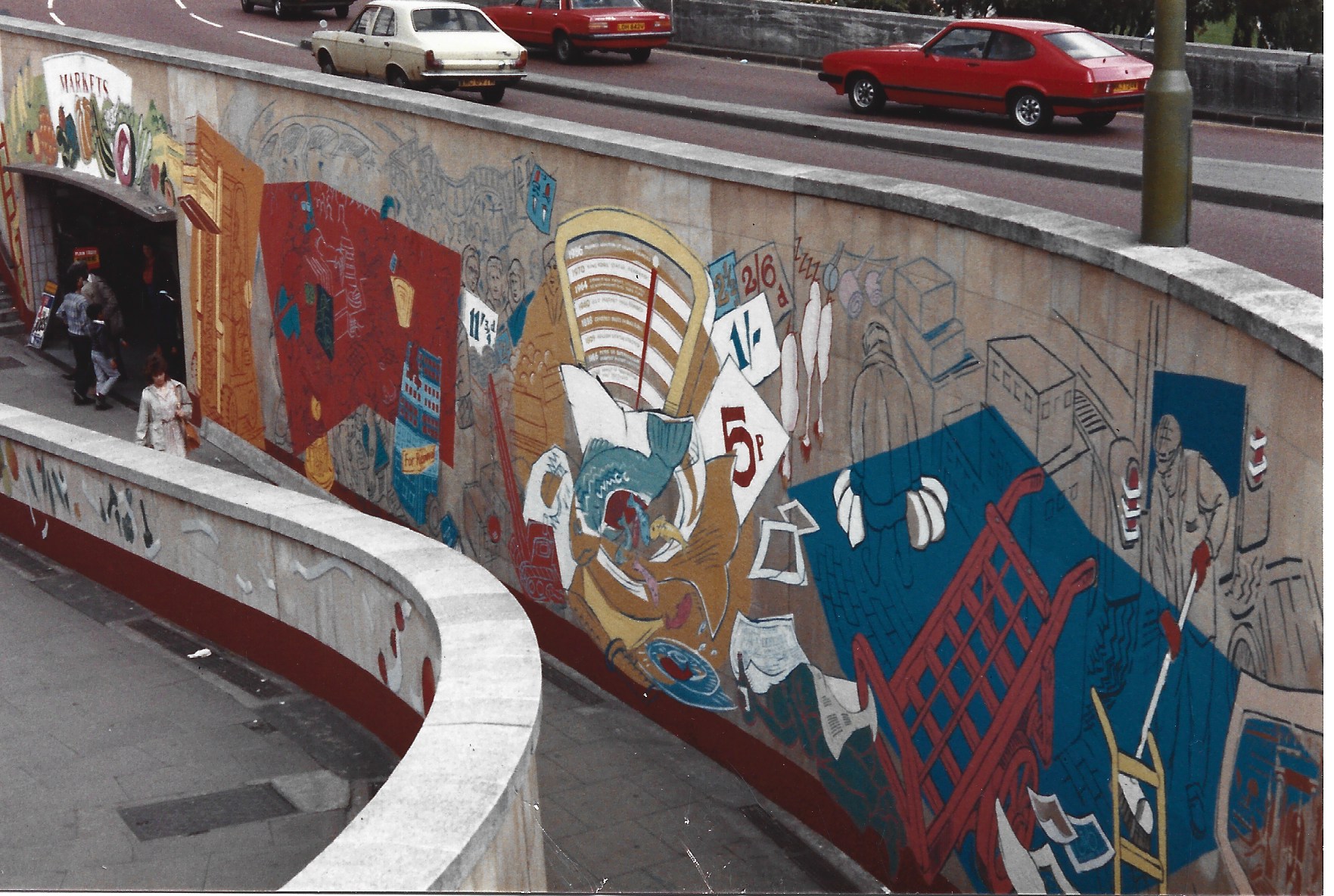
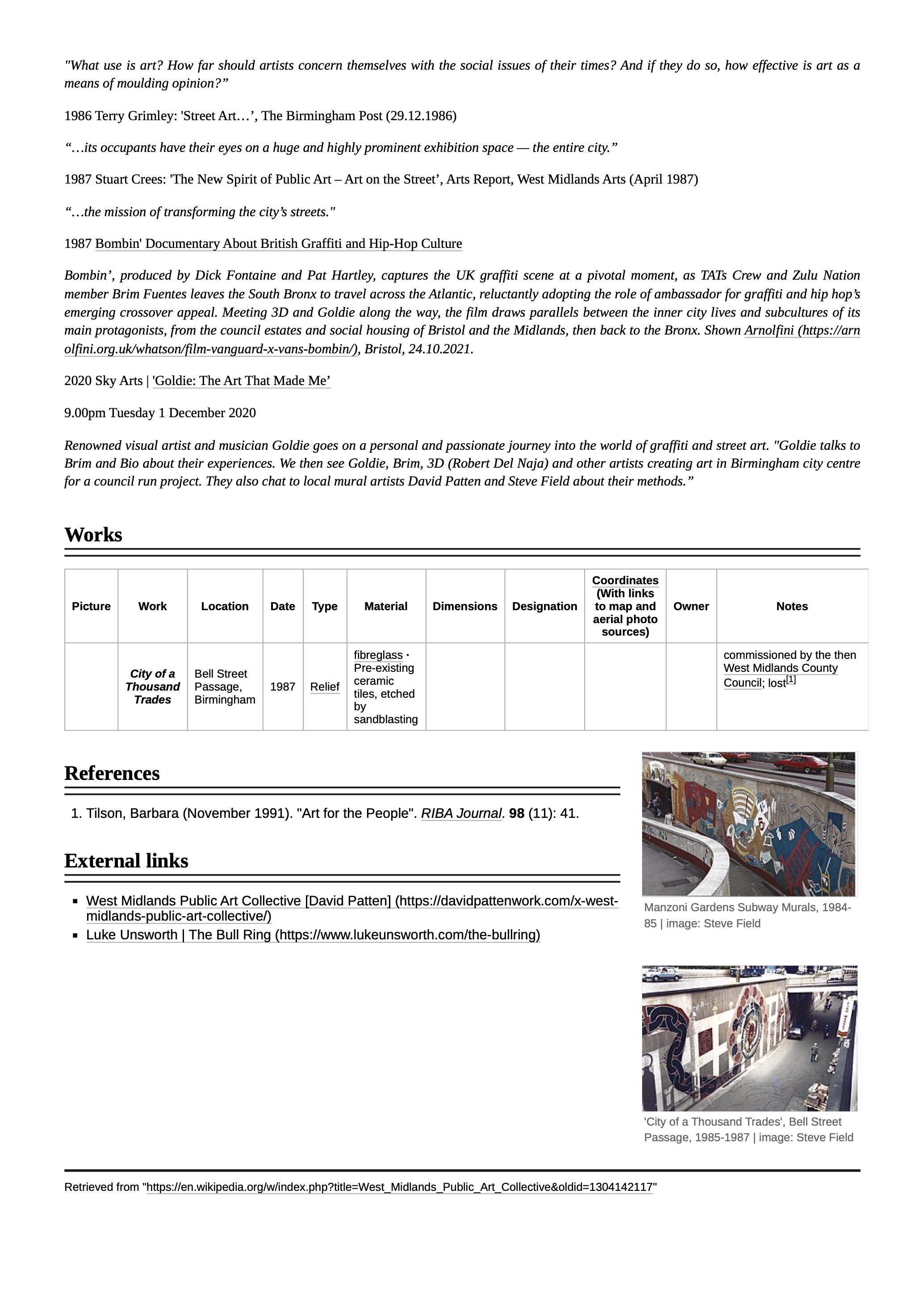
Manzoni Gardens Approach, Birmingham, 1984-1986 (image: ©Steve Field)
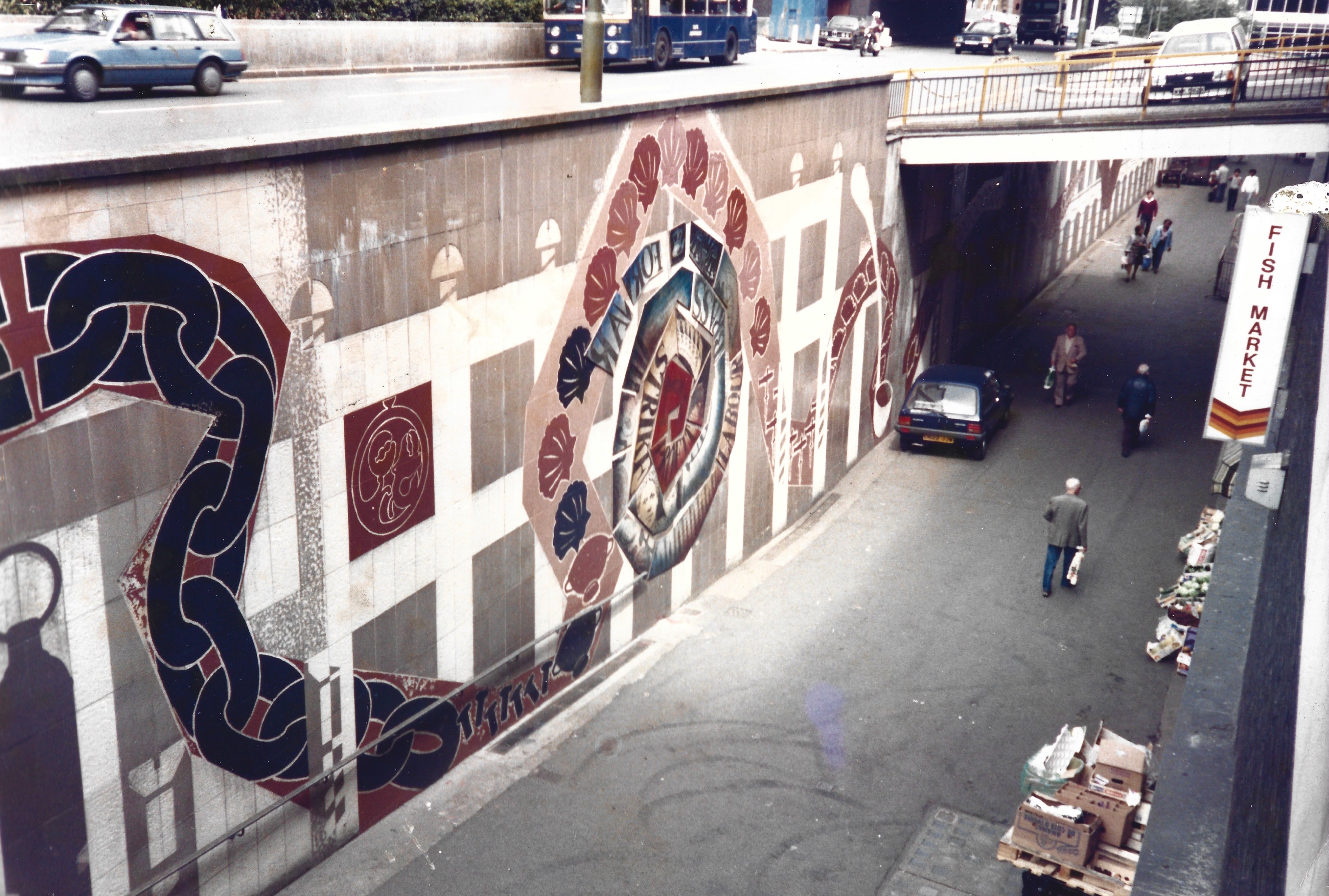
‘City of a Thousand Trades’, Bell Street Passage, Birmingham, 1986-1987 (image: ©Steve Field)
Funding
WMPAC’s funding came from a mixture of sources, including West Midlands Arts, local authorities, the Arts Council, private developers, and the education sector. This diversity enabled adaptability but also required projects to align with institutional and civic expectations.
Recognition
In 1987, the Collective was a joint winner of the City of Birmingham Fine Art Award, recognising its contribution to the integration of art, community, and urban renewal in the city.
Legacy
Although short-lived, the West Midlands Public Art Collective played an influential role in shaping participatory and place-based approaches to public art in the UK. It demonstrated how artists could balance aesthetic authorship with social engagement, and how public art could serve both community expression and regeneration agendas.
The group’s work was documented in the 1986 BBC2 programme Art and Upheaval: Art and Society, and was situated in broader contemporary debates about the role of art in shaping society, graffiti and urban culture, as seen in the documentary Bombin’ [https://www.imdb.com/title/tt1105264/?utm_source=chatgpt.com] and later in Goldie’s The Art That Made Me [https://www.imdb.com/title/tt13665080/?utm_source=chatgpt.com]. These references reveal the ways in which WMPAC’s practice intersected with.
Manzoni Gardens Clash of the Titans event
Description: In Aug 85, Brim, Bio from New York, The Chrome Angelz from London, 3D and Goldie from the UK battled one another in Birmingham’s Manzoni Gardens, in an event called ‘Clash of the Titans’ creating a 100′ long mural in the process. It was filmed for a documentary called Bombin’ by Dick Fontaine which was shown on Channel 4 in Jan 1988.
Brim is interviewed by his mural by David Patten of the Birmingham mural collective.
http://archives.dudley.gov.uk/CalmView/Record.aspx?src=CalmView.Catalog&id=DZD%2f1%2f25%2f16&pos=7
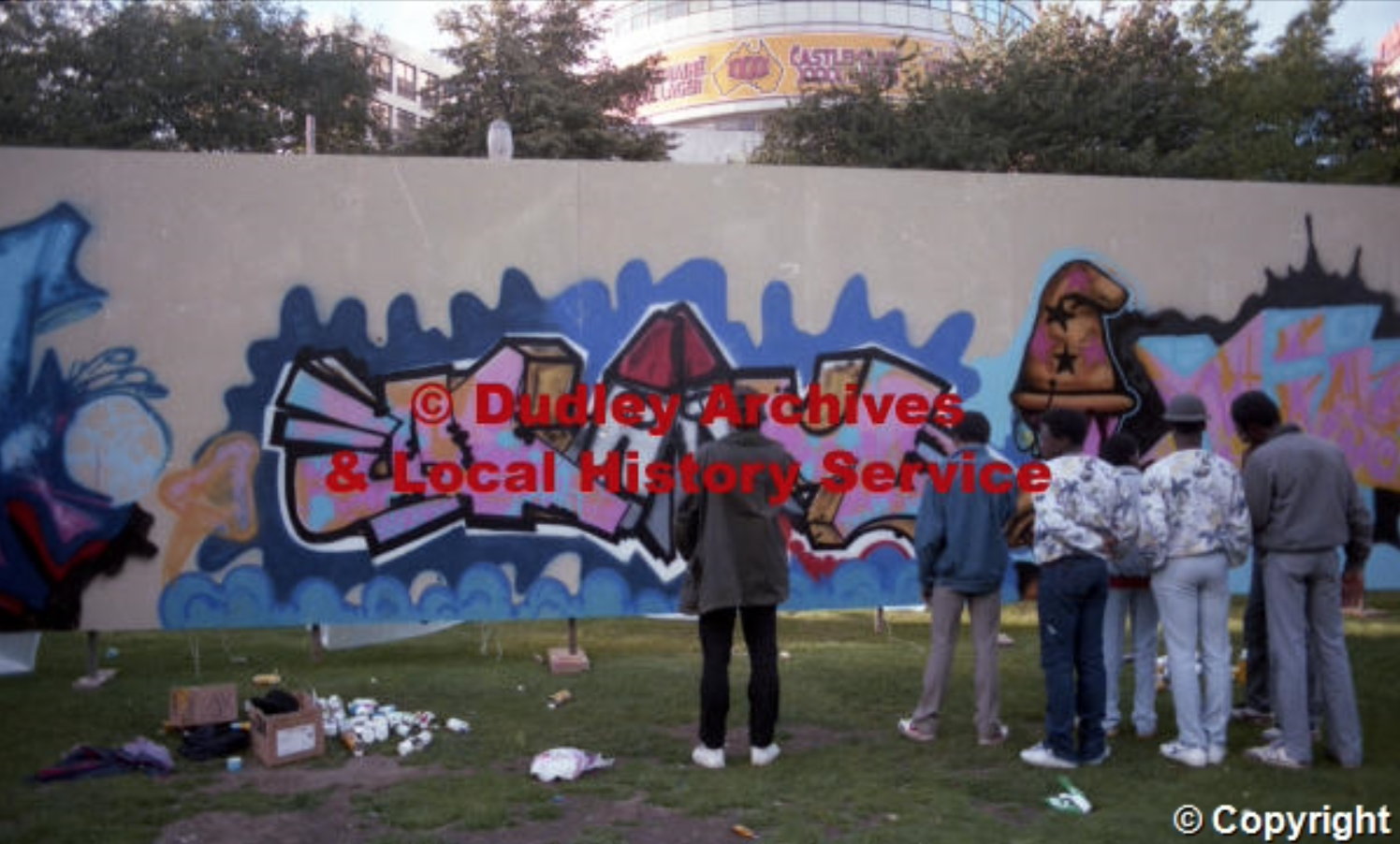
Brim’s mural. Dave Patten of Brmingham Mural Collective looks on.
http://archives.dudley.gov.uk/CalmView/Record.aspx?src=CalmView.Catalog&id=DZD%2f1%2f25%2f23&pos=8
See also
- [[Public art in the United Kingdom]]
- [[Art of Birmingham]]
- [[Cultural democracy]]
- [[Community arts]]
- [[Urban regeneration in the United Kingdom]]
External links
Mark Renn obituary – The Guardian (2019)
BBC Genome Project – Art and Upheaval: Art and Society (1986)
[Stuart Crees, The New Spirit of Public Art – Art on the Street (Arts Report, West Midlands Arts, 1987)]
Barbara Tilson, “Art for the People” (1991), RIBA Journal
Bombin’ (1987) documentary on IMDb
Goldie: The Art That Made Me (2020) on IMDb
[LINK 04.08.2025] https://en.wikipedia.org/wiki/West_Midlands_Public_Art_Collective
References:
1. Barbara Tilson’s November 1991 article “Art for the People” in RIBA Journal (Vol. 98, No. 11, p. 41)
Tilson discusses public art initiatives and initiatives in architecture that aimed to engage communities directly—“art for the people.”
In particular, regarding the West Midlands Public Art Collective the article highlights how a group of local artists were challenging traditional ideas of public art. They were working collaboratively to create site‐specific artworks that reflected local identity and civic engagement. The collective—consisting of artists such as Steve Field, Paula Woof, Mark Renn, David Patten, and Derek Jones—produced murals, reliefs, and sculptural installations that responded to the urban environment and the needs of the community.
Tilson emphasizes that by embedding art within public spaces (often in collaboration with local authorities or civic bodies), the collective was not only beautifying the urban landscape but also generating dialogue between art, architecture, and the public. This “art for the people” approach was seen as democratic, participatory, and innovative: it sought to break down barriers between high art and everyday urban life by engaging directly with local communities, addressing local histories and issues, and by rethinking how public art could be both functional and expressive.
In summary, Barbara Tilson’s article noted that:
• The West Midlands Public Art Collective was an innovative group that integrated artistic practice with community engagement.
• Their work challenged traditional hierarchical models of public art by collaborating closely with local communities and civic bodies.
• Their projects (including murals and installations) were both beautification efforts and means to foster civic dialogue, thus embodying the “art for the people” ethos.
This reading of the article places the collective’s work in a broader context of post-industrial urban regeneration and shifting cultural policy in the UK during that period.
In short, Tilson’s article presents the West Midlands Public Art Collective as a pivotal example of how regional artists in the Midlands responded to evolving public art policy by producing inclusive, community‑oriented, and regeneration‑aligned artworks in the late 1980s.
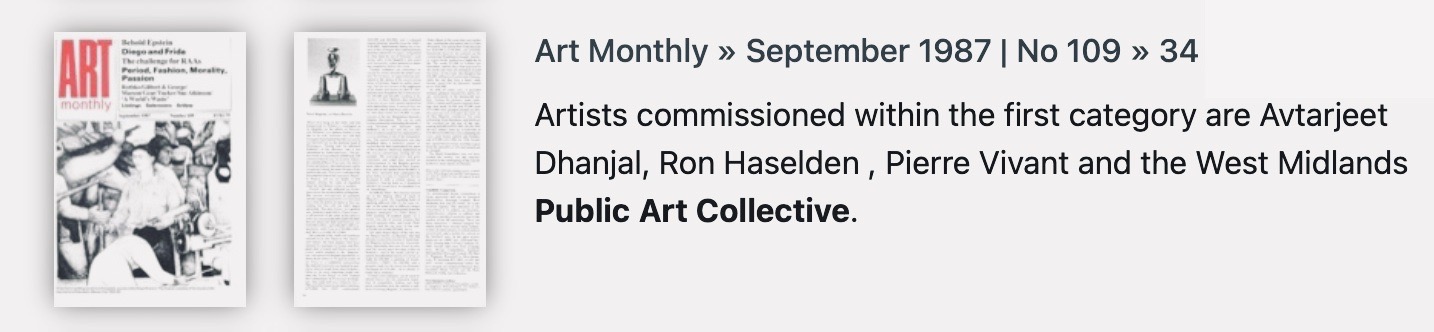
2. Art Monthly
Images (DP & ©Luke Unsworth)
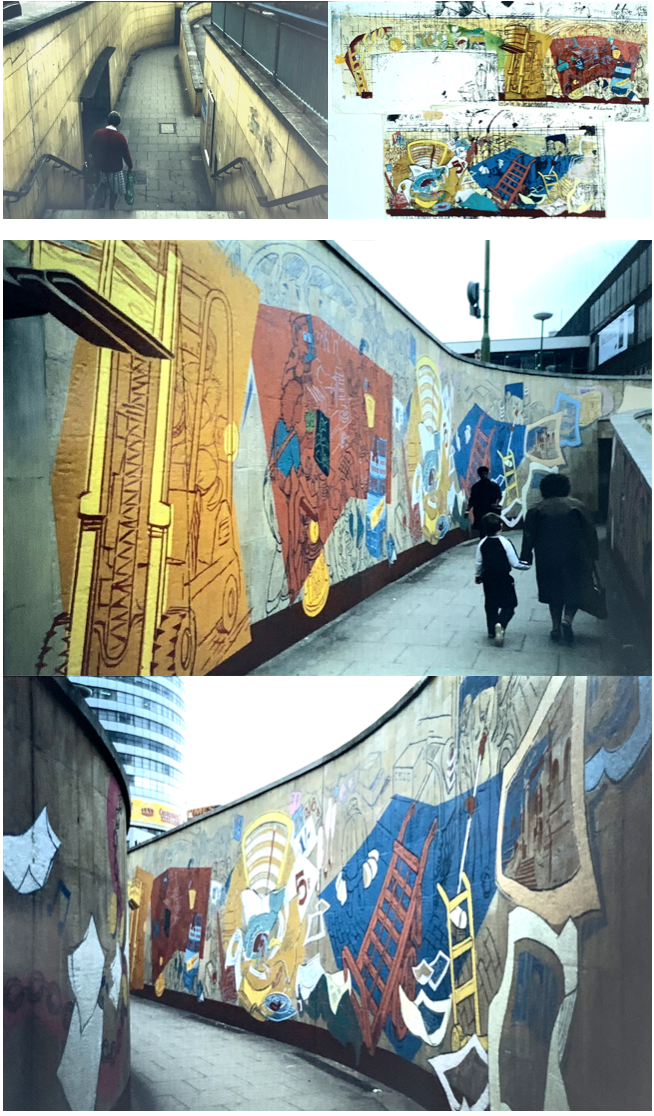
1984-1985 Manzoni Gardens Station Approach Subway [WMCC]
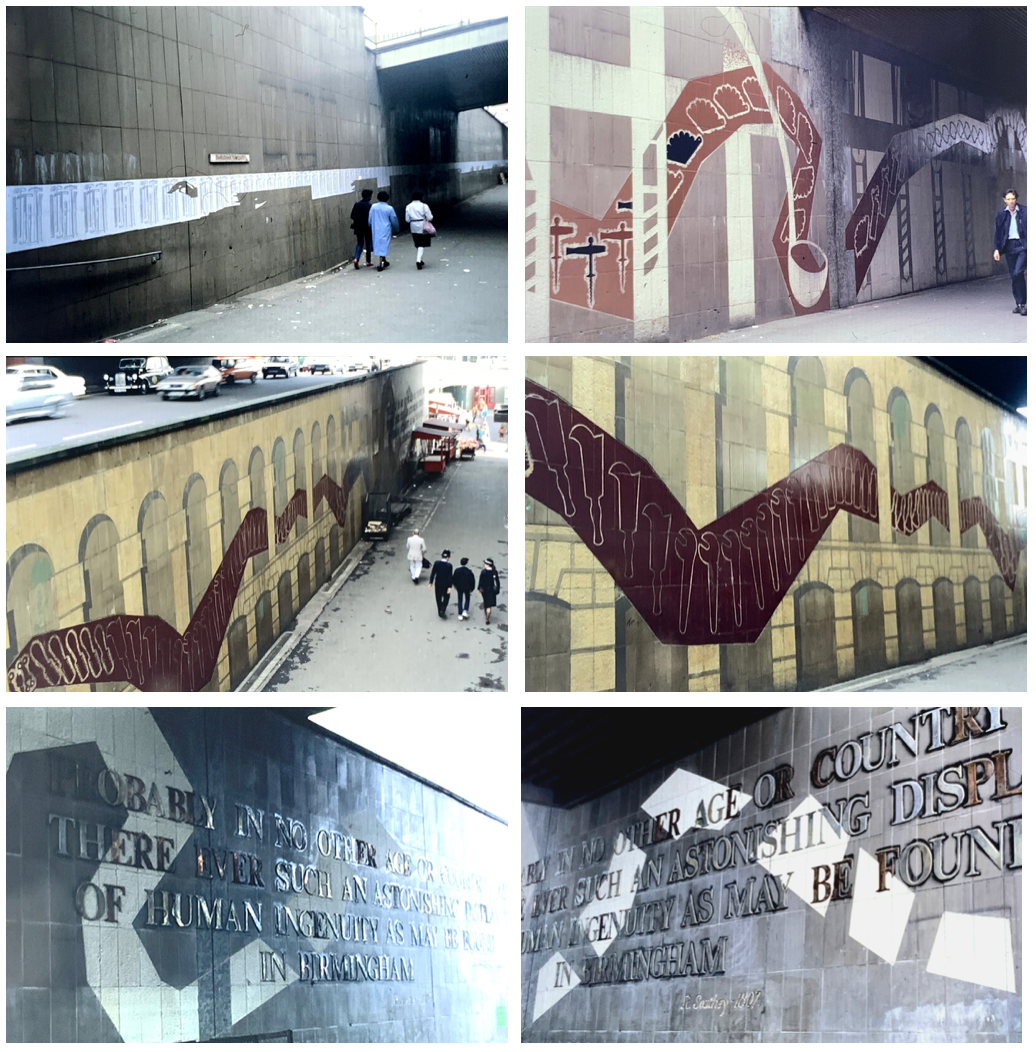
1985-1987 Bell Street Passage, Bull Ring [WMCC]
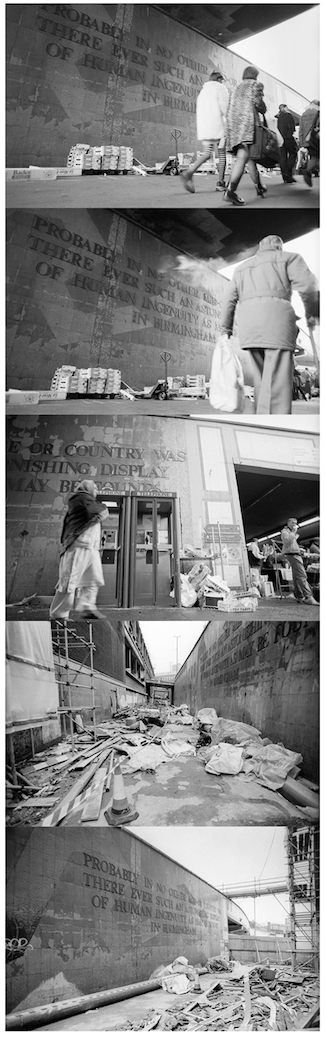
B&W images ©Luke Unsworth
[17.07.2025 | 376 words]
The West Midlands Public Art Collective (WMPAC), active during the 1980s and early 1990s, exemplifies the shifting landscape of UK public art policy, particularly amid the rise of cultural democracy, regionalism, and urban regeneration. Formed by artists Steve Field, Paula Woof, Mark Renn, David Patten, and Derek Jones, WMPAC emerged in response to growing interest in public art that reflected local identities, community voices, and post-industrial urban renewal—especially in towns such as Dudley, Wolverhampton, and Birmingham.
WMPAC’s formation coincided with broader shifts in UK cultural policy. In the 1970s and early 1980s, the Arts Council of England and regional arts boards began promoting community-based and socially inclusive practices. This movement, known as cultural democracy, sought to decentralize art from elite institutions and bring it into everyday life. WMPAC embodied these values through their creation of canal-side sculpture trails, community murals, mosaics, and other site-specific public works. Their projects often reflected local narratives, working-class culture, and industrial heritage.
The 1980s and 1990s also saw public art increasingly tied to urban regeneration under neoliberal policies. As Thatcher-era cuts to public spending pushed local authorities toward public-private partnerships, art became instrumental in place-making and softening the impacts of redevelopment. WMPAC adapted by working with planners, architects, housing associations, and educational institutions, embedding their art within architectural features and urban landscapes. Their work balanced civic beautification with community pedagogy, often involving schools and local residents.
WMPAC’s funding came from diverse sources—West Midlands Arts, local authorities, the Arts Council, private developers, and the education sector—reflecting evolving models of arts support. While this funding ecology enabled responsiveness and adaptability, it also introduced potential constraints, as projects had to align with institutional or civic expectations.
Artistically, WMPAC was defined by collaborative, artist-led processes. Members maintained aesthetic authorship while facilitating local participation. Their works, typically made from durable materials like steel, glass, and mosaic, were designed to be long-lasting and integrated into the public realm. The collective navigated tensions between artistic autonomy and social function, embodying the dual imperatives of formal innovation and public utility.
Ultimately, WMPAC’s legacy lies in its synthesis of community engagement and artistic authorship. It reflects the complex evolution of UK public art policy and remains influential in shaping participatory, place-based art in the Midlands and beyond.
A. West Midlands Public Art Collective / Entry / 16.02.2025
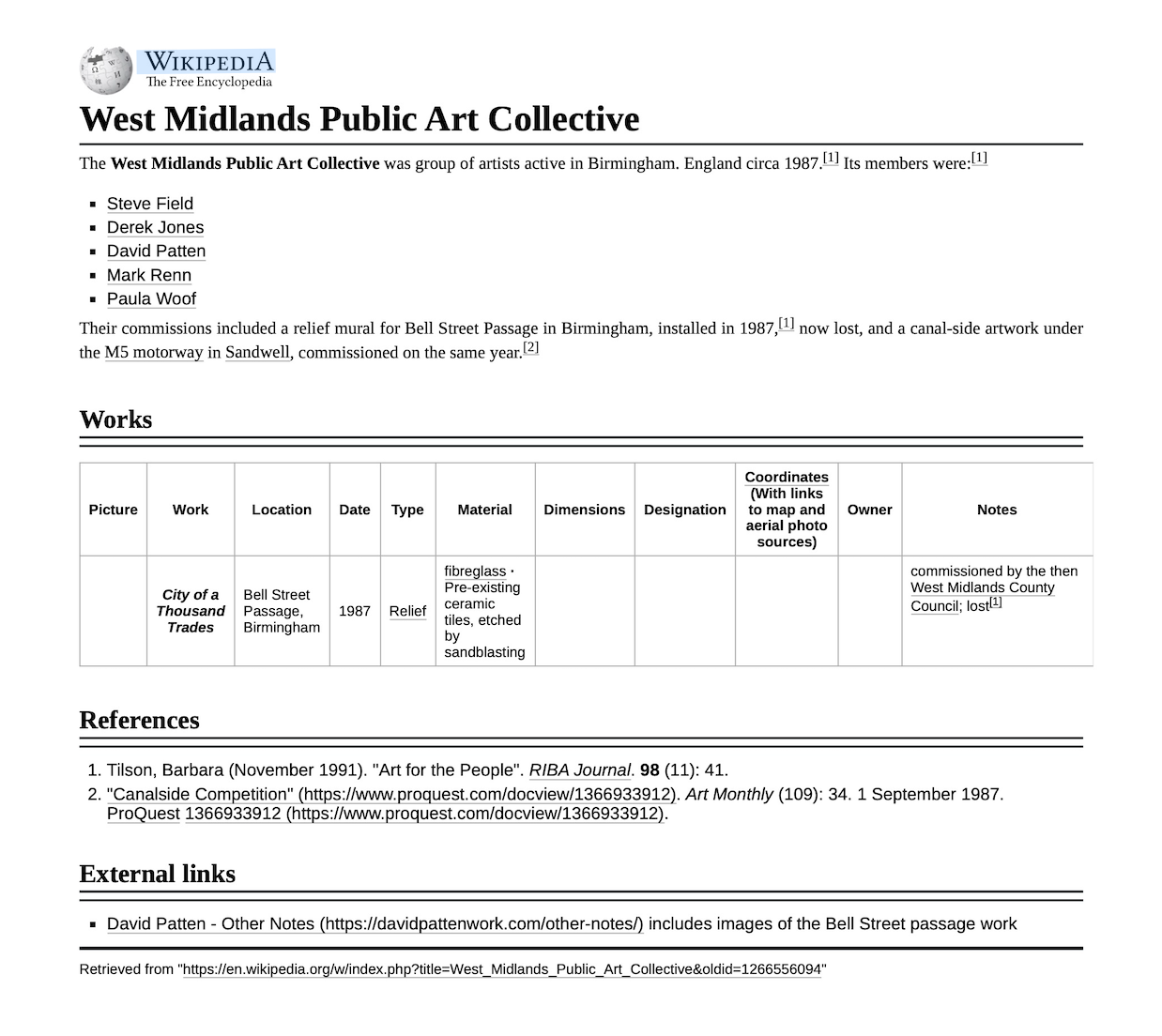
B. Main text (existing):
The West Midlands Public Art Collective was group of artists active in Birmingham. England circa 1987.[1] Its members were:[1]• Steve Field [LINK] • Derek Jones [NO LINK] • David Patten [NO LINK] • Mark Renn [LINK] • Paula Woof [LINK] / Their commissions included a relief mural for Bell Street Passage in Birmingham, installed in 1987,[1] now lost, and a canal-side artwork under the M5 motorway in Sandwell, commissioned on the same year.[2]
C. Editing West Midlands Public Art Collective / Edit source / 16.02.2025
{{Use dmy dates|date=April 2022}}
The ”’West Midlands Public Art Collective”’ was group of artists active in Birmingham. England circa 1987.<ref name=”Tilson”>{{cite journal |last1=Tilson |first1=Barbara |title=Art for the People |journal=[[RIBA Journal]] |date=November 1991 |volume=98 |issue=11 |page=41}}</ref> Its members were:<ref name=”Tilson” />
* [[Steve Field (sculptor)|Steve Field]] -> [https://en.wikipedia.org/wiki/Steve_Field_(sculptor)]
* [[Derek Jones (artist)|Derek Jones]] [NO LINK]
* [[David Patten (artist)|David Patten]] [NO LINK]
* [[Mark Renn]] -> [https://en.wikipedia.org/wiki/Mark_Renn]
* [[Paula Woof]] -> [https://en.wikipedia.org/wiki/Paula_Woof]
Their commissions included a relief mural for Bell Street Passage in Birmingham, installed in 1987,<ref name=”Tilson” /> now lost, and a canal-side artwork under the [[M5 motorway]] in [[Sandwell]], commissioned on the same year.<ref name=”AM-CC”>{{cite journal |last1=<!–Anon–> |title=Canalside Competition |journal=Art Monthly |date=1 September 1987 |issue=109 |page=34 |url=https://www.proquest.com/docview/1366933912 |id={{ProQuest|1366933912}} |url-access=subscription }}</ref>
== Works ==
{{Public art header for bio}}
{{Public art row for bio
| image =
| commonscat =
| subject = ”City of a Thousand Trades”
| location = Bell Street Passage, Birmingham
| date = {{Start date|1987}}
| type = [[Relief]]
| material = {{Flatlist|
* [[fibreglass]]
* Pre-existing ceramic tiles, etched by sandblasting
}}
| dimensions =
| designation =
| coordinates =
| owner =
| notes = commissioned by the then [[West Midlands County Council]]; lost<ref name=”Tilson” />
}}
|}
== References ==
{{Reflist}}
== External links ==
* [https://davidpattenwork.com/other-notes/ David Patten – Other Notes] includes images of the Bell Street passage work [CORRECT LINK: https://davidpattenwork.com/wp-content/uploads/2019/09/bell-street-passage-c2a9luke-unsworth.pdf / ref. https://www.lukeunsworth.com/the-bullring%5D
[[Category:Collectives]]
[[Category:20th-century British sculptors]]
D. Overview [NEW TEXT]
The West Midlands Public Art Collective, 1983 to 1987
[ref.] Artist led collectives and the emergence of the public art infrastructure -> Long View (IXIA) https://davidpattenwork.com/wp-content/uploads/2020/06/2011-ixia-longview-list.pdf + Long View (Jubilee) https://jubileeartsarchive.com/wp-content/uploads/2023/03/2011-ixia-longview.pdf%5D
The West Midlands Public Art Collective was formed in response to a commission opportunity (managed through West Midlands Arts) for a site in Birmingham city centre owned by West Midlands County Council. The Collective’s subsequent activities included:
• core group commissions;
• sub-contracted commissions to other artists;
• design strategies and master plans for the County Council;
• a Public Art Centre that accommodated artists’ studios, an exhibition space, and which hosted the Artists & Architects Group; and
• a range of exhibition and event-based initiatives, including ‘Artists-in-Public’. [1]
The Collective ceased operations in 1987 when ‘abolition funding’ following the closure of the Metropolitan County Councils was used by West Midlands Arts to establish the post of Public Art Development Agent.
Sources:
[1] David Patten/West Midlands Arts: Public Art in the West Midlands – A History, 1995
E. Additional [NEW TEXT]
Core group skills and experience included: studio practice, mural painting, community mural painting and community arts (Jubilee Arts), participatory arts practice (Art Link, Interlink and Ikon Gallery ‘Artist in Schools’), and research (MPhil fellowship at Wolverhampton Polytechnic, and the ‘Survey of Public Art in Coventry’ for the Herbert Museum & Art Gallery).
F. Main Works [NEW TEXT / IMAGES NEEDED]
1984-1985 Manzoni Gardens Station Approach Subway [WMCC]
1985-1987 Bell Street Passage, Bull Ring [WMCC]
1987 Soho Road (Birmingham) Design Study [WMCC]
1987 China Town (Birmingham) Design Study [WMCC]
1987 High Bullen Design Study [Sandwell MBC]
G. Exhibitions, etc. [NEW TEXT / IMAGES NEEDED]
[DATE?] Mural (Graham Cooper Touring Show), Ikon Gallery, Birmingham
1989 Birmingham Fine Art Award (joint winners), Ikon Gallery, Birmingham
H. Images (DP & ©Luke Unsworth)
1984-1985 Manzoni Gardens Station Approach Subway [WMCC]
1985-1987 Bell Street Passage, Bull Ring [WMCC]
B&W images ©Luke Unsworth
 David Patten