[2015-2026]
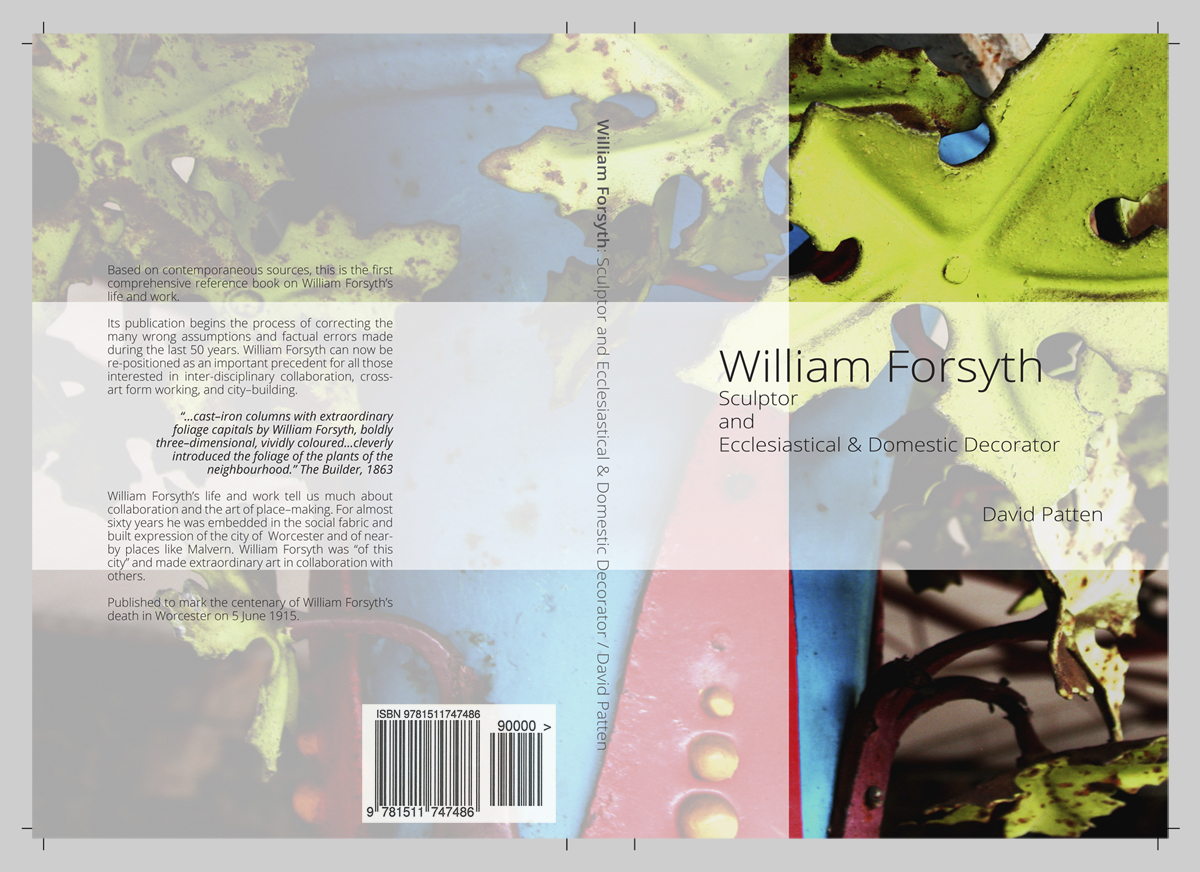
The publication will only be of any interest to those of us looking at the contribution of art to the development of Worcester and Worcestershire during the second half of the 19th century. It might also be of interest to those wanting to understand how art worked with the Victorian ecological imagination, and how this might save us now from our increasingly impoverished attitudes towards collaboration, city-building and place-making.
This publication provides an essential baseline for future research. In the words of the poet Yeats, it is about “Those images that yet Fresh images beget…”, except, of course, there are no images in this publication. For such niceties, you should keep your money in your pocket and go to the free on-line resource for entertainment: https://williamforsythworcester.com
— — —
[draft outline, 06.03.2026]
William Forsyth’s Monumental Studio at 5–6 Tything, Worcester, may be understood as an early framing of Georgi Valentinovich Plekhanov’s conception of the artist’s social function when contrasted with the “hopeless disaccord” of “art for art’s sake.” In this sense, the Monumental Studio exemplifies how artistic production already functioned collectively long before modern theory began to describe it in such terms. Creative agency lies not solely in the individual artist but in organised collaboration with other artists, designers, craftsmen, apprentices, architects, and clients.
This interpretation rests on three observations.
A. Early training and institutional context
William Forsyth’s early association with architect C. Bruce Allen’s School for Art-Workmen at the Architectural Museum on Cannon Row, Westminster, in the early 1850s is significant. The school aimed, in Allen’s words, “to do, indeed, for the men just what the Royal Academy does for students and painters,” focusing on the “education of architectural art-workers.” During this period, William Forsyth was awarded second prize for wood-carving by Charles Robert Cockerell, Professor of Architecture at the Royal Academy of Arts. This positions William Forsyth within a tradition that emphasised skilled collaborative craft within architectural production rather than the later model of the autonomous fine artist.
B. The multidisciplinary practice of the Monumental Studio
Across a long career, William Forsyth worked variously as architect, sculptor, decorator, furniture maker, stained-glass artist, designer, and builder. This range is reflected in the output of the Monumental Studio, which produced reredoses, pulpits, fonts, choir stalls, benches, lecterns, marble floors, as well as general wood and stone carving. The studio also undertook wall painting and gilding “in all styles,” chimney pieces in marble, stone and wood, together with garden sculpture, fountains, vases, tazzas, pedestals, balustrades, and other architectural ornament.
This range of activity closely resembles that of high-end London decorating firms of the period, such as Crace & Co (including the later firms of Frederick Crace & Son and J. G. Crace & Son). The similarity suggests a possible context for William Forsyth’s apprenticeship and points to a model of artistic practice rooted in workshop organisation and collective production.
C. Signature, authorship, and the problem of artistic ownership
The Copyright Act 1911 reinforced the idea of the artist as the proprietor of intellectual property within a modern market system, emphasising the primacy of the singular, named artist over collective or socially produced art. William Forsyth never signed his work. This contrasts with his older brother James Forsyth, who aspired to and exhibited at the Royal Academy. The distinction suggests two different artistic models: the “art-workman” and the “Academy artist.”
Working Notes [06.03.2026]
In Art and Social Life (1912), Georgi Valentinovich Plekhanov argues that art cannot be understood as an autonomous sphere separate from social relations. Rather, art emerges from networks of institutions, labour, materials, and audiences. The artist therefore appears less as a solitary author and more as a participant within a distributed cultural system. Artistic forms arise from the organisation of labour, the structure of society, and the cultural traditions of a particular historical moment.
William Forsyth’s work was consistently embedded in place. His practice responded to local environments, referencing regional flora and fauna while collaborating with newly emerging local industries. The Monumental Studio functioned not only as a commercial enterprise but as a sub-regional cultural institution, supporting apprentices, artisans, architects, and patrons across Worcester and the surrounding area.
In this sense, the Monumental Studio can be understood as a form of collective artistic agency, structured around collaborative production involving:
# distributed authorship — including the training of apprentices and the support of younger artists
# integration with the built environment — responding to architectural context and a developing sense of place, and
# civic engagement through work for churches, public institutions, charities, and local organisations.
Seen in this light, William Forsyth’s practice anticipates Plekhanov’s later theoretical insight: that art is fundamentally a social process rather than the expression of an isolated individual.
Links:
William Forsyth & Monumental Studio:
http://www.theforsythbrothers.com/
Georgi Valentinovich Plekhanov — Art and Social Life (1912):
— — —
Introduction
Link: William Forsyth — Sculptor and Artist
This archival site dedicated to William Forsyth, a Victorian-era sculptor and craftsman who lived from 1833 to 1915, is compiled from original documents, artworks, photographs, and historical archive material, and presents a rich picture of Forsyth’s personal life, artistic career, studio practice, and influence on Worcester’s architectural heritage.
Forsyth was a multi-faceted artist whose work spanned sculpture, architectural ornamentation, ecclesiastical carving, funerary monuments, and decorative arts. Although not widely famous outside his local area, he played a key role in shaping the visual character of late Victorian Worcester — contributing sculptures and carvings that still exist today in the city’s buildings, churches, cathedrals and public spaces.
— — —
Postscript 15.03.2025
Seeing ‘The Hop Pickers’ on Sansome Street for the first time in late 2011 was one of those half dozen or so life-changing (or life-defining or life-affirming) experiences we all get at various times. In this instance, it was a ‘perfect moment’ combining aesthetic shock and a recognition of something timeless. I didn’t know then that the work was by William Forsyth, who had some connection with C. Bruce Allen’s School for Artist Workmen (a forerunner of the Royal College of Art) and who had more than likely drawn George Gilbert Scott’s plaster casts of European Gothic architectural ornament in the associated Architectural Museum (a forerunner of the Victoria & Albert Museum) at 9 Bridge Street, Cannon Row, in Westminster. 125 years later, as a student at the RCA in the mid-1970s, I had drawn the same plaster casts in the Cast Courts at the V&A. I may not share a bloodline DNA with William Forsyth, but we do share something timeless which is to do with art and drawing.
To know something of an artist as an individual helps with questions about ‘what’ and ‘when’, and to know something of their personality and lived experience can help build an understanding of ‘why’. But this approach assumes that ‘Artists make Art’.
The line of thought I follow [from late 18th century Romanticism to Ardengo Soffici’s ‘Picasso e Braque’ (1911) through Vladimir Markov’s ‘The Principles of Creativity in the Plastic [Visual] Arts: Faktura’ (1914), and on to later thinking by artists like Barnett Newman and Ad Reinhardt [1], etc.] is that ‘Art makes Artists’. This is to see Art as rhizome or, even better, as Indra’s net where Art is ‘infinite and spreads in all directions with no beginning or end’, and where each Artist is one jewel reflecting the light of another artists. Instead of questions of ‘what’ and ‘when’ and ‘why’, we become more focused on issues of relationship and connection.
William Forsyth’s most important relationships seem to have come early in his life. He was always a ‘man of Pugin’, and still championed A.W.N. Pugin’s Gothic Revival in his old age [see his letter to the Worcestershire Chronicle, 21.03.1903]. And he had a long term working relationship with the ‘decorative art painter’ George E. Fox, which connects him to ‘Crace & Co’ (Pugin’s high-end London-based decorators) and the 2nd Earl Somers at Eastor Castle.
In the 1860s, William Forsyth’s closest connections were to the architects Edmund Wallace Elmslie in Great Malvern (originally Elmslie, Franey & Haddon, 43 Parliament Street, Westminster, and not far from the Architectural Museum at Cannon Row) and John Gibbs (of Oxford).
By the 1870s, though, William Forsyth was in the business of art and operating out of his ‘Monumental Studio’, at 5 and 6 Tythings, in Worcester, as an architect, sculptor, decorator, furniture maker, stained glass artist, designer and builder. By 1871 he was employing “12 Men & 3 Boys.”
A bigger view connects William Forsyth, via Pugin and William Morris’ socialism, to the architect and urban designer (Richard) Norman Shaw RA student (a former student of Morris and one time partner of William Eden Nesfield, the son of W. A. Nesfield who designed the Perseus and Andromeda fountain at Witley Court carved by James Forsyth, William’s elder brother), to Shaw’s Chief Clerk W.R. Lethaby, the highly influential architect, architectural historian, teacher, and educationalist (Central School of Arts and Crafts and, later, the Royal College of Art) and also advocate for A. K. Coomaraswamy’s ‘well-doing/well-making’ [2], all of which informed the programme of the Bauhaus when it opened in 1918 in Weimar, Germany, which then, in turn, influenced the training of the architects who led on the post-War rebuilding of British cities (like Coventry but not Worcester) and, of course, the artists of my generation.
Notes:
1. There is just one truth in art, one form, one change, one secrecy. / There is just one direction, one directionlessness, one size, one sizelessness, one form, one formlessness, one formula, one formulalessness, one formulation. / Secret principle, one form, continuous connection in time, where to cut, cleavage? Artist, one who works upon forms and whom forms work upon…
– Ad Reinhardt: ’THERE IS JUST ONE PAINTING (Art-as-Art Dogma, Part XII)’, Artforum, March 1966.
2. It has sometimes been asked whether the “artist” can survive under modern conditions. In the sense in which the word is used by those who ask the question, one does not see how he can or why he should survive. For, just as the modern artist is neither a useful or significant, but only an ornamental member of society, so the modern workman is nothing but a useful member and is neither significant nor ornamental. It is certain we shall have to go on working, but not so certain that we could not live, and handsomely, without the exhibitionists of our studios, galleries, and playing fields. We cannot do without art, because art is the knowledge of how things ought to be made, art is the principle of manufacture (recta ratio factibilium), and while an artless play may be innocent, an artless manufacture is merely brutish labor and a sin against the wholesomeness of human nature; we can do without “fine” artists, whose art does not “apply” to anything, and whose organized manufacture of art in studios is the inverse of the laborer’s artless manufacture in factories; and we ought to be able to do without the base mechanics “whose souls are bowed and mutilated by their vulgar occupations even as their bodies are marred by their mechanical arts.”
– A. K. Coomaraswamy | A Figure of Speech, or a Figure of Thought?, 1946 (1972)
LINKS:
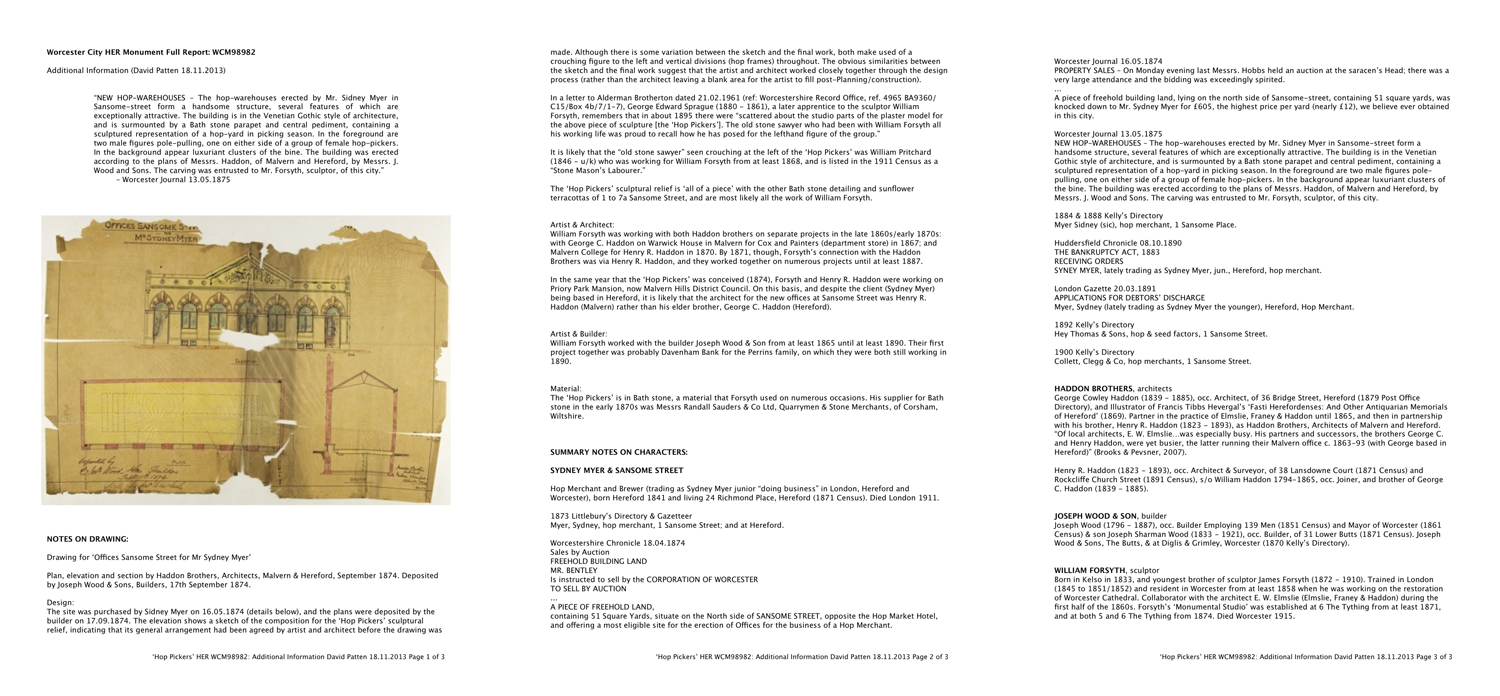
PDF: WF_Full_Accounts_534
PDF: William_Forsyth_Proof 2016
PDF: William Forsyth 1914
PDF: William Forsyth & Eric Gill
PDF: JF_P&A Studio 4×4
PDF: 2015 C. Bruce Allen & Architectural Museum
PDF: 1856.01.12 The Builder p21
 David Patten